

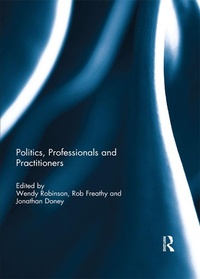
Politics, Professionals and Practitioners
Published on 26. July 2018
168 pages
978-1-351-86277-6 (ISBN)
Description

This book presents eight distinctive historical chapters that explore the complex relationship between politics, professionals and practitioners in a range of different educational contexts. It offers a timely contribution to current debates about the contested place and status of educational professionalism in modern society. It is grounded in a firm commitment to the value that a historical perspective might bring to current and recurrent educational concerns, of which educational professionalism remains key.
With fresh examples from nineteenth, twentieth and twenty-first century education, as well as a diversity of methodological approaches and sources, the book addresses a range of fundamental questions about educational professionalism. These include the wider politics of professionalism; issues of professional knowledge and expertise; what and who counts as professional within various power discourses; professional training, socialisation and accreditation; and professional identities, power, agency, autonomy regulation, accountability, and control. Overall, there is a sense from these chapters that there is something fractured and disconnected in current discourses around educational professionalism, but that there have been particular moments in the past when there was the promise of something different and possibly something more authentic. Moving beyond a narrow focus on schoolteachers as professional practitioners, to embrace a wider conceptualisation of educational professionalism within higher education, the churches, educational leadership, and quasi-professional and voluntary organisations, the book represents a rich and novel contribution to the field.
The chapters in this book were originally published in various issues of History of Education and the British Journal of Religious Education.
With fresh examples from nineteenth, twentieth and twenty-first century education, as well as a diversity of methodological approaches and sources, the book addresses a range of fundamental questions about educational professionalism. These include the wider politics of professionalism; issues of professional knowledge and expertise; what and who counts as professional within various power discourses; professional training, socialisation and accreditation; and professional identities, power, agency, autonomy regulation, accountability, and control. Overall, there is a sense from these chapters that there is something fractured and disconnected in current discourses around educational professionalism, but that there have been particular moments in the past when there was the promise of something different and possibly something more authentic. Moving beyond a narrow focus on schoolteachers as professional practitioners, to embrace a wider conceptualisation of educational professionalism within higher education, the churches, educational leadership, and quasi-professional and voluntary organisations, the book represents a rich and novel contribution to the field.
The chapters in this book were originally published in various issues of History of Education and the British Journal of Religious Education.
More details
Language
English
Place of publication
London
United Kingdom
Publishing group
Taylor & Francis Ltd
Target group
College/higher education
Professional and scholarly
File size
4,84 MB
ISBN-13
978-1-351-86277-6 (9781351862776)
Copyright in bibliographic data and cover images is held by Nielsen Book Services Limited or by the publishers or by their respective licensors: all rights reserved.
Schweitzer Classification
Other editions
Additional editions
Wendy Robinson | Rob Freathy | Jonathan Doney
Politics, Professionals and Practitioners
Book
09/2018
1st Edition
Routledge
€55.70
Shipment within 15-20 days
Wendy Robinson | Rob Freathy | Jonathan Doney
Politics, Professionals and Practitioners
Book
02/2017
1st Edition
Routledge
€215.41
Shipment within 15-20 days
Persons
Wendy Robinson is Professor of Education at the University of Exeter, UK. She has published extensively in the history of education, with a particular focus on the history of teaching. Her books include: Pupil Teachers and their Professional Training in Pupil Teacher Centres in England and Wales, 1870-1914 (2003); Power to Teach: Learning through Practice (2004); and A Learning Profession? Teachers and their Professional Development in England and Wales 1920-2000 (2014).
Rob Freathy is Associate Professor of History of Education at the University of Exeter, UK. His research interests include religious education, education for citizenship, the historiography of twentieth century education, and the application of historical methods in educational research. His recent publications include Religious Education and Freedom of Religion and Belief (2012) and History, Remembrance and Religious Education (2015).
Jonathan Doney is a Research Fellow at the University of Exeter, UK, an Associate Lecturer at the University of Winchester, UK, an honorary Research Associate with the International Centre for Historical Research in Education, and holds a post-doctoral fellowship from the British Academy, funded by the ESRC. His wider research interests are in methodological innovation, critical studies, and the role of education in developing identity.
Rob Freathy is Associate Professor of History of Education at the University of Exeter, UK. His research interests include religious education, education for citizenship, the historiography of twentieth century education, and the application of historical methods in educational research. His recent publications include Religious Education and Freedom of Religion and Belief (2012) and History, Remembrance and Religious Education (2015).
Jonathan Doney is a Research Fellow at the University of Exeter, UK, an Associate Lecturer at the University of Winchester, UK, an honorary Research Associate with the International Centre for Historical Research in Education, and holds a post-doctoral fellowship from the British Academy, funded by the ESRC. His wider research interests are in methodological innovation, critical studies, and the role of education in developing identity.
Content
Introduction: Politics, professionals and practitioners 1. Can we still speak of there being an academic profession? 2. Intellectual portraits: politics, professions and identity in twentieth-century England 3. Context, curriculum and professional knowledge 4. Knowledge, character and professionalization in nineteenth-century British science 5. Reconstructing the life histories of Spanish primary school teachers: a novel approach for the study of the teaching profession and school culture 6. Re-shaping teacher identity? The Liverpool Teachers' Centre 1973-1976 7. 'That great educational experiment': the City of London Vacation Course in Education 1922-1938: a forgotten story in the history of teacher professional development 8. Conceptualising and researching the professionalisation of Religious Education teachers: historical and international perspectives
