

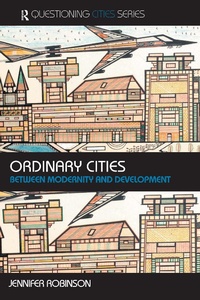
Ordinary Cities
Between Modernity and Development
Published on 4. July 2013
224 pages
978-1-134-40694-4 (ISBN)
Description

With the urbanization of the world's population proceeding apace and the equally rapid urbanization of poverty, urban theory has an urgent challenge to meet if it is to remain relevant to the majority of cities and their populations, many of which are outside the West.
This groundbreaking book establishes a new framework for urban development. It makes the argument that all cities are best understood as 'ordinary', and crosses the longstanding divide in urban scholarship and urban policy between Western and other cities (especially those labelled 'Third World'). It considers the two framing axes of urban modernity and development, and argues that if cities are to be imagined in equitable and creative ways, urban theory must overcome these axes with their Western bias and that resources must become at least as cosmopolitan as cities themselves.
Tracking paths across previously separate literatures and debates, this innovative book - a postcolonial critique of urban studies - traces the outlines of a cosmopolitan approach to cities, drawing on evidence from Rio, Johannesburg, Lusaka and Kuala Lumpur. Key urban scholars and debates, from Simmel, Benjamin and the Chicago School to Global and World Cities theories are explored, together with anthropological and developmentalist accounts of poorer cities. Offering an alternative approach, Ordinary Cities skilfully brings together theories of urban development for students and researchers of urban studies, geography and development.
This groundbreaking book establishes a new framework for urban development. It makes the argument that all cities are best understood as 'ordinary', and crosses the longstanding divide in urban scholarship and urban policy between Western and other cities (especially those labelled 'Third World'). It considers the two framing axes of urban modernity and development, and argues that if cities are to be imagined in equitable and creative ways, urban theory must overcome these axes with their Western bias and that resources must become at least as cosmopolitan as cities themselves.
Tracking paths across previously separate literatures and debates, this innovative book - a postcolonial critique of urban studies - traces the outlines of a cosmopolitan approach to cities, drawing on evidence from Rio, Johannesburg, Lusaka and Kuala Lumpur. Key urban scholars and debates, from Simmel, Benjamin and the Chicago School to Global and World Cities theories are explored, together with anthropological and developmentalist accounts of poorer cities. Offering an alternative approach, Ordinary Cities skilfully brings together theories of urban development for students and researchers of urban studies, geography and development.
Reviews / Votes
"All cities are ordinary, argues Robinson, and categorizing them as Western, Third World, developed, developing, world, or global ascribes prominence to certain cities and to certain features of cities. Instead, she starts from the fact that all cities are dynamic and diverse, if conflicted, arenas for social and economic life and anchors on that notion a new post-colonial framework for thinking about cities that avoids the underlying assumption of urban scholarship that Western cities are exemplary and Third World cities more or less poor imitations." --Reference & Research Book NewsMore details
Series
Language
English
Place of publication
London
United Kingdom
Publishing group
Taylor & Francis Ltd
Target group
College/higher education
Product notice
Reflowable
Illustrations
1 s/w Zeichnung, 3 s/w Tabellen, 5 s/w Photographien bzw. Rasterbilder, 9 s/w Abbildungen
3 Tables, black and white; 1 Line drawings, black and white; 5 Halftones, black and white; 9 Illustrations, black and white
File size
6,04 MB
ISBN-13
978-1-134-40694-4 (9781134406944)
Copyright in bibliographic data and cover images is held by Nielsen Book Services Limited or by the publishers or by their respective licensors: all rights reserved.
Schweitzer Classification
Other editions
Additional editions
Book
12/2005
1st Edition
Routledge
€206.20
Shipment within 15-20 days
Book
12/2005
1st Edition
Routledge
€63.10
Shipment within 15-20 days
Person
Jennifer Robinson is Professor of Urban Geography at the Open University, Milton Keynes, UK.
Content
Introduction; Chapter 1 Dislocating modernity; Chapter 2 Re-imagining the city through comparative urbanism; Chapter 3 Ways of being modern; Chapter 4 World cities, or a world of ordinary cities?; Chapter 5 Bringing the city bock in; Chapter 6 City Futures;
