

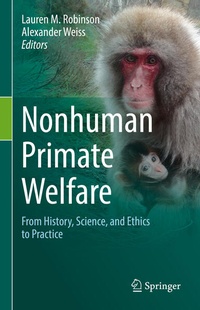
Nonhuman Primate Welfare
Description

Since humans began keeping nonhuman primates we have made vast strides in understanding their cognitive abilities, strong social bonds, vibrant personalities, and their capacity for joy and suffering. With an increasing number of countries banning the use of great apes in biomedical research, the welfare of primates in zoos and research facilities has gained increasing attention.
This interdisciplinary work features contributors from many of the fields involved and those on both sides of the issue, thus providing an exhaustive overview of primate welfare.Readers from animal welfare science, primatology, animal testing, veterinary medicine, conservation to ethics and legislation will find this an important account.
Reviews / Votes
"Nonhuman Primate Welfare: From History, Science, and Ethics to Practice, edited by Lauren M. Robinson and Alexander Weiss, serves as a crucial resource for professionals dedicated to improving nonhuman primate welfare. The book offers comprehensive guidance for veterinarians, researchers, and animal care professionals by covering historical contexts, ethical considerations, and practical strategies for enhancing primate welfare in diverse settings, such as zoos, laboratories, and sanctuaries." (Syalsa Bella Fitriana, Anang Prayitno, Christin Yoanti Parera and Husnul Yaqin, International Journal of Primatology, Vol. 46 (4), 2025) "This book will appeal to a wide range of people who work with and study primates although the cost of the book may be a barrier to some." (Giulia Ciminelli, Animal Welfare, Vol. 32, 2023)
More details
Other editions
Additional editions
Persons
Lauren M Robinson is an animal welfare scientist and psychologist specializing in the welfare, personality, and cognition of animals and has multiple publications across these topics. She has a Ph.D. in psychology and wrote her thesis on nonhuman primate personality and welfare. She has worked across several countries (UK, US, and Austria) and done postdoc work in animal behavior and endocrinology, animal joy, and canid cognition and cooperation for universities including UCLA and the University of Veterinary Medicine Vienna. Her work has spanned zoos, research facilities, and sanctuaries and she has worked with more than a dozen species, including half a dozen nonhuman primate species, wolves and dogs, and even the occasional Nubian goat.
Alexander Weiss has been a lecturer in Psychology at the University of Edinburgh since 2005. Prior to that, he was a postdoctoral researcher at the Laboratory of Personality and Cognition at the National Institute on Aging in Baltimore, Maryland. He did his Ph.D. on genetic and environmental contributions to personality and subjective well-being in captive chimpanzees. Alex is a member of the Scottish Primate Research Group and a Fellow of the Royal Society of Biology. He has been involved continuously in leading or collaborating on projects related to personality, aging, well-being, and health in nonhuman primates, humans, and other animals, and has co-edited three other volumes, and published many articles and chapters on his research.
