

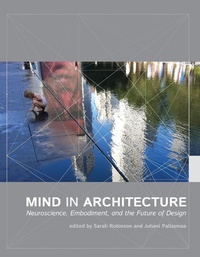
Mind in Architecture
Description

Although we spend more than ninety percent of our lives inside buildings, we understand very little about how the built environment affects our behavior, thoughts, emotions, and well-being. We are biological beings whose senses and neural systems have developed over millions of years; it stands to reason that research in the life sciences, particularly neuroscience, can offer compelling insights into the ways our buildings shape our interactions with the world. This expanded understanding can help architects design buildings that support both mind and body. In Mind in Architecture, leading thinkers from architecture and other disciplines, including neuroscience, cognitive science, psychiatry, and philosophy, explore what architecture and neuroscience can learn from each other. They offer historical context, examine the implications for current architectural practice and education, and imagine a neuroscientifically informed architecture of the future. Architecture is late...
More details
Other editions
Additional editions
Persons
Juhani Pallasmaa, architect, educator, and writer, is the author of more than thirty books, including The Eyes of the Skin: Architecture and the Senses. He is the former director of both the Finnish Museum of Architecture and the Department of Architecture at Helsinki University of Technology.
Juhani Pallasmaa, architect, educator, and writer, is the author of more than thirty books, including The Eyes of the Skin: Architecture and the Senses. He is the former director of both the Finnish Museum of Architecture and the Department of Architecture at Helsinki University of Technology.
Michael Arbib has played a leading role at the interface of neuroscience and computer science ever since his first book, Brains, Machines, and Mathematics. From Neuron to Cognition provides a worthy pedagogical sequel to his widely acclaimed Handbook of Brain Theory and Neural Networks. After thirty years at University of Southern California he is now pursuing interests in ?how the brain got language? and ?neuroscience for architecture? in San Diego.
Sarah Robinson is a practicing architect and the author of Nesting: Body, Dwelling, Mind.
Alberto Pérez Gómez directs the History and Theory of Architecture Program at McGill University, where he is Saidye Rosner Bronfman Professor of the History of Architecture. He is the author of Architecture and the Crisis of Modern Science, Built upon Love: Architectural Longing after Ethics and Aesthetics (both published by the MIT Press), and other books.
