

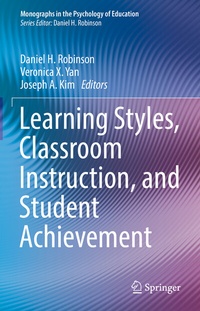
Learning Styles, Classroom Instruction, and Student Achievement
1st Edition
Published on 29. January 2022
V, 77 pages
978-3-030-90792-1 (ISBN)
Description

The book examines the history of learning styles, including their widespread acceptance and endorsement in educational settings. In addition, it explores both the support of and opposition to learning styles by academics. The book discusses cases for and against learning styles and offers a systematic review of empirical evidence. It describes consequences of promoting learning styles in the classroom and offers insights into future directions in research and practice.The book offers a critical examination that adds to the broader discussion of what is truthful and what is fake news in education.
Key areas of coverage include:
Key areas of coverage include:
- History of learning styles.
- Widespread belief in and uses of learning styles.
- Review of recent learning styles coverage in academic journals.
- The case for learning styles.
- The case against learning styles.
- Consequences associated with using learning styles.
Learning Styles, Classroom Instruction, and Student Achievement is an essential resource for researchers, professors, and graduate students as well as teachers and educational professionals in such varied fields as clinical child and school psychology, educational psychology, social work, public health, teaching and teacher education, and educational practice and policy.
Reviews / Votes
"The structure of Learning Styles is very readable, with clearly defined chapters and sections that each discuss a different component of learning styles. The book is written in a conversational tone with limited jargon, making it approachable for parents, practitioners, and researchers alike. This book could be used in higher education coursework related to student engagement, differentiation, or pedagogical approaches. . I would recommend this book for anyone interested in the history or application of learning styles . ." (Kassandra R. Spurlock, Education Review, April 19, 2023)"The book is more palatable for those educators, administrators, or parents already opposing the implementation of learning styles as a cure-all for struggling students. . The text should be highly recommended for future educators, current educators, and parents wanting to understand the conflicting messages about learning styles sent home pertaining to their child's education. . This book plays a vital role in educators' self-reflections on learning styles and its continued flourishing." (John Essington, Education Review, April 19, 2023)
More details
Other editions
Additional editions
Daniel H. Robinson | Veronica X. Yan | Joseph A. Kim
Learning Styles, Classroom Instruction, and Student Achievement
Book
01/2022
Springer
€160.49
Shipment within 7-9 days
Persons
Daniel H. Robinson, Ph.D., M.Ed., is Associate Dean of Research and the K-16 Mind, Brain, and Education Endowed Chair in the College of Education at the University of Texas at Arlington. He previously served as Chair of the Department of Curriculum and Instruction at UTA from 2017 to2020, and Director of the School of Education at Colorado State University from 2012 to 2013. As a faculty member, he has taught at Mississippi State University (1993 to 1997), the University of South Dakota (1997 to 1998), the University of Louisville (1998 to 1999), the University of Texas at Austin (1999 to2012), and Colorado State University (2012 to2015). Dr. Robinson served as Editor of Educational Psychology Review from 2006 to 2015 and as Associate Editor of the Journal of Educational Psychology from 2014 to 2020. He has also served as an editorial board member of nine refereed international journals. Dr. Robinson has published more than 100 articles, books, and book chapters, presented more than 100 papers at research conferences, and taught more than 100 college courses. His research interests include educational technology innovations that may facilitate learning and team-based approaches to learning. He was a Visiting Fulbright Scholar, Victoria University, Wellington, New Zealand, and was named as one of the most published authors in educational psychology journals from 1991 to 2002, 2003 to 2008, and 2009 to 2014, Contemporary Educational Psychology, 2004, 2010, 2015.
Veronica X. Yan, Ph.D., is an Assistant Professor of Educational Psychology at the University of Texas at Austin. She received her doctorate from the University of California, Los Angeles in cognitive psychology and then worked as a postdoctoral researcher in the Mind and Society Center at the University of Southern California. She now directs the Science of Learning and Metacognition lab, which bridges social, cognitive, and educational psychology fields to explore how people can be empowered to become motivated and effectively self-regulated learners. She serves as an academic editor for the PloS One journal. She is the recipient of the UCLA Shepherd Ivory Franz Distinguished Teaching Award (2014) and the UT Educational Psychology Excellence in Teaching Award (2020). Dr. Yan is not only well-published in academic journals and books on educational psychology, but she also conducts professional development workshops and provides consulting for educational technology companies.
Joseph A. Kim, Ph.D., is an associate professor of psychology at McMaster University. After receiving his doctorate in experimental psychology (McMaster University), Dr. Kim completed a postdoctoral fellowship at University of California San Francisco, and he is Associate Professor in Psychology, Neuroscience and Behaviour. As a teaching professor, Dr. Kim is actively involved in all aspects of the scholarship ofteaching and learning. He coordinates the innovative McMaster Introductory Psychology program (MacIntroPsych), which combines traditional lectures with interactive online resources and small group tutorials. The program has been prominently featured in Maclean's, the Globe and Mail, and the Toronto Star. In 2010, Dr. Kim received the Innovator of the Year Award (McMaster VPR) and also led his development team to receive the 2010 President's Award for Excellence in Course and Resource Design. With an active interest in curriculum and education, Dr. Kim consults on several policy groups including the Council of Ontario Universities Online Workgroup and the Innovation and Productivity Roundtable for the Ontario Ministry of Training, Colleges and Universities.
Veronica X. Yan, Ph.D., is an Assistant Professor of Educational Psychology at the University of Texas at Austin. She received her doctorate from the University of California, Los Angeles in cognitive psychology and then worked as a postdoctoral researcher in the Mind and Society Center at the University of Southern California. She now directs the Science of Learning and Metacognition lab, which bridges social, cognitive, and educational psychology fields to explore how people can be empowered to become motivated and effectively self-regulated learners. She serves as an academic editor for the PloS One journal. She is the recipient of the UCLA Shepherd Ivory Franz Distinguished Teaching Award (2014) and the UT Educational Psychology Excellence in Teaching Award (2020). Dr. Yan is not only well-published in academic journals and books on educational psychology, but she also conducts professional development workshops and provides consulting for educational technology companies.
Joseph A. Kim, Ph.D., is an associate professor of psychology at McMaster University. After receiving his doctorate in experimental psychology (McMaster University), Dr. Kim completed a postdoctoral fellowship at University of California San Francisco, and he is Associate Professor in Psychology, Neuroscience and Behaviour. As a teaching professor, Dr. Kim is actively involved in all aspects of the scholarship ofteaching and learning. He coordinates the innovative McMaster Introductory Psychology program (MacIntroPsych), which combines traditional lectures with interactive online resources and small group tutorials. The program has been prominently featured in Maclean's, the Globe and Mail, and the Toronto Star. In 2010, Dr. Kim received the Innovator of the Year Award (McMaster VPR) and also led his development team to receive the 2010 President's Award for Excellence in Course and Resource Design. With an active interest in curriculum and education, Dr. Kim consults on several policy groups including the Council of Ontario Universities Online Workgroup and the Innovation and Productivity Roundtable for the Ontario Ministry of Training, Colleges and Universities.
Content
Chapter 1. The Importance of Examining Possible Educational Myths in an Era of Fake News.- Chapter 2. What Are Learning Styles and How Did They Get Started.- Chapter 3. The Widespread Belief in and Uses of Learning Styles.- Chapter 4. A Systematic Review of Learning Styles in Academic Journals.- Chapter 5. Reconceptualizing Learning Styles.- Chapter 6. Consequences of Endorsing the Learning Styles Myth.- Chapter 7. Possible Consequences Associated with the Use of Learning Styles.- Chapter 8. Future Directions in Research and Practice of Learning Styles.
