

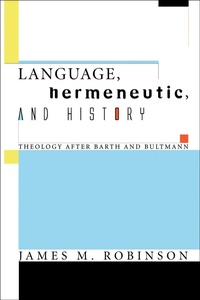
Language, Hermeneutic, and History
Theology after Barth and Bultmann
Published on 1. January 2008
260 pages
978-1-7252-4366-8 (ISBN)
Description

James M. Robinson, together with John B. Cobb, published a series of three volumes entitled New Frontiers in Theology: The Later Heidegger and Theology (1963), The New Hermeneutic (1964), and Theology as History (1967). Here they introduced the new directions that Continental theology was taking after the break caused by the Nazi period and World War II. In each volume it was Robinson's assignment to write an extensive introduction of the new direction: "The German Discussion of the Later Heidegger," "Hermeneutic since Barth," and "Revelation as Word and as History." Then others contributed essays. These three seminar introductions are here brought together in a single volume, which thus is the basic tool for getting into the Continental theology of the second half of the twentieth century.
More details
Other editions
Additional editions
James M. Robinson
Language, Hermeneutic, and History
Book
01/2008
Wipf & Stock Publishers
€31.00
Shipment within 3-4 weeks
James M. Robinson
Language, Hermeneutic, and History
Book
01/2008
Wipf & Stock Publishers
€46.70
Shipment within 15-20 days
Person
James M. Robinson did his doctorate under Karl Barth in Basel, Switzerland (1952). He taught again and again as Visiting Professor at Continental universities: Gottingen (1959), Zurich (1960, 1962), Strasbourg (1970-71), Tubingen (1986), Geneva (1992), and Bamberg (1997). As an expert on Continental theology, he experienced the shift from the prewar debate of the Confessing Church to the postwar focus on demythologizing (Rudolf Bultmann), language (the later Heidegger), the new hermeneutic (Ernst Fuchs and Gerhard Ebeling), and neo-conservatism (Wolfhart Pannenberg).
