

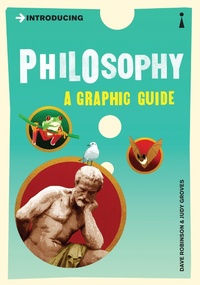
Introducing Philosophy
A Graphic Guide
Published on 5. June 2014
176 pages
978-1-84831-758-1 (ISBN)
Description

Philosophers have always enjoyed asking awkward and provocative questions, such as: What is the nature of reality? What are human beings really like? What is special about the human mind and consciousness? Are we free to choose who we are and what we do? Can we prove that God exists? Can we be certain about anything at all? What is truth? Does language provide us with a true picture of the world? How should we behave towards each other? Do computers think? "Introducing Philosophy" is a comprehensive graphic guide to the thinking of all the significant philosophers of the Western world from Heraclitus to Derrida. It examines and explains their key arguments and ideas without being obscure or solemn. Lively and accessible, it is the perfect introduction to philosophers and philosophical ideas for anyone coming to the subject for the first time.
More details
Other editions
Additional editions
Book
09/2007
Icon Books
€11.50
Shipment within 3-4 weeks
Persons
Dave Robinson has taught philosophy for many years and is the author of numerous Introducing titles including the best-selling Ethics. He is now a part-time lecturer in Critical Studies and lives in Devon. Judy Groves is a painter, illustrator and designer who has worked on numerous Introducing titles.
Content
- Intro
- Cover
- Title Page
- Copyright
- Contents
- Questions
- What is Philosophy?
- Theocracies
- The Greeks
- The Milesians' Big Question
- Pythagoras and Mathematics
- Heraclitus and the World in Flux
- Parmenides
- Zeno's Paradox of Motion
- Empedocles and the Four Elements
- The Atomists
- Introducing Socrates
- Cultural Relativism
- Protagoras the Sophist
- Socratic Dialogue
- Condemned to Death
- Plato and the Philosopher Kings
- The Doctrine of Innatism
- The Ideal Forms
- The Parable of the Cave
- Philosophical Experts
- Aristotle the Teacher
- Deductive or Syllogistic Logic
- Induction and Science
- Final Causes
- Souls and Substances
- The Ethics of Moderation
- Taking the Blame
- Platonist Dreamers and Aristotelian Realists
- Interlude: A Brief History
- The Epicureans - "Cultivate Your Garden"
- The Stoics
- Sceptics and Cynics
- More Short History
- Christianity Arrives
- The Church Fathers
- The Problem of Evil
- St Anselm's Proof
- Abelard's Nominalism
- Aquinas and Natural Theology
- Ockham's Razor
- Renaissance Humanism
- Erasmus the Sceptic
- Political Theorists
- The Social Contract Theory
- Bacon's Philosophy of Science
- Origins of Modern Philosophy
- Scientific Doubt
- Cogito Ergo Sum
- Clear and Distinct Ideas
- Descartes' Legacy
- Spinoza's Questions
- Spinoza's Monism
- Leibniz and the Monadology
- Voltaire and the Enlightenment
- Locke and British Empiricism
- Berkeley's Idealism
- Hume and Empirical Scepticism
- The Problem of Causation
- Moral Scepticism
- Rousseau's Primitive State of Innocence
- The General Will
- Kant's Response to hume
- Mental Structures Precede Experience
- Phenomenal and Noumenal Worlds
- Categorical Imperatives
- Hegel's Dialectic
- Dialectical Logic
- Human Consciousness and Knowledge
- Relative and Absolute knowledge
- The State and the End of History
- Schopenhauer's Concept of Will
- Nietzsche: The Anti-Christ
- Beyond Good and Evil
- Postmodern Forecast
- Eternal Recurrence
- Kierkegaard's Christian Existentialism
- The Leap of Faith
- From Idealism to Materialism
- Marx's Dialectical Materialism
- A Philosophy of Economics
- Surplus Value
- The End of Capitalism
- The Prophet Marx
- Utilitarianism: The Moral Science
- Public Happiness
- The Tyranny of the Majority and Pluralism
- Origins of American Philosophy
- No Government is the Best Government
- Emerson: The Knowledge that Lies Beyond
- Pragmatism
- C.S. Peirce
- Semiotics
- William James
- John Dewey
- Democracy
- Neo-Pragmatists
- The Philosophical Avalanche
- Introduction to 20th Century Philosophy
- Origins of Phenomenology
- Links to Psychology and Mathematics
- The Method of Reductions
- Heidegger: The Quest for Being
- Nothingness and Inauthenticity
- Sartre's Existentialism
- Freedom and Bad Faith
- Authentic Political Life
- Camus and the Absurd
- Analytical Philosophy: The Problem of Mathematics
- Frege and Demystified Maths
- The Mystery Remains
- Meaning and Reference
- Russell's Logical Atomism
- Logical Analysis
- The Logical Positivists
- A.J. Ayer's Logical Positivism
- Testing for Meaning
- Wittgenstein's Logical Atomism
- The Meaning of Meaning
- Language Games
- Private Thoughts
- Freud's Theory of the Unconscious
- Ordinary Language Philosophy
- The Ghost in the Machine
- The Philosophy of Science
- The Induction Method
- Falsification Theory
- Thomas Kuhn: The Paradigm Shift
- Epistemological Anarchism
- From Modern to Postmodern
- The Three Big "IFS" of Postmodernism
- Nietzsche: The Delusion of Truth
- Language and Reality
- A System of Signs
- Structuralists
- Derrida and Deconstruction
- Logocentrism
- The Inexistent Self
- The End of Grand Narratives
- Foucault: Power Plays
- A World of Hyperreality
- What About Science?
- The Realist Viewpoint
- Western Philosophy at a Glance
- Further Reading
- Acknowledgements
- Index
