

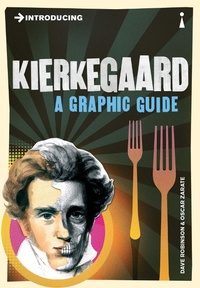
Introducing Kierkegaard
A Graphic Guide
Published on 3. September 2015
176 pages
978-1-78578-015-8 (ISBN)
Description

Father of existentialism or the Eeyore of philosophy?
Known as the first modern theologian, Søren Kierkegaard was a prolific writer of the Danish 'golden age'. A philosopher, poet and social critic, his key concepts of angst, despair, and the importance of the individual, influenced many 20th-century philosophers and literature throughout Europe.
Dave Robinson and Oscar Zarate's brilliant graphic guide explains what Kierkegaard means by 'anti-philosophy', and tells an illuminating story of the strange life and ideas of a man tortured by his attempts to change the very priorities of Western thought.
More details
Other editions
Additional editions
Book
05/2013
Icon Books
€11.50
Shipment within 3-4 weeks
Persons
Dave Robinson has taught philosophy for many years and is the author of numerous Introducing titles. Oscar Zarate is one of the UK's leading graphic artists. He has illustrated numerous Introducing titles. His graphic novel A Small Killing won the Will Eisner Prize.
Content
- Intro
- Title Page
- Copyright
- Contents
- A Radical Change in Philosophy
- The Fork
- The Father
- The Paterfamilias
- The Mother
- The Doomed Family
- The Curse of God
- The Prophecy
- Relief
- Student Life
- The Holy Alliance
- Futility
- Reconciliation
- Father and Son
- The Irony of Socrates
- Regine Olsen
- A Dreadful Mistake
- The Broken Engagement
- Strange Deceiver
- Escape to Berlin
- Finding a Way
- The Lectures
- The Hegelian Dialectic
- Objects and Thoughts
- Individuals and Communities
- The Individual Submerged
- Kierkegaard's Criticism of Hegel
- The Future and the Past
- Humanity Is Not an Idea
- Truth and Commitment
- Fictional and Real People
- Is this Fair?
- The Outsider
- The Philistines
- The Crowd
- The Writer's Existence
- Either/Or
- Against Consensus
- The Reader's Choice
- The Aesthete
- Don Juan
- "Diary of a Seducer"
- The Aesthetic Life and Despair
- Emptiness
- Disillusionment
- Escape from Life
- Judge Wilhelm
- Marriage and Commitment
- Choose Despair
- Ethics, the Individual and the Eternal
- Who is Judge Wilhelm?
- The Religious Life
- Stages and Leaps
- The Religious Stage
- Freedom Is a Choice
- Books, Books, Books .
- The Swelling Mind
- The Imagined Future
- Indecision
- "Being Present to Oneself"
- Repetition is in the Present
- What is Existence?
- No Guide to Choice
- Dread, Despair and Guilt
- The Eccentric Dane
- Beliefs and Uncertainty
- A Faith Based on Reason?
- Natural Theology
- Religion and Philosophy
- Incompatibilists
- Negative Theology
- Pascal's Wager
- The Ultimate Incompatibilist
- State Christianity
- Rational Christendom
- True Christians
- Demonstrating Existence
- The Ontological Argument
- The Reasoning Irrationalist
- Hans Lassen Martensen
- Hegel's Christ
- The Folk Religion
- Kierkegaard's Christ
- The Transcendent God
- Objective and Subjective Truth
- The Leap of Faith
- Faith and Proof
- A Way of Life
- Fear and Trembling
- The Divine Command
- The Ethical and Religious Spheres
- The Religious Sphere
- Beyond Civic Duties
- The Reader's Choice
- The Knight of Faith
- The Concept of Dread
- The Meaning of Dread
- Adam's Temptation
- The Fear of Freedom
- Inheriting Original Sin
- Sex and Sin
- The Age of Anxiety
- Further Stages
- The Nightmares
- The Sickness Unto Death
- Our Task of Therapy
- Willpower and the Self
- Neglect of the Self
- What is the Sickness?
- Being a True Christian
- The Monastery in the World
- The Applicant Pastor
- The Wild and the Tame
- Bishop Mynster
- The Instant
- The Corsair Incident
- "The Present Age"
- The Modern Public
- Last Years
- Sickness and Death
- The Deathbed
- The Legacy
- Kierkegaard the Aesthete
- The Production Line
- How to Approach Kierkegaard
- The Father of Existentialism?
- Who is an Existentialist?
- The Anonymous Crowd
- Indifference to Choice
- The Objectively Subjective
- Passionate Belief
- Existence and Human Presence
- Responsibility and Commitment
- Cowardice
- Existentialist Key Words
- What Does He Mean?
- Subjective Truth
- Are We Really "Free"?
- The Issue of Determinism
- Is the Mind Transparent?
- The Uncertainty of Freedom
- Social Products
- The Abstraction of Freedom
- Kierkegaard's Grandchildren
- Modern Theology
- Existentialist Theologians
- Postmodern Anti-Philosopher
- Is There a "True Self"?
- Adorno, Irigaray, Derrida
- The Open Reading
- Further Reading
- About the Author and Artist
- Acknowledgements
- Index
