

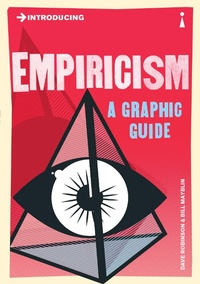
Introducing Empiricism
A Graphic Guide
Published on 3. September 2015
176 pages
978-1-78578-017-2 (ISBN)
Description

Our knowledge comes primarily from experience - what our senses tell us. But is experience really what it seems?
The experimental breakthroughs in 17th-century science of Kepler, Galileo and Newton informed the great British empiricist tradition, which accepts a 'common-sense' view of the world - and yet concludes that all we can ever know are 'ideas'.
Dave Robinson, with the aid of Bill Mayblin's brilliant illustrations, outlines the arguments of Locke, Berkeley, Hume, J.S. Mill, Bertrand Russell and the last British empiricist, A.J. Ayer. They also explore criticisms of empiricism in the work of Kant, Wittgenstein, Karl Popper and others, providing a unique overview of this compelling area of philosophy.
More details
Other editions
Additional editions
Book
03/2013
Icon Books
€10.50
Available immediately
Persons
Dave Robinson has taught philosophy for many years and is the author of numerous Introducing titles. He is now a part-time lecturer in Critical Studies and lives in Devon. Bill Mayblin in a north London-based graphic designer.
Content
- Intro
- Title Page
- Copyright
- Contents
- What is Empiricism?
- Knowledge and Belief
- Inside and Outside
- Originals and Copies
- Questions Lead to Uncertainty
- To Begin at the Beginning
- Aristotle and Observation
- Medieval Scholasticism
- New Ways of Thinking
- Rationalists and Empiricists
- Logic and a Deeper Reality?
- Francis Bacon
- Empiricist Ants and Rationalist Spiders
- Scientific Bees and Induction
- Bacon, Scientism and Thomas Hobbes
- Hobbes's Leviathan
- Hobbes the Empiricist
- Locke and Empiricist Theory
- Innate Ideas on Blank Sheets
- The Empiricist Account
- Direct Realism
- Differences of Property and Experience
- Appearances Are All We Have
- Responding to Scepticism
- Representative Realism
- Mental Images
- Simple Ideas
- Mental Jamjars
- Complex Ideas
- Problems of Reflection
- Primary and Secondary Qualities
- The Philosophy of Corpuscles
- Secondary Qualities
- Subjective Objects of Sense
- Substances Underlying Qualities
- The Word "Idea" and Concepts
- Concepts as Images
- Looking and Thinking
- Language as Ideational
- Abstract Ideas
- Nominal and Real Essences
- Identity in Time
- Personal Identity
- Locke's Politics
- The Legacy of Locke's Empiricism
- Was He Right?
- The Prodigy
- Berkeley's Aims
- Ending in Scepticism
- Berkeley's Idealism
- Esse est Percipi
- A New Theory of Vision
- Abstract Ideas
- Shape and Colour
- Triangles
- Images of Particulars
- Language
- How It All Works
- Dr Johnson's Refutation
- Berkeley's Monist Argument
- Imagination and Truth
- Purely Mental Existence
- The Argument from God
- The Existence of the Self
- Science Depends on God
- Space and Numbers
- God and Minds
- Is Berkeley Irrefutable?
- Are the Arguments Convincing?
- Begging the Question
- God's Intervention
- The Counter-argument from Evolution
- David Hume
- Hume's Philosophy of Scepticism
- Ideas and Impressions
- Impressions and Truth
- The Criteria of Force and Vivacity
- The External World
- Philosophy and Everyday Life
- Hume's Fork
- Science, Theology and Proof
- The Problem of Cause and Effect
- What is Cause?
- The Appearance of Constant Conjunction
- What is Necessity?
- Cause is Psychological and not Logical
- Hume Explains "Why"
- Induction and Deduction
- Rules of Deductive Logic
- The Uses of Induction
- Solutions to the Problem
- The Response of Pragmatism
- What About Identity?
- Looking Within
- Hume on Free Will
- Religion, Proof and Design
- Ethics, Moral Language and Fact
- Meta-Ethics
- Conclusions on Hume
- Kant's Criticism of Hume
- J.S. Mill's Empirical Philosophy
- The Permanent Possibility of Sensation
- Possible Sensations
- Why Do We Believe in Objects?
- Problems with Mill's Position
- Mathematics
- Mill's Logic
- Induction
- Mill's Treatment of Cause
- What are Minds?
- Mill's Ethics and Politics
- Higher Pleasures
- Mill's Politics
- Bertrand Russell
- Relative Perception
- Sense Data
- Russell's Theory of Knowledge
- Logical Atomism
- Meaning and Atomic Facts
- Mathematics and Logic
- A.J. Ayer and the Vienna Circle
- Meaning and Logical Positivism
- Language Bewitchment
- The Isness of Is
- Ayer's Phenomenalism
- The A Priori Tautologies
- Is This Correct?
- Analytic Philosophy
- What of Religion?
- And Ethics?
- Problems with Verificationism
- Ayer's Theory of Meaning
- Meaning as Use
- The Doctrine Examined
- Knowledge Claims
- The Foundations of Empiricism
- Images as Sense Knowledge
- The Knowledge Building
- What Does Science Tell Us?
- The Person Inside the Head
- The Argument from Observer Relativity
- Questions of Reliability
- A Private World of Representations
- How Real Are Sense Data?
- The Adverbial Solution
- Perceptions as Beliefs
- Immediacy
- Looking and Seeing
- Logical and Psychological Processes
- What Do We See?
- The Private Language Argument
- Public Language
- Wittgenstein's Criticism
- The Outside Within Experience
- Knowledge in the World
- The Power of Knowledge
- Kant on Perception
- The Kantian Categories
- Conceptual Frameworks
- Language and Experience
- Making Our World
- Empiricism Denied
- British and European Philosophy
- The Unknowable Mind
- A Future for Empiricism?
- Further Reading
- About the Author
- Acknowledgements
- Index
