

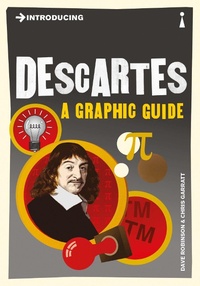
Introducing Descartes
A Graphic Guide
Published on 18. June 2015
176 pages
978-1-84831-985-1 (ISBN)
Description

René Descartes is famous as the philosopher who was prepared to doubt everything- even his own physical existence. Most people also know that he said 'I think, therefore I am', even if they are not always sure what he really meant by it.
Introducing Descartes explains what Descartes doubted, and why he is usually called the father of modern philosophy. It is a clear and accessible guide to all the puzzling questions he asked about human beings and their place in the world. Dave Robinson and Chris Garratt give a lucid account of Descartes' contributions to modern science, mathematics, and the philosophy of mind- and also reveal why he liked to do all of his serious thinking in bed.
Introducing Descartes explains what Descartes doubted, and why he is usually called the father of modern philosophy. It is a clear and accessible guide to all the puzzling questions he asked about human beings and their place in the world. Dave Robinson and Chris Garratt give a lucid account of Descartes' contributions to modern science, mathematics, and the philosophy of mind- and also reveal why he liked to do all of his serious thinking in bed.
More details
Other editions
Additional editions
Book
11/2010
Icon Books
€11.50
Shipment within 3-4 weeks
Persons
Dave Robinson has taught philosophy for many years and is the author of numerous 'Introducing' titles.
Chris Garratt is an illustrator. He is the cartoonist behind the legendary 'Biff' comic strip in the Guardian.
Content
- Intro
- Cover
- Title Page
- Copyright
- Contents
- The Modern Beginner
- Early Days and Youth
- The Soldier
- Descartes' Three Dreams
- The First and Second Dreams
- The Third Dream
- Descartes Settles in Holland
- Scholasticism
- The Early Days of Science
- What is Science?
- Reduction to Mathematics
- Descartes the Scientist
- Cause
- Discourse on The Method
- Clear in the Mind
- What Is a Clear Idea?
- Logical and Causal Necessity
- Can You Know Wax?
- Rationalists and Empiricists
- Brief History of Scepticism
- The Pyrrhonists
- The Pyrrhonists Arguments
- Sextus and Other Sceptics
- Cartesian Doubt
- How to Doubt Everything
- Seeing Isn't Believing
- Dreaming
- Rationalists and Reason
- The Invisible Demon
- Do Our Senses Lie to Us?
- Are We Awake or Not?
- Invisible Demons?
- The Impossibility of a "Private Language"
- Back to the Basket
- The Last Apple: Cogito ergo Sum
- What is the Cogito?
- The Cul de Sac of the Cogito
- Public Knowledge
- The Clear and Distinct Rule
- Problems of the Clear and Distinct Rule
- The Need for God
- The Trademark Argument
- The Cartesian Circle
- The Ontological Argument
- A Series of Leaky Proofs
- Making Mistakes
- Intellect versus Will
- Belief Is Cheap
- Belief and Faith
- A Good Bet
- A Quiet Life in Holland
- Meditations on Perception
- Bringing in God Again
- Mathematical Certainties
- Ancient Greek Mathematics
- Is the Universe Mathematical?
- Descartes the Mathematician
- The Rigour of Mathematics
- But What is Mathematics?
- Mathematical Relativism
- Formalists
- The Success Story
- Mathematical Humans
- The Mathematization of Everything
- Res Extensa
- Res Cogitans
- Cartesian Dualism
- The Dualist Agrument
- Thinking Existence
- Problems with Cartesian Dualism
- Another Argument
- Human Beings and Language
- Brains or Minds?
- Effects of Brain Damage
- Mind-Body Interaction
- Seeing and Hearing the World
- Perceiving and Imagining
- Trialism Explains Sensations
- The Philosophy of Mind
- Open to Criticism
- The Mind and Body Problem
- Some Odd Answers
- How Did Brains Evolve Minds?
- What is Consciousness?
- Aspects of Consciousness
- Brains not Minds
- Behaviourists
- Problems with Behaviourism
- Physicalist
- Problems
- Functionalism
- Problems
- Humans and Computers
- Can Computers Understand?
- The Principles
- Retirement
- Descartes and Ethics
- Invitation to England?
- Invitation to Sweden
- All Frenchmen Dance .
- Lessons at 5 A.M.
- Descartes' Legacy
- The Thinking Individual
- The Postmodern Mind
- "How do we really think?"
- Knowledge and Certainty
- The Postmodern Condition
- Further Reading
- Acknowledgements
- Index
- About the Authors
