

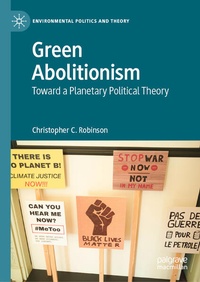
Green Abolitionism
Description

While scientific consensus on climate change is widely accepted, political responses to the crisis remain slow and inadequate. Current approaches often rely on incremental reforms or technological fixes, while the language of "sustainability" has failed to inspire broad democratic action. These limits stem from deep-seated assumptions-human exceptionalism, capitalist growth, and the idea that ecosystems are mere "resources." As climate disruption accelerates, we need a new way of thinking that moves beyond these constraints and sparks collective imagination.
Green Abolitionism offers a new approach. Drawing on abolitionist traditions and ecological economics, Christopher C. Robinson introduces "green abolitionism" as a framework for reimagining environmental politics around freedom rather than sustainability. Across nine engaging lectures, Robinson blends political theory, ecological critique, and stories of activism to show how anti-capitalist, democratic strategies can transform our relationship to the planet. Accessible yet thought-provoking, Green Abolitionism invites readers to see climate action not as technical adjustment but as a bold, abolitionist project-one that demands creativity, justice, and hope.
More details
Other editions
Additional editions
Person
Christopher C. Robinson is University Professor of Political Theory and Public Law at Clarkson University. He is the author of Wittgenstein and Political Theory: The View From Somewhere (2009) and the editor of John G. Gunnell: History, Discourses and Disciplines (2017).
Content
Chapter 1: Green Abolition.- Chapter 2: The Ecological and Oppositional Politics of Green Abolitionist Democracy.- Chapter 3: Seeing Like An Ecological Economist.- Chapter 4: Green Abolition Democracy and the Steady State.- Chapter 5: Truth, Reconciliation, and Environmental Justice.- Chapter 6: Being Human in the Anthropocene: The Paradox.- Chapter 7: Green Abolitionists: The Formation of Radical Democratic Subjectivities.- Chapter 8: The Inhuman Condition: From Sustainability to Freedom.- Chapter 9: The Inhuman Condition II: Abolition and the Political Economy of Freedom.
