

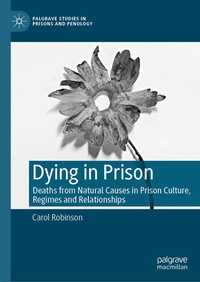
Dying in Prison
Description

This book uses empirical data gathered using ethnographic methods in two contrasting prisons to provide a rare insight into death and dying in prisons in the UK. The majority of deaths in prison custody in England and Wales result from natural causes, yet the experiences of people dying in prison and the impact of these deaths on the wider prison are under-researched areas. It provides a novel insight into the impact of deaths from natural causes on the prison as an institution and challenges existing work juxtaposing occupational philosophies of 'care' and 'control'. It also identifies how end of life care is provided in prisons and the impact this has on culture and relationships shows how deaths from natural causes in prison custody 'soften' prison regimes, culture and relationships. It speaks to an international audience by drawing on the global literature including from the US.
Reviews / Votes
"Essential reading for all studying prisons, working in prisons, or creating policies on prisons! This beautifully written book provides us with a brilliant, powerful, ethical and compassionate critique of prison regimes and cultures as well as a more caring way forward, based on ethnographic observations and interviews with incarcerated men and prison staff."- Professor Maggie O'Neill, Department of Sociology and Criminology, University College Cork; Visiting Professor, Northumbria University, UK"This fascinating, timely, and elegantly written book provides an unrivalled insight into an under-explored but increasingly frequent phenomenon, namely the deaths of prisoners from natural causes. Robinson provides an evocative, penetrating and deeply attentive analysis of the complex moral, spatial and practical questions surrounding the care of dying prisoners, revealing how prisoners and prison staff grapple with mortality and grief in places where notions of humanityand care are contested and unevenly practiced. Dying in Prison is essential reading for anyone with a serious interest in what happens within prisons and the realities of dying in circumstances and settings few would choose for their final days and hours." -Dr Kate Gooch, Department of Social and Policy Sciences, University of Bath, UKMore details
Other editions
Additional editions
Person
Carol Robinson
is a lecturer in Criminology at the University of York, UK, where she teaches at undergraduate and postgraduate level. She previously worked as a prison chaplain.
Content
Chapter 1: Introduction.- Chapter 2: The carceral geography of death and dying in prison custody.- Chapter 3: The governance of mortality.- Chapter 4: Constructing the dying prisoner.- Chapter 5: Caring at the end of life in prison custody.- Chapter 6: Evaluating end of life care in prison custody.- Chapter 7: After a death.- Chapter 8: Conclusion.
