

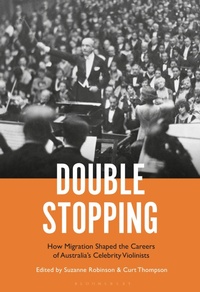
Double Stopping
How Migration Shaped the Careers of Australia's Celebrity Violinists
1st Edition
Published on 25. December 2025
296 pages
979-8-7651-3506-8 (ISBN)
Description

Double Stopping traces the migration of celebrity violinists to and from Australia to investigate routes of contact between metropoles and peripheries, and the impact of world wars and political instability on patterns of musical migration.
Mobility and migration were integral to the careers of twentieth-century concert artists. Double Stopping explores how the increasing speed of travel and communication, the development of new media and the rise of celebrity culture enabled outstanding musicians to construct a global career.
Documenting movement through and between Belgium, Britain, Germany, Hungary, Poland, Russia and emerging hubs in Australia, New Zealand and the United States, this book explores aspects of musical migrant culture including the influence of teachers who were themselves migrants, the role of arts organizations in promoting (or hampering) the careers of immigrant musicians, the impact of the explicitly racist 'White Australia' policy on immigrant artists whose mission was to propagate whiteness and cultural elitism, the obstacles faced by women as aspiring soloists as well as immigrants, and the ways that migration re-oriented or re-shaped career trajectories. It argues that an approach to the history of music performance through the lens of migration can bring into view lives that have been obscured because they crossed borders and transgressed boundaries.
With reference to migration studies, empire studies, postcolonialist theory, celebrity studies and studies of violinists and violin culture, Double Stopping interweaves life stories and migration history to explore the interconnectedness of migration and music-making in an era of modernization and globalization.
Mobility and migration were integral to the careers of twentieth-century concert artists. Double Stopping explores how the increasing speed of travel and communication, the development of new media and the rise of celebrity culture enabled outstanding musicians to construct a global career.
Documenting movement through and between Belgium, Britain, Germany, Hungary, Poland, Russia and emerging hubs in Australia, New Zealand and the United States, this book explores aspects of musical migrant culture including the influence of teachers who were themselves migrants, the role of arts organizations in promoting (or hampering) the careers of immigrant musicians, the impact of the explicitly racist 'White Australia' policy on immigrant artists whose mission was to propagate whiteness and cultural elitism, the obstacles faced by women as aspiring soloists as well as immigrants, and the ways that migration re-oriented or re-shaped career trajectories. It argues that an approach to the history of music performance through the lens of migration can bring into view lives that have been obscured because they crossed borders and transgressed boundaries.
With reference to migration studies, empire studies, postcolonialist theory, celebrity studies and studies of violinists and violin culture, Double Stopping interweaves life stories and migration history to explore the interconnectedness of migration and music-making in an era of modernization and globalization.
More details
Edition
1. Auflage
Language
English
Place of publication
New York
United States
Publishing group
Bloomsbury Publishing Plc
Target group
Professional and scholarly
ISBN-13
979-8-7651-3506-8 (9798765135068)
Copyright in bibliographic data and cover images is held by Nielsen Book Services Limited or by the publishers or by their respective licensors: all rights reserved.
Schweitzer Classification
Other editions
Additional editions
Suzanne Robinson | Curt Thompson
Double Stopping
How Migration Shaped the Careers of Australia's Celebrity Violinists
Book
approx. 01/2026
Bloomsbury Academic USA
€123.50
Not yet published
Persons
Suzanne Robinson is a former lecturer and research fellow at the University of Melbourne, Australia, the recipient of the Kurt Weill Prize, the H. Earle Johnson Award from the Society of American Music and research grants from the Australian Research Council, the Academy of the Humanities and the State Library of NSW. Her books on modernist composers and Australian music history include Peggy Glanville-Hicks: Composer and Critic (2019).
Curt Thompson is Associate Professor and Head of Strings at the Melbourne Conservatorium of Music, Australia, and founder and director of the Mimir Chamber Music Festival, Australia. He has held teaching appointments at the Indiana University Jacobs School of Music, USA and Texas Christian University, USA, and as a concerto soloist, recitalist and chamber musician has appeared in such prestigious venues as Carnegie Hall's Weill Recital Hall, Salle Gaveau in Paris and Shanghai Concert Hall.
Curt Thompson is Associate Professor and Head of Strings at the Melbourne Conservatorium of Music, Australia, and founder and director of the Mimir Chamber Music Festival, Australia. He has held teaching appointments at the Indiana University Jacobs School of Music, USA and Texas Christian University, USA, and as a concerto soloist, recitalist and chamber musician has appeared in such prestigious venues as Carnegie Hall's Weill Recital Hall, Salle Gaveau in Paris and Shanghai Concert Hall.
Content
List of Illustrations
List of Contributors
List of Abbreviations
Acknowledgements
Foreword by William Hennessy AM
Introduction
Part I: Leaving Australia
1: For love of the violin: The travels, tribulations and triumphs of Johann Kruse
Johanna Selleck, University of Melbourne, Australia
2: Alma Moodie: A tragic story of a true violin heroine
Tatjana Goldberg, City, University of London; Middlesex University; Purcell School, UK
3: Miss Daisy Kennedy: 'Of her sex without a doubt the foremost living violinist'
Laura Case, Sydney Conservatorium of Music, Australia
4: Dorcas McClean: An Australian violinist in the British World
Suzanne Robinson, University of Melbourne, Australia
5: Ernest Llewellyn: Australia's leading violinist
Suzanne Robinson, University of Melbourne, Australia
6: Beryl Kimber OBE: Dynamic performer and pedagogue
Elizabeth Layton, University of Adelaide, Australia
Part II: Arriving in Australia
7: Adventurer of consciousness: The violinist Henri Verbrugghen
Goetz Richter, Sydney University's Conservatorium of Music, Australia
8: Tossy Spivakovsky in exile: The Australian years
Curt Thompson, Melbourne Conservatorium of Music, Australia
9: Richard Goldner: A Viennese violinist in mid-century Sydney
Julia Russoniello, University of Sydney, Australia
10: 'Tones of gently cradled eloquence': Robert Pikler, a Hungarian violinist in Australia
Curt Thompson, Melbourne Conservatorium of Music, Australia
11: From the crossroads of two tyrannies: Nathan Gutman, violinist and educator
Elizabeth Sellars, Flinders Quartet, Australia
Bibliography
Index
List of Contributors
List of Abbreviations
Acknowledgements
Foreword by William Hennessy AM
Introduction
Part I: Leaving Australia
1: For love of the violin: The travels, tribulations and triumphs of Johann Kruse
Johanna Selleck, University of Melbourne, Australia
2: Alma Moodie: A tragic story of a true violin heroine
Tatjana Goldberg, City, University of London; Middlesex University; Purcell School, UK
3: Miss Daisy Kennedy: 'Of her sex without a doubt the foremost living violinist'
Laura Case, Sydney Conservatorium of Music, Australia
4: Dorcas McClean: An Australian violinist in the British World
Suzanne Robinson, University of Melbourne, Australia
5: Ernest Llewellyn: Australia's leading violinist
Suzanne Robinson, University of Melbourne, Australia
6: Beryl Kimber OBE: Dynamic performer and pedagogue
Elizabeth Layton, University of Adelaide, Australia
Part II: Arriving in Australia
7: Adventurer of consciousness: The violinist Henri Verbrugghen
Goetz Richter, Sydney University's Conservatorium of Music, Australia
8: Tossy Spivakovsky in exile: The Australian years
Curt Thompson, Melbourne Conservatorium of Music, Australia
9: Richard Goldner: A Viennese violinist in mid-century Sydney
Julia Russoniello, University of Sydney, Australia
10: 'Tones of gently cradled eloquence': Robert Pikler, a Hungarian violinist in Australia
Curt Thompson, Melbourne Conservatorium of Music, Australia
11: From the crossroads of two tyrannies: Nathan Gutman, violinist and educator
Elizabeth Sellars, Flinders Quartet, Australia
Bibliography
Index
