

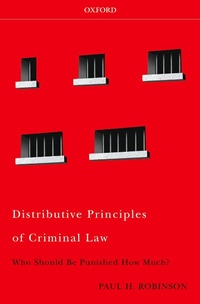
Distributive Principles of Criminal Law
Who Should be Punished How Much
Published on 10. September 2008
286 pages
978-0-19-971093-5 (ISBN)
Description

The rules governing who will be punished and how much determine a society's success in two of its most fundamental functions: doing justice and protecting citizens from crime. Drawing from the existing theoretical literature and adding to it recent insights from the social sciences, Paul Robinson describes the nature of the practical challenge in setting rational punishment principles, how past efforts have failed, and the alternatives that have been tried. He ultimately proposes a principle for distributing criminal liability and punishment that will be most likely to do justice and control crime.
Paul Robinson is one of the world's leading criminal law experts. He has been writing about criminal liability and punishment issues for three decades, and has published dozens of influential articles in the best scholarly journals. This long-awaited volume is a brilliant synthesis of social science research and legal reasoning that brings together three decades of work in a compelling line of argument that addresses all of the important issues in assessing liability and punishment.
More details
Other editions
Additional editions
Book
09/2008
Oxford University Press Inc
€135.00
Shipment within 15-20 days
Person
Paul H. Robinson, the Colin S. Diver Professor of Law at the University of Pennsylvania, is one of the world's leading experts on criminal law. Holding law degrees from U.C.L.A., Harvard, and Cambridge, he served as a federal prosecutor, as counsel for the U.S. Senate Subcommittee on Criminal Law, and as one of the original commissioners of the U.S. Sentencing Commission, where he was the lone dissenter to promulgation of what are the current federal sentencing guidelines. Among his dozen books are the standard lawyer's reference book on criminal law defenses, an internationally known Oxford monograph on criminal law theory, a highly-regarded criminal law treatise, a popular innovative case studies course book, and a ground-breaking empirical study of the conflict between criminal law rules and lay intuitions of justice. He also has published scholarly articles in nearly ever top law review. Robinson, who has given scholarly lectures and assisted in criminal code reform throughout the world, led two recent criminal code reform projects in the United States and, under United Nations sponsorship, directed the effort in producing the first Islamic criminal code to use a modern code format.
Content
- Intro
- Contents
- Acknowledgments
- Selected Robinson Bibliography
- 1. Distributing Criminal Liability and Punishment
- 2. The Need for an Articulated Distributive Principle
- A. The Criterion for Each Alternative Distributive Principle
- 1. Deterrence General and Special
- 2. Incapacitation of the Dangerous
- 3. Rehabilitation
- 4. Deontological Desert
- 5. Empirical Desert
- B. Conflicts Among Distributive Principles
- 1. Deterrence General and Special
- 2. Incapacitation and Rehabilitation
- 3. Deontological and Empirical Desert
- C. The Problem of Unarticulated Combinations of Distributive Principles
- 3. Does Criminal Law Deter?
- A. The Prerequisites to Deterrence
- 1. The Legal Knowledge Hurdle
- 2. The Rational Choice Hurdle
- 3. The Perceived Net Cost Hurdle
- 4. Tripping Over Any Hurdle as Fatal to Deterrent Effect
- 5. The Cumulative Dissipation Problem
- B. The Aggregated-Effect Studies
- 1. Studies That Find No Deterrent Effect from Doctrinal Formulation
- 2. Studies That Find Mixed or Conflicting Results
- 3. Studies That Find a Deterrent Effect from Doctrinal Manipulation
- C. The Possibilities and Impossibilities of Improving Deterrent Effect
- 1. Insuring That the Target Audience Knows, Directly or Indirectly, of the Rule Designed to Influence Their Conduct
- 2. Insuring That the Target Audience Perceives a Meaningful Net Cost for a Violation
- 3. Insuring That the Target Audience Is Capable of and Willing to Bring a Perceived Threat of Punishment to Bear on Their Conduct Decisions
- 4. Summary and Conclusion
- 4. Deterrence as a Distributive Principle
- A. The Traditional Assumption That the Formulation of Criminal Law Doctrine Will Influence Conduct
- 1. Doctrinal Formulations Calculated to Deter
- 2. "Deterrence Speak" versus Deviations from Justice
- B. Difficulties of Deterrence as a Distributive Principle
- 1. The Information and Complexity Problems
- 2. The Problem of Comparative Deterrent Effect: The Deterrent Effect Inherent in Other Distributive Principles
- 3. The Problem of Deviating from Desert: Deterrence at Its Worst When Doing Its Best
- 4. The Problem of Offsetting Crimogenic Effect: The Utility of Desert
- 5. Rehabilitation
- A. Does Rehabilitation Work?
- 1. Programs for a General Prison Population
- 2. Programs Targeting Specific Offenders, In and Out of Prison: Drug Users and Sexual Offenders
- B. Rehabilitation as a Distributive Principle
- 6. Incapacitation of the Dangerous
- A. Cloaking Preventive Detention as Criminal Justice
- 1. The Practical Value to Reformers of Creating Desert-Dangerousness Ambiguity
- 2. The Start to Modern Cloaking: The Model Penal Code's Surreptitiously Discounting the Significance of Resulting Harm
- 3. The Inevitable Conflict Between Desert and Dangerousness as Distributive Criteria
- 4. Denying the Conflict
- B. The Justice Problems
- C. The Preventive Detention Problems
- D. Segregating Doing Justice and Preventive Detention
- 7. Competing Conceptions of Desert: Vengeful, Deontological, and Empirical
- A. Competing Conceptions of Desert
- 1. Vengeful Desert
- 2. Deontological Desert
- 3. Empirical Desert
- 4. Vengeful versus Other Conceptions of Desert
- 5. Deontological versus Empirical Desert
- B. Resulting Confusions About the Nature of Deserved Punishment
- 1. Harsh?
- 2. Based on Anger and Hatred?
- 3. A Preference for Prison, or Worse?
- 4. Only Vague Demands?: "Limiting Retributivism" in Setting the Punishment Continuum Endpoint
- 5. Subject to Profound Disagreement?
- 6. Fails to Avoid Avoidable Crime?
- 7. Immoral?
- 8. Impractical to Implement?
- C. Summary: A More Detailed Account of Three Conceptions of Desert
- D. Conclusion
- 8. The Utility of Desert
- A. The Crime-Control Value of Empirical Desert as a Distributive Principle
- 1. Harnessing the Power and Efficiency of Normative Social Influence, Stigmatization
- 2. Avoiding the Resistance and Subversion Produced by a System That Is Seen as Not Doing Justice
- 3. Avoiding Vigilantism
- 4. Having a Role in Shaping Societal Norms: The Persuasive Power of the Law
- 5. Gaining Compliance in Borderline Cases
- 6. Conclusion
- B. The Determinants of Criminal Law's Moral Credibility
- 1. The Detrimental Effect of Blurring the Criminal-Civil Distinction
- 2. The Problem of Moral Divisions within the Community
- 3. The Generalization of Disrespect
- 4. Persuasion versus Contempt
- 5. The Fragility of Reputation: The Costs of Deviations from Desert
- 6. Underestimating the Power of Moral Credibility
- C. Determining Community Perceptions of Desert
- 1. Misconceptions of Empirical Desert as Inevitably Draconian: The Disutility of Injustice
- 2. Do People Intuitively Assess Punishment According to Desert, or Do They Look to Deterrence or Incapacitation?
- 3. Using Community Principles of Justice to Draft Criminal Codes and Sentencing Guidelines
- 4. Community Principles of Justice versus Current Law
- D. Summary and Conclusion
- 9. "Restorative Justice"
- A. The Virtues of Restorative Processes, the Vices of "Restorative Justice"
- B. "Restorative Justice" and Doing Justice
- C. Using Restorative Processes More Widely and in More Serious Cases
- 10. The Strengths and Weaknesses of Alternative Distributive Principles
- A. General Deterrence
- B. Special Deterrence
- C. Rehabilitation
- D. Incapacitation
- E. Empirical Desert
- F. Deontological Desert
- G. Conclusion
- 11. Hybrid Distributive Principles
- A. Alternative Approaches to Constructing an Articulated Hybrid Distributive Principle
- 1. Relying upon the Principle with the Greatest Punishment
- 2. Establishing Priorities
- 3. Distinguishing Determining Principles from Limiting Principles
- 4. Combining Principles: Deferring to the Greatest Utility
- 5. Distinguishing Liability Assignment and Amount of Punishment from the Method of Punishment
- B. The A.L.I.'s Distributive Principle of "Limiting Retributivism"
- 1. The Effectiveness Requirement
- 2. The Problem of Countervailing Criminogenic Effect
- 3. The Nonexistent Range and Desert's Ordinal Ranking Demands
- 12. A Practical Theory of Justice: Proposal for a Hybrid Distributive Principle Centered on Empirical Desert
- A. A Proposed Distributive Principle
- 1. Paragraph 1. Primary Principle of Empirical Desert
- 2. Paragraph 2. Inconspicuous Deviations
- 3. Paragraph 3. Deviations to More Effectively Control Crime
- 4. Paragraph 4. Deviations to Advance Interests Other Than Crime Control
- 5. Paragraph 5. Method of Punishment
- 6. Weakness of the Proposal
- B. Deviations from Empirical Desert
- 1. Promoting Justice in a Complex World
- 2. Sacrificing Justice to Promote Other Interests
- C. Strategies for Avoiding Deviations from Empirical Desert
- 1. Criminal Justice Reforms
- 2. Employing Civil Rather Than Criminal Processes
- D. The Limits of Criminal Law's Distributive Principle
- Index
- A
- B
- C
- D
- E
- F
- G
- H
- I
- J
- K
- L
- M
- N
- O
- P
- Q
- R
- S
- T
- U
- V
- W
- Z
