

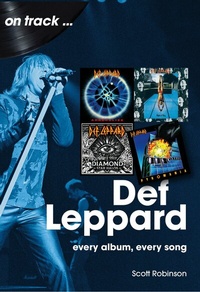
Def Leppard
Description

In the beginning, there was Led Zeppelin, Black Sabbath, and Deep Purple; the progenitors of early 1970s British heavy metal. Inspired by the DIY ethic of punk, the late 1970s brought the New Wave of British Heavy Metal and five young men from Sheffield - some of them still in school - took that new sound and infused it with large doses of the glam they'd grown up on with T. Rex, Queen and Davie Bowie - and blazed a trail into the Eighties, leading this updated genre into the new era of MTV. Taking the name Def Leppard, they brought unprecedented energy and innovation to every song, to every show and then partnered with legendary producer Mutt Lange to become heavy metal's apostles to top 40 radio - delivering an astonishing string of hit singles and multi-platinum albums while setting new standards for arena rock. They're still rocking the world today, touring the world and never resting on their laurels. Heavy metal, the NWOBHM and hair metal have all come and gone, but Def Leppard remain. This book discusses all of their recorded work in detail, from the legendary rawness of The Budgeon Riffola EP to the polished hard rock of Pyromania and Hysteria and beyond.
Scott Robinson is a writer, musician, technologist, and lifelong fan of classic rock. He was a music critic for the Louisville Courier-Journal for 20 years and has been published in Rolling Stone and the Wall Street Journal. His previous books include The Beatles Guide to Love & Sex, All We Are Saying: The Political Beatles, and the Rock Candy series. He lives in Indiana, USA
All prices
More details
Other editions
Additional editions
Content
On Through The Night (1980)
Personnel:
Joe Elliott: lead and backing vocals
Rick Savage: bass, vocals
Steve Clark: lead and rhythm guitars, vocals
Rick Allen: drums, vocals
Pete Willis: lead and rhythm guitars, vocals
Chris M. Hughes: synthesiser
Dave Cousins: spoken vocals
Recorded at Startling Studios in December 1979
Producer: Col. Tom Allom
Engineers: Louis 'Snook' Austin, Dick Plant
Released 14 March 1980
Label: Vertigo Records
Certification: Platinum (US)
Chart activity: UK Albums: 15, US Billboard 200: 51
Running time: 43:47
A band's first album presents unique challenges. Even after some experience cutting demos (or, as in Leppard's case, doing an EP), it's an adjustment to settle into the studio environment for days, even weeks on end. Years of success on stage in front of screaming crowds is one thing, but finding a process that works for everything - to say nothing of learning to defer to a producer - is something else entirely. It's a new kind of chemistry that can't be taken for granted, but must be patiently sought out.
So it was with the young Leppard. Having been signed by Vertigo - the label of their heroes, Thin Lizzy - they were sent to Startling Studios in Berkshire, into the arms of veteran rock producer Col. Tom Allom. Allom's hard rock credentials were unassailable. He'd been the architect of Black Sabbath's launch, helming both their debut album and its marvellous successor, Paranoid; he had just wrapped Judas Priest's first live disc, Unleashed In The East. Leppard had nothing to fear.
Good to know, but it also added to their intimidation. That was nothing, however, compared to the locale of Startling Studios: it was, in fact, Tittenhurst, John Lennon's former estate, where the Beatles legend had recorded Imagine. 'It was insane', Joe recalled. 'I'd grown up in a terraced house in Sheffield, and suddenly I was in the place where Lennon was filmed singing 'Imagine' with Yoko in the white room. We were in fucking Downton Abbey! We were just soaking up that whole Beatles vibe. And I drew the long straw and got Lennon's bedroom.'
It was a three-week residency, though the work itself was efficient and, at times, brisk. The band rapidly homed in on the studio chemistry that would only get sharper and more potent over time. And, as is often the case with debut album recording, they had plenty of material ready to go, refined from dozens of nights on stage. 'Getcha Rocks Off' and 'The Overture' would jump over from the EP (with shorter names); their signature anthems 'Rock Brigade' and 'Hello America' were givens, as was Steve's 'Wasted'. Their power ballad 'Sorrow Is A Woman' would be the first of an obligatory many. Two tracks - 'It Could Be You' and 'It Don't Matter' - were written and recorded on the spot, owing possibly to the inspiring surroundings.
'We got most of the backing tracks done in that one day,' Joe recalled. 'Nine songs. It was easy. Basically, it was just our live set, without the vocals.' Finishing the songs off, 'We spent too much time on the overdubs,' he said in Definitely, 'and as a result, the album ended up a bit too smooth. It also left me with way too little time for the vocals. I had to blast through the whole record in four days, three songs a day. For an unschooled but very enthusiastic singer, it was hard.'
One of the biggest innovations was the recording of Rick's drums on the ominous 'When The Walls Came Tumblin' Down', which were laid down in the chapel on the estate grounds. The idea was to catch the echo off the chapel walls. Another more quirky innovation was the use of a kettle stolen from the kitchen in place of a cowbell on 'It Don't Matter'. They managed to destroy the thing, and when the cook arrived the next day and saw it, she tore them a new one.
And if you're going to spend three weeks at John Lennon's old estate, the temptation to simply have fun would be irresistible. 'I took this motorcycle with me', Rick Allen reported in the liner notes of The Early Years. 'Steve and I would ride all around the gardens, really tearing it up. I also remember drinking copious amounts of alcohol and thinking, 'Wow, this is what being in a band is all about!''
'If I have one regret, it's that we should have recorded that album in a week and not three', he went on. 'I think we overdid it. The essence of those songs - the energy they had when we played them live - was a bit lacking. It wasn't the perfect album. I do hear naiveté. But I think that's part of its charm.'
Joe was happier with it. 'I remember being very happy with that record at the time,' he wrote. 'And I look back on it now with an enormous amount of affection.'
Future bandmates Phil Collen and Vivian Campbell, who would one day replace Pete Willis and Steve Clark, respectively, remembered hearing On Through The Night for the first time: 'I thought On Through The Night was great', recalled Phil. 'It was very different to all the other New Wave of British Heavy Metal stuff. Good melodies, lots of harmonies - it was very cool.'
'There was so much exuberance in that album', Viv said. 'But more than anything else, I could hear the deep ambition in the band.'
Based on this debut work, Canadian critic Martin Popoff declared Leppard 'one of the most polished and savvy of the NWOBHM ... a welcome breath of fresh air ... [recalling] acts like Thin Lizzy, UFO, even Queen and Mott the Hoople.'
Rolling Stone's David Fricke, who would become one of the band's perennial cheerleaders, wrote that the album 'shows they not only respect their elders, they've taken cues from their New Wave peers, too ... guitarists Pete Willis and Steve Clark shoot from the hip, packing their licks into tight, three-minute pop arrangements ... [Elliott] wails wonderfully in a resonating tenor, fortified by backup harmonies, and Tom Allom's battering-ram production ... displays a wisdom beyond their years, awfully impressive for a band making its vinyl debut.'
Creem was quick to praise the band's spirit, above and beyond their technical prowess: '...amplified zeal and spirited bravura ... this band frequently transcends the mundane through sheer musical energy and playing ability.'
Steve Huey, retrospectively writing for Allmusic, said that the album 'established the band as one of the leading lights of the New Wave of British Heavy Metal ... it may lack the detailed production and more pop-oriented songwriting of later efforts, [but] some Leppard fans prefer this sound.'
The band were fortunate enough to tour in support of the album, not only in their native UK, but across the ocean in the US. They warmed up for that tour by playing small clubs in January and February, then started a proper UK tour in April - after which they crossed the ocean to play two and a half months in the US.
Before heading across the ocean, however, they paid a nostalgic visit to a beloved hometown venue - Sheffield City Hall, their old home turf, where they'd first seen most of their most beloved rock heroes. Recalling that sold-out 10 April show, Joe said in the liner notes of the Def Leppard: The Early Years box set, 'It was only nine years after the 12-year-old me saw Marc Bolan on that stage', remembered Joe. 'I'd seen all these amazing shows there - Hunter-Ronson, Lynyrd Skynyrd, Elton John, Black Sabbath, with Van Halen opening. And now, that stage was ours. Being a headline act was what we wanted, and what we believed - naively, arrogantly, youthfully - that we deserved to be.'
'If you peer through the curtain of uncertainty that my voice was in those days, you hear the beginnings of a very good band', he continued. 'That was based on the foundation of an insane rhythm section, which Sav and Rick were, and the spread of colour that those guitarists had. As the guy who stood between Pete and Steve - literally, in the middle - I knew how good they were when they got it right. They played off each other, like opposites ... they were instinctive. It was really exciting, and when it clicked, it was unique.'
Savage agreed. 'It's easy to forget how good Pete and Steve were,' he said, 'because we were young and we've gone on to so many more levels since then. But they really were great together, full of ideas, and so tight. The band were smoking.'
'According to Artery, Leppard are 'positively the worst group ever to have graced this city with their presence'', reported the Sheffield Star. 'That view, which was reported in an alternative publication, shows a certain bias towards bands that have been electronically tested. Def Leppard are more your Thin Lizzy. But, dominantly, they're original material, heavy rock with more than just a touch of melody.'
Off they went to America, returning home in time for the Reading Rock Festival, headlined by Whitesnake. They were not exactly hailed as...
