

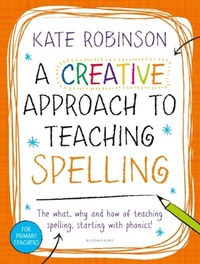
A Creative Approach to Teaching Spelling: The what, why and how of teaching spelling, starting with phonics
1st Edition
Published on 11. August 2016
96 pages
978-1-4729-3011-8 (ISBN)
Description

A Creative Approach to Teaching Spelling is packed full of fun and effective multi-sensory games and activities that build phonic skills as a key strategy for spelling. In addition, there are games that develop further strategies to supplement phonic skills. Preceding the games is a summary of major developments in the teaching of spelling over the last forty years. This leads to an analysis of the current research and approaches on which the games are based. With the knowledge, skills and ideas offered, teachers can enhance the growing range of phonic-based spelling programmes currently used within schools, or they can build engaging spelling programmes of their own to meet the specific groups or individual pupils.
The games and activities will help to develop and embed children's phonological awareness, phonic knowledge and auditory memory.
The games and activities will help to develop and embed children's phonological awareness, phonic knowledge and auditory memory.
Reviews / Votes
This book is great for student-teachers, NQTs, or primary school teachers who wish to expand their repertoire of strategies for supporting spelling with their pupils. * UKED Chat *More details
Edition
1. Auflage
Language
English
Place of publication
London
United Kingdom
Publishing group
Bloomsbury Publishing PLC (Digital)
Target group
College/higher education
Professional and scholarly
ISBN-13
978-1-4729-3011-8 (9781472930118)
Copyright in bibliographic data and cover images is held by Nielsen Book Services Limited or by the publishers or by their respective licensors: all rights reserved.
Schweitzer Classification
Other editions
Additional editions
Kate Robinson
A Creative Approach to Teaching Spelling: The what, why and how of teaching spelling, starting with phonics
Book
08/2016
Bloomsbury Education
€41.07
Article exhausted; check different version
Person
Kate Robinson has been working in education for over 25 years. In that time, she has gained extensive experience as a writer, consultant, manager, teacher trainer and teacher. She has specialised in the areas of English, Maths and Family Learning. Her key aim is to make learning fun through practical, multi-sensory games and activities that capture the imagination and inspire learning. Kate has also worked as a consultant supporting educational providers to improve their practice and as a teacher trainer for prospective teachers and Learning Support Assistants.
Content
- Cover
- Half Title
- Title
- Copyright
- Contents
- Introduction
- 1 Spelling: the what, why and how
- Why teach spelling?
- Changing attitudes and approaches to the teaching of spelling
- Phonics
- The difference between reading and spelling
- 2 Phonics plus
- Sub-lexical sound-spelling correspondences
- Morphology
- Rules
- Association
- Multisensory approaches
- Further approaches for tricky words
- Look Say Cover Write Check (LSCWC)
- Revisiting
- Dictionaries and spell checks
- Spelling in context
- Self- and peer-editing
- 3 Summary of key current approaches to word analysis for spelling
- 4 Introducing how we spell to pupils
- Processes for word building and strategies for spelling
- Terminology for spelling
- 5 Assessment and self-assessment
- Why are we assessing spelling?
- What are we assessing and what will we do with the information gathered?
- How should we assess?
- Gathering, collating and applying assessment information
- Selecting words to learn
- 6 Selecting and preparing games
- Selecting games
- How can computers enhance spelling games?
- Articulation
- Presentation
- 7 Games and activities for spelling
- Written words (Games 1-6)
- Spoken words (Games 7-10)
- Morphological analysis (Games 11-13)
- Word association (Games 14 and 15)
- Rules (Games 16 and 17)
- Tricky words (Game 18)
- Further multisensory approaches (Games 19-23)
- Revisiting and editing (Games 24-27)
- 8 Sample multi-activity spelling session
- 'ou' for the short /u/ sound
- 9 Spelling at home
- Appendix 1: Some common affixes, their meanings and example words
- Appendix 2: Word sets with activity suggestions
- Glossary
- Bibliography
