

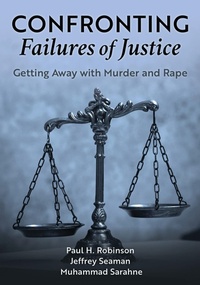
Confronting Failures of Justice
Getting Away with Murder and Rape
1st Edition
Published on 6. August 2024
588 pages
979-8-216-33264-0 (ISBN)
Description

Most murderers and rapists escape justice, a horrifying fact that has gone largely unexamined until now. This groundbreaking book tours nearly the entire criminal justice system, examining the rules and practices that regularly produce failures of justice in serious criminal cases. Each chapter outlines the nature and extent of justice failures in present practice, describing the interests at stake, and providing real-world examples. Finally, each chapter reviews proposed and implemented reforms that could balance the competing interests in a less justice-frustrating manner and recommends one-sometimes completely original-reform to improve the system.
A systematic study of justice failures is long overdue. As this book discusses, regular failures of justice in serious criminal cases undermine deterrence and the criminal justice system's credibility with the community as a moral authority. The damage caused by unpunished crime is immense and, even worse, falls primarily on vulnerable minority communities. Now for the first time, students, researchers, policymakers, and citizens have a resource that explains why justice failures occur and what can be done about them.
Confronting Failures of Justice is accessible for use by college freshman through graduate students and law students and is designed to be main text for a course on justice failures, but it could be used in conjunction with other texts in a broad range of courses touching on criminal justice. It presents arguments in a highly-organized fashion and provides dozens of case studies, many with photographs, to gain student interest and to bring the academic discussions to life.
A systematic study of justice failures is long overdue. As this book discusses, regular failures of justice in serious criminal cases undermine deterrence and the criminal justice system's credibility with the community as a moral authority. The damage caused by unpunished crime is immense and, even worse, falls primarily on vulnerable minority communities. Now for the first time, students, researchers, policymakers, and citizens have a resource that explains why justice failures occur and what can be done about them.
Confronting Failures of Justice is accessible for use by college freshman through graduate students and law students and is designed to be main text for a course on justice failures, but it could be used in conjunction with other texts in a broad range of courses touching on criminal justice. It presents arguments in a highly-organized fashion and provides dozens of case studies, many with photographs, to gain student interest and to bring the academic discussions to life.
More details
Edition
1. Auflage
Language
English
Place of publication
United States
Publishing group
Bloomsbury Publishing Plc
Illustrations
53 BW Photos, 3 Tables, 1 Textbox
ISBN-13
979-8-216-33264-0 (9798216332640)
Copyright in bibliographic data and cover images is held by Nielsen Book Services Limited or by the publishers or by their respective licensors: all rights reserved.
Schweitzer Classification
Other editions
Additional editions
Paul H. Robinson | Jeffrey Seaman | Muhammad Sarahne
Confronting Failures of Justice
Getting Away with Murder and Rape
Book
08/2024
Rowman & Littlefield Publishers
€48.00
Shipment within 3-4 weeks
Persons
Paul Robinson is one of the world's leading criminal law scholars. He is a member of the American Law Institute and a former federal prosecutor and counsel for the US Senate Subcommittee on Criminal Laws and Procedures. A prolific writer and lecturer, Robinson has published twenty books and articles in virtually all of the top law reviews, lectured in more than 110 cities in thirty-four states and twenty-seven countries, and had his writings appear in fifteen languages. Robinson is the lead editor of Criminal Law Conversations (Oxford) and the author of Intuitions of Justice and the Utility of Desert (Oxford); Mapping American Criminal Law (Praeger); Distributive Principles of Criminal Law (Oxford); and Structure and Function in Criminal Law (Oxford). He also writes popular books for general audiences, such as Would You Convict? (NYU), Law Without Justice (Oxford), Crimes That Changed Our World (Rowman & Littlefield), Shadow Vigilantes (Prometheus), and American Criminal Law (Routledge). Robinson recently completed three criminal code reform projects in the U.S. and two modern Islamic penal codes, including one under the auspices of the U.N. Development Programme.
Jeffrey Seaman is a researcher and writer on the U.S. criminal justice system and a JD student at the University of Pennsylvania. He is committed to bringing an interdisciplinary approach to the problem of criminal justice reform to make the system more just for all.
Muhammad Sarahne, SJD, LLM, LLB, is an attorney in the Criminal Department of the State Attorney's Office in Israel, representing the state in criminal matters before the Israeli Supreme Court. He previously worked as a prosecutor in the Economic Crime Department and was an assistant to the Israeli Deputy Attorney General (Criminal). He is an adjunct teacher at the Law School of the Hebrew University of Jerusalem and has published a number of articles in American and British law reviews.
Jeffrey Seaman is a researcher and writer on the U.S. criminal justice system and a JD student at the University of Pennsylvania. He is committed to bringing an interdisciplinary approach to the problem of criminal justice reform to make the system more just for all.
Muhammad Sarahne, SJD, LLM, LLB, is an attorney in the Criminal Department of the State Attorney's Office in Israel, representing the state in criminal matters before the Israeli Supreme Court. He previously worked as a prosecutor in the Economic Crime Department and was an assistant to the Israeli Deputy Attorney General (Criminal). He is an adjunct teacher at the Law School of the Hebrew University of Jerusalem and has published a number of articles in American and British law reviews.
Content
Acknowledgments
Chapter 1: Getting Away with Murder and Rape
A. Introduction: Failures of Justice
B. The Causes of Justice Failures
C. The Frequency and Seriousness of Justice Failures
D. Case Examples and the Public Reaction to Them
E. The Costs of Justice Failures
F. Systemic Indifference to Justice Failures
G. A New Look at the Competing Interests and Imagining Reforms
Part I: Criminal Liability Rules
Chapter 2: Legal Bars to Prosecution
A. Statutes of Limitation
B. Double Jeopardy
C. Diplomatic Immunity
D. The Legality Principle and the Rule of Strict Construction
Chapter 3: Anti-Justice Distributive Principles
A. Deontological Desert as a Distributive Principle
B. Doing Justice as the Most Effective Means of Controlling Crime: Maximizing the Criminal Law's Moral Credibility with the Community
C. The Problems with General Deterrence and Incapacitation of the Dangerous as Distributive Principles
D. Public Complaints Regarding Anti-Justice Distributive Principles
E. Reforms
F. Recommendation: Adopt the MPC Revision that Sets Desert as the Inviolate Distributive Principle
Part II: Limitations on Criminal Investigation
Chapter 4: Investigative Errors
A. Case Example: O. J. Simpson
B. Case Example: Kenneth "Exxon" Davis
C. Competing Interests
D. The Nature and Extent of the Problem
E. Public Complaints About Investigative Failures
F. Reforms
G. Recommendation: Create a National Center for Crime Investigation Effectiveness (CCIE) to Establish Best Practices and Assist Departments in Meeting Them
Chapter 5: Inadequate Financing
A. Introduction
B. Competing Interests
C. The Nature and Extent of the Problem
D. Public Complaints
E. Past Reform Efforts
F. Reform Possibilities
G. Recommendation: Create a National Center for Crime Investigation Effectiveness (CCIE) to Assist Departments in Obtaining Funding to Meet Practices
Chapter 6: Legal Limitations on Police Investigation
A. Search and Seizure Rules
B. Custodial Interrogation Rule
Chapter 7: Restraints on Use of Technology
A. Competing Interests
B. Public Views on Investigative Use of Technology
C. Restraints on the Use of Biometrics and Forensics (Such as DNA)
D. Restraints on the Use of Surveillance Technologies (Including CCTV)
E. Restraints on the Use of Data Analytics (Including Facial Recognition Software)
Part III: Criminal Justice Adjudication Procedures
Chapter 8: Excluding Reliable and Probative Evidence
A. Excluding Reliable Evidence to Restrain Police and Prosecutors (the Exclusionary Rule)
B. Excluding Reliable Probative Evidence to Avoid "Prejudice"
Chapter 9: Pretrial Procedures
A. Pretrial Release
B. Speedy Trial Rules
Chapter 10: Plea Bargaining
A. Introduction
B. Competing Interests
C. The Nature and Extent of the Problem
D. Public Complaints
E. Reforms
F. Recommendation: Use Consolidated Offense Drafting with Particularized Offense Grades to Reduce the Justice-Frustrating Costs of Plea Bargains
Chapter 11: Unchecked Judicial Sentencing Discretion
A. Introduction
B. Competing Interests
C. The Nature and Extent of the Problem
D. When Judicial Sentencing Discretion Damages the Criminal Law's Moral Credibility: The Example of Rape
E. Public Complaints About Unchecked Judicial Sentencing Discretion
F. Reforms
G. Recommendation: Adopt Comprehensive Presumptive Sentencing Guidelines (as in the Federal System)
Chapter 12: Early Release on Parole and Compassionate Release
A. Early Release on Parole
B. Compassionate Release
Chapter 13: Executive Clemency and Pardon
A. Introduction
B. Competing Interests
C. The Nature and Extent of the Problem
D. Public Complaints
E. Reforms
F. Recommendation: Adopt Model Pardon Board to Reduce Clemency Abuse and Promote Transparency
Part IV: Social and Political Influences
Chapter 14: Citizen Non-Cooperation
A. Introduction
B. Witness Intimidation
C. The Stop Snitching Movement
D. Cynicism About Criminal Justice Effectiveness
E. Community Upset over Police Use of Force: The False Narrative Problem
F. Recommendation: Create a Police-Community Oversight Commission that Will Help Police Earn Credibility with the Community and Promote Community Cooperation with Police
Chapter 15: Police Non-Intervention
A. Competing Interests
B. Anti-Police Rhetoric and Attacks on Police
C. Depolicing: Defunding Police and Police Exclusion Zones
D. Police Demoralization: Early Retirements and Hiring Difficulties
E. Voluntary Police Non-Intervention: The Ferguson Effect
F. Reforms to Reduce Police Non-Intervention
G. Recommendation: Create a Police-Community Oversight Commission that Will Earn Credibility with the Police
Chapter 16: Anti-Justice Ideological Movements
A. Decarceration, Decriminalization, and Prison Abolition Movements
B. Ideologically Motivated Nonenforcement Policies
Chapter 17: Insights, Patterns & Reform Priorities
A. Why We Should Care About Justice Failures and Why Some Don't
B. Balancing Competing Interests
C. Reform Priorities
Appendix: Discussion Issues
Notes
Selected Bibliography
Index
About the Authors
Chapter 1: Getting Away with Murder and Rape
A. Introduction: Failures of Justice
B. The Causes of Justice Failures
C. The Frequency and Seriousness of Justice Failures
D. Case Examples and the Public Reaction to Them
E. The Costs of Justice Failures
F. Systemic Indifference to Justice Failures
G. A New Look at the Competing Interests and Imagining Reforms
Part I: Criminal Liability Rules
Chapter 2: Legal Bars to Prosecution
A. Statutes of Limitation
B. Double Jeopardy
C. Diplomatic Immunity
D. The Legality Principle and the Rule of Strict Construction
Chapter 3: Anti-Justice Distributive Principles
A. Deontological Desert as a Distributive Principle
B. Doing Justice as the Most Effective Means of Controlling Crime: Maximizing the Criminal Law's Moral Credibility with the Community
C. The Problems with General Deterrence and Incapacitation of the Dangerous as Distributive Principles
D. Public Complaints Regarding Anti-Justice Distributive Principles
E. Reforms
F. Recommendation: Adopt the MPC Revision that Sets Desert as the Inviolate Distributive Principle
Part II: Limitations on Criminal Investigation
Chapter 4: Investigative Errors
A. Case Example: O. J. Simpson
B. Case Example: Kenneth "Exxon" Davis
C. Competing Interests
D. The Nature and Extent of the Problem
E. Public Complaints About Investigative Failures
F. Reforms
G. Recommendation: Create a National Center for Crime Investigation Effectiveness (CCIE) to Establish Best Practices and Assist Departments in Meeting Them
Chapter 5: Inadequate Financing
A. Introduction
B. Competing Interests
C. The Nature and Extent of the Problem
D. Public Complaints
E. Past Reform Efforts
F. Reform Possibilities
G. Recommendation: Create a National Center for Crime Investigation Effectiveness (CCIE) to Assist Departments in Obtaining Funding to Meet Practices
Chapter 6: Legal Limitations on Police Investigation
A. Search and Seizure Rules
B. Custodial Interrogation Rule
Chapter 7: Restraints on Use of Technology
A. Competing Interests
B. Public Views on Investigative Use of Technology
C. Restraints on the Use of Biometrics and Forensics (Such as DNA)
D. Restraints on the Use of Surveillance Technologies (Including CCTV)
E. Restraints on the Use of Data Analytics (Including Facial Recognition Software)
Part III: Criminal Justice Adjudication Procedures
Chapter 8: Excluding Reliable and Probative Evidence
A. Excluding Reliable Evidence to Restrain Police and Prosecutors (the Exclusionary Rule)
B. Excluding Reliable Probative Evidence to Avoid "Prejudice"
Chapter 9: Pretrial Procedures
A. Pretrial Release
B. Speedy Trial Rules
Chapter 10: Plea Bargaining
A. Introduction
B. Competing Interests
C. The Nature and Extent of the Problem
D. Public Complaints
E. Reforms
F. Recommendation: Use Consolidated Offense Drafting with Particularized Offense Grades to Reduce the Justice-Frustrating Costs of Plea Bargains
Chapter 11: Unchecked Judicial Sentencing Discretion
A. Introduction
B. Competing Interests
C. The Nature and Extent of the Problem
D. When Judicial Sentencing Discretion Damages the Criminal Law's Moral Credibility: The Example of Rape
E. Public Complaints About Unchecked Judicial Sentencing Discretion
F. Reforms
G. Recommendation: Adopt Comprehensive Presumptive Sentencing Guidelines (as in the Federal System)
Chapter 12: Early Release on Parole and Compassionate Release
A. Early Release on Parole
B. Compassionate Release
Chapter 13: Executive Clemency and Pardon
A. Introduction
B. Competing Interests
C. The Nature and Extent of the Problem
D. Public Complaints
E. Reforms
F. Recommendation: Adopt Model Pardon Board to Reduce Clemency Abuse and Promote Transparency
Part IV: Social and Political Influences
Chapter 14: Citizen Non-Cooperation
A. Introduction
B. Witness Intimidation
C. The Stop Snitching Movement
D. Cynicism About Criminal Justice Effectiveness
E. Community Upset over Police Use of Force: The False Narrative Problem
F. Recommendation: Create a Police-Community Oversight Commission that Will Help Police Earn Credibility with the Community and Promote Community Cooperation with Police
Chapter 15: Police Non-Intervention
A. Competing Interests
B. Anti-Police Rhetoric and Attacks on Police
C. Depolicing: Defunding Police and Police Exclusion Zones
D. Police Demoralization: Early Retirements and Hiring Difficulties
E. Voluntary Police Non-Intervention: The Ferguson Effect
F. Reforms to Reduce Police Non-Intervention
G. Recommendation: Create a Police-Community Oversight Commission that Will Earn Credibility with the Police
Chapter 16: Anti-Justice Ideological Movements
A. Decarceration, Decriminalization, and Prison Abolition Movements
B. Ideologically Motivated Nonenforcement Policies
Chapter 17: Insights, Patterns & Reform Priorities
A. Why We Should Care About Justice Failures and Why Some Don't
B. Balancing Competing Interests
C. Reform Priorities
Appendix: Discussion Issues
Notes
Selected Bibliography
Index
About the Authors
