

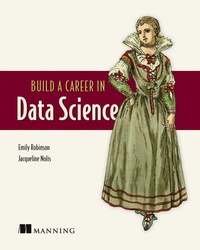
Build a Career in Data Science
1st Edition
Published on 6. March 2020
354 pages
978-1-63835-015-6 (ISBN)
Description

Summary
You are going to need more than technical knowledge to succeed as a data scientist. Build a Career in Data Science teaches you what school leaves out, from how to land your first job to the lifecycle of a data science project, and even how to become a manager.
Purchase of the print book includes a free eBook in PDF, Kindle, and ePub formats from Manning Publications.
About the technology
What are the keys to a data scientist's long-term success? Blending your technical know-how with the right "soft skills" turns out to be a central ingredient of a rewarding career.
About the book
Build a Career in Data Science is your guide to landing your first data science job and developing into a valued senior employee. By following clear and simple instructions, you'll learn to craft an amazing resume and ace your interviews. In this demanding, rapidly changing field, it can be challenging to keep projects on track, adapt to company needs, and manage tricky stakeholders. You'll love the insights on how to handle expectations, deal with failures, and plan your career path in the stories from seasoned data scientists included in the book.
What's inside
Creating a portfolio of data science projects
Assessing and negotiating an offer
Leaving gracefully and moving up the ladder
Interviews with professional data scientists
About the reader
For readers who want to begin or advance a data science career.
About the author
Emily Robinson is a data scientist at Warby Parker. Jacqueline Nolis is a data science consultant and mentor.
Table of Contents:
PART 1 - GETTING STARTED WITH DATA SCIENCE
1. What is data science?
2. Data science companies
3. Getting the skills
4. Building a portfolio
PART 2 - FINDING YOUR DATA SCIENCE JOB
5. The search: Identifying the right job for you
6. The application: Résumés and cover letters
7. The interview: What to expect and how to handle it
8. The offer: Knowing what to accept
PART 3 - SETTLING INTO DATA SCIENCE
9. The first months on the job
10. Making an effective analysis
11. Deploying a model into production
12. Working with stakeholders
PART 4 - GROWING IN YOUR DATA SCIENCE ROLE
13. When your data science project fails
14. Joining the data science community
15. Leaving your job gracefully
16. Moving up the ladder
You are going to need more than technical knowledge to succeed as a data scientist. Build a Career in Data Science teaches you what school leaves out, from how to land your first job to the lifecycle of a data science project, and even how to become a manager.
Purchase of the print book includes a free eBook in PDF, Kindle, and ePub formats from Manning Publications.
About the technology
What are the keys to a data scientist's long-term success? Blending your technical know-how with the right "soft skills" turns out to be a central ingredient of a rewarding career.
About the book
Build a Career in Data Science is your guide to landing your first data science job and developing into a valued senior employee. By following clear and simple instructions, you'll learn to craft an amazing resume and ace your interviews. In this demanding, rapidly changing field, it can be challenging to keep projects on track, adapt to company needs, and manage tricky stakeholders. You'll love the insights on how to handle expectations, deal with failures, and plan your career path in the stories from seasoned data scientists included in the book.
What's inside
Creating a portfolio of data science projects
Assessing and negotiating an offer
Leaving gracefully and moving up the ladder
Interviews with professional data scientists
About the reader
For readers who want to begin or advance a data science career.
About the author
Emily Robinson is a data scientist at Warby Parker. Jacqueline Nolis is a data science consultant and mentor.
Table of Contents:
PART 1 - GETTING STARTED WITH DATA SCIENCE
1. What is data science?
2. Data science companies
3. Getting the skills
4. Building a portfolio
PART 2 - FINDING YOUR DATA SCIENCE JOB
5. The search: Identifying the right job for you
6. The application: Résumés and cover letters
7. The interview: What to expect and how to handle it
8. The offer: Knowing what to accept
PART 3 - SETTLING INTO DATA SCIENCE
9. The first months on the job
10. Making an effective analysis
11. Deploying a model into production
12. Working with stakeholders
PART 4 - GROWING IN YOUR DATA SCIENCE ROLE
13. When your data science project fails
14. Joining the data science community
15. Leaving your job gracefully
16. Moving up the ladder
More details
Other editions
Additional editions
Emily Robinson | Jacqueline Nolis
Build A Career in Data Science
Book
06/2020
Manning Publications
€37.50
Shipment within 10-20 days
Persons
Emily Robinson is a data scientist at Warby Parker. Jacqueline Nolis is a data science consultant and mentor.
Content
- Intro
- Copyright
- Brief Table of Contents
- Table of Contents
- Preface
- Acknowledgments
- About This Book
- About the Authors
- About the Cover Illustration
- Part 1. Getting started with data science
- Chapter 1. What is data science?
- 1.1. What is data science?
- 1.2. Different types of data science jobs
- 1.3. Choosing your path
- 1.4. Interview with Robert Chang, data scientist at Airbnb
- Summary
- Chapter 2. Data science companies
- 2.1. MTC: Massive Tech Company
- 2.2. HandbagLOVE: The established retailer
- 2.3. Seg-Metra: The early-stage startup
- 2.4. Videory: The late-stage, successful tech startup
- 2.5. Global Aerospace Dynamics: The giant government contractor
- 2.6. Putting it all together
- 2.7. Interview with Randy Au, quantitative user experience researcher at Google
- Summary
- Chapter 3. Getting the skills
- 3.1. Earning a data science degree
- 3.2. Going through a bootcamp
- 3.3. Getting data science work within your company
- 3.4. Teaching yourself
- 3.5. Making the choice
- 3.6. Interview with Julia Silge, data scientist and software engineer at RStudio
- Summary
- Chapter 4. Building a portfolio
- 4.1. Creating a project
- 4.2. Starting a blog
- 4.3. Working on example projects
- 4.4. Interview with David Robinson, data scientist
- Summary
- Chapters 1-4 resources
- Part 2. Finding your data science job
- Chapter 5. The search: Identifying the right job for you
- 5.1. Finding jobs
- 5.2. Deciding which jobs to apply for
- 5.3. Interview with Jesse Mostipak, developer advocate at Kaggle
- Summary
- Chapter 6. The application: Résumés and cover letters
- 6.1. Résumé: The basics
- 6.2. Cover letters: The basics
- 6.3. Tailoring
- 6.4. Referrals
- 6.5. Interview with Kristen Kehrer, data science instructor and course creator
- Summary
- Chapter 7. The interview: What to expect and how to handle it
- 7.1. What do companies want?
- 7.2. Step 1: The initial phone screen interview
- 7.3. Step 2: The on-site interview
- 7.4. Step 3: The case study
- 7.5. Step 4: The final interview
- 7.6. The offer
- 7.7. Interview with Ryan Williams, senior decision scientist at Starbucks
- Summary
- Chapter 8. The offer: Knowing what to accept
- 8.1. The process
- 8.2. Receiving the offer
- 8.3. Negotiation
- 8.4. Negotiation tactics
- 8.5. How to choose between two "good" job offers
- 8.6. Interview with Brooke Watson Madubuonwu, senior data scientist at the ACLU
- Summary
- Chapter 5-8 resources
- Part 3. Settling into data science
- Chapter 9. The first months on the job
- 9.1. The first month
- 9.2. Becoming productive
- 9.3. If you're the first data scientist
- 9.4. When the job isn't what was promised
- 9.5. Interview with Jarvis Miller, data scientist at Spotify
- Summary
- Chapter 10. Making an effective analysis
- 10.1. The request
- 10.2. The analysis plan
- 10.3. Doing the analysis
- 10.4. Wrapping it up
- 10.5. Interview with Hilary Parker, data scientist at Stitch Fix
- Summary
- Chapter 11. Deploying a model into production
- 11.1. What is deploying to production, anyway?
- 11.2. Making the production system
- 11.3. Keeping the system running
- 11.4. Wrapping up
- 11.5. Interview with Heather Nolis, machine learning engineer at T-Mobile
- Summary
- Chapter 12. Working with stakeholders
- 12.1. Types of stakeholders
- 12.2. Working with stakeholders
- 12.3. Prioritizing work
- 12.4. Concluding remarks
- 12.5. Interview with Sade Snowden-Akintunde, data scientist at Etsy
- Summary
- Chapters 9-12 resources
- Part 4. Growing in your data science role
- Chapter 13. When your data science project fails
- 13.1. Why data science projects fail
- 13.2. Managing risk
- 13.3. What you can do when your projects fail
- 13.4. Interview with Michelle Keim, head of data science and machine le- earning at Pluralsight
- Summary
- Chapter 14. Joining the data science community
- 14.1. Growing your portfolio
- 14.2. Attending conferences
- 14.3. Giving talks
- 14.4. Contributing to open source
- 14.5. Recognizing and avoiding burnout
- 14.6. Interview with Renee Teate, director of data science at HelioCampus
- Summary
- Chapter 15. Leaving your job gracefully
- 15.1. Deciding to leave
- 15.2. How the job search differs after your first job
- 15.3. Finding a new job while employed
- 15.4. Giving notice
- 15.5. Interview with Amanda Casari, engineering manager at Google
- Summary
- Chapter 16. Moving up the ladder
- 16.1. The management track
- 16.2. Principal data scientist track
- 16.3. Switching to independent consulting
- 16.4. Choosing your path
- 16.5. Interview with Angela Bassa, head of data science, data engineeri- ing, and machine learning at iRobot
- Summary
- Chapters 13-16 resources
- Blogs
- Epilogue
- Appendix. Interview questions
- A.1. Coding and software development
- A.2. SQL and databases
- A.3. Statistics and machine learning
- A.4. Behavioral
- A.5. Brain teasers
- Index
- List of Figures
- List of Tables
