

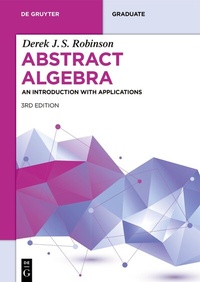
Abstract Algebra
Description

This is a high level introduction to abstract algebra which is aimed at readers whose interests lie in mathematics and the information and physical sciences. In addition to introducing the main concepts of modern algebra - groups, rings, modules and fields - the book contains numerous applications, which are intended to illustrate the concepts and to show the utility and relevance of algebra today. In particular applications to Polya coloring theory, latin squares, Steiner systems, error correcting codes and economics are described. There is ample material here for a two semester course in abstract algebra. Proofs of almost all results are given. The reader led through the proofs in gentle stages. There are more than 500 problems, of varying degrees of diffi culty. The book should be suitable for advanced undergraduate students in their fi nal year of study and for fi rst or second year graduate students at a university in Europe or North America. In this third edition three new chapters have been added: an introduction to the representation theory of fi nite groups, free groups and presentations of groups, an introduction to category theory.
Reviews / Votes
"Altogether, this book represents a very gentle, user-friendly and skillful introduction to undergraduate abstract algebra for students in various fields of science. [...] a very experienced teacher has here presented a valuable introductory text on abstract algebra that can universally be used as a source for a one or two semester course on the subject for students in their second or third year of study: Without any doubt, this text is also very suitable for private study and exam preparation of undergraduates." Werner Kleinert in: Zentralblatt MATH 2003/10
***
"Robinson's textbook Abstract Algebra: an introduction with applications is an abstract algebra textbook written for advanced undergraduates and beginning graduate students. The book covers all of the standard topics that one expects such a book to cover (groups, rings, modules, tensor products, fields, Galois theory), as well as a number of interesting applications (the Polya enumeration theorem, latin squares, error correcting codes, as well as an interesting and far less standard application to algebraic models of accounting systems)." Benjamin Linowitz in: MAA, https://www.maa.org/press/maa-reviews/abstract-algebra-an-introduction-with-applications-0 (03.06.2022)
More details
Other editions
Additional editions

Previous edition
Person
Content
- Intro
- Preface
- Contents
- List of symbols
- 1 Sets, Relations and Functions
- 2 The Integers
- 3 Introduction to Groups
- 4 Quotient groups and Homomorphisms
- 5 Groups Acting on Sets
- 6 Introduction to rings
- 7 Division in Commutative Rings
- 8 Vector Spaces
- 9 Introduction to Modules
- 10 The Structure of Groups
- 11 The Theory of Fields
- 12 Galois Theory
- 13 Tensor Products
- 14 Representations of groups
- 15 Presentations of groups
- 16 Introduction to category theory
- 17 Applications
- Bibliography
- Index
