

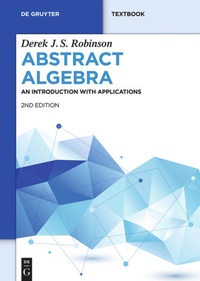
Abstract Algebra
Description

This is a high level introduction to abstract algebra which is aimed at readers whose interests lie in mathematics and in the information and physical sciences. In addition to introducing the main concepts of modern algebra, the book contains numerous applications, which are intended to illustrate the concepts and to convince the reader of the utility and relevance of algebra today. In particular applications to Polya coloring theory, latin squares, Steiner systems and error correcting codes are described. Another feature of the book is that group theory and ring theory are carried further than is often done at this level. There is ample material here for a two semester course in abstract algebra.
The importance of proof is stressed and rigorous proofs of almost all results are given. But care has been taken to lead the reader through the proofs by gentle stages. There are nearly 400 problems, of varying degrees of difficulty, to test the reader's skill and progress. The book should be suitable for students in the third or fourth year of study at a North American university or in the second or third year at a university in Europe, and should ease the transition to (post)graduate studies.
Reviews / Votes
"Altogether, this book represents a very gentle, user-friendly and skillful introduction to undergraduate abstract algebra for students in various fields of science. [...] a very experienced teacher has here presented a valuable introductory text on abstract algebra that can universally be used as a source for a one or two semester course on the subject for students in their second or third year of study: Without any doubt, this text is also very suitable for private study and exam preparation of undergraduates."Werner Kleinert in: Zentralblatt MATH 10/2003More details
Other editions
Additional editions
Previous edition
Person
Content
- Intro
- Preface
- 1 Sets, relations and functions
- 1.1 Sets and subsets
- 1.2 Relations, equivalence relations, partial orders
- 1.3 Functions
- 1.4 Cardinality
- 2 The integers
- 2.1 Well-ordering and mathematical induction
- 2.2 Division in the integers
- 2.3 Congruences
- 3 Introduction to groups
- 3.1 Permutations
- 3.2 Semigroups, monoids and groups
- 3.3 Groups and subgroups
- 4 Quotient groups and homomorphisms
- 4.1 Cosets and Lagrange's Theorem
- 4.2 Normal subgroups and quotient groups
- 4.3 Homomorphisms
- 5 Groups acting on sets
- 5.1 Group actions
- 5.2 Orbits and stabilizers
- 5.3 Applications to the structure of groups
- 5.4 Applications to combinatorics
- 6 Introduction to rings
- 6.1 Elementary properties of rings
- 6.2 Subrings and ideals
- 6.3 Integral domains, division rings and fields
- 6.4 Finiteness conditions on ideals
- 7 Division in commutative rings
- 7.1 Euclidean domains
- 7.2 Principal ideal domains
- 7.3 Unique factorization in integral domains
- 7.4 Roots of polynomials and splitting fields
- 8 Vector spaces
- 8.1 Vector spaces and subspaces
- 8.2 Linear independence, basis and dimension
- 8.3 Linear mappings
- 8.4 Eigenvalues and eigenvectors
- 9 Introduction to modules
- 9.1 Elements of module theory
- 9.2 Modules over principal ideal domains
- 9.3 Applications to linear operators
- 10 The Structure of groups
- 10.1 The Jordan-Hölder Theorem
- 10.2 Solvable and nilpotent groups
- 10.3 Theorems on finite solvable groups
- 11 The Theory of fields
- 11.1 Field extensions
- 11.2 Constructions with ruler and compass
- 11.3 Finite fields
- 11.4 Latin squares and Steiner triple systems
- 12 Galois Theory
- 12.1 Normal and separable extensions
- 12.2 Automorphisms of field extensions
- 12.3 The Fundamental Theorem of Galois theory
- 12.4 Solvability of equations by radicals
- 13 Tensor products
- 13.1 Definition of the tensor product
- 13.2 Properties of tensor products.
- 13.3 Extending the ring of operators.
- 14 Further topics
- 14.1 Zorn's Lemma with applications
- 14.2 Roots of polynomials and discriminants
- 14.3 Presentations of groups
- 14.4 Introduction to error correcting codes
- Bibliography
- List of symbols
- Index
