

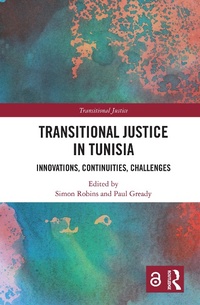
Transitional Justice in Tunisia
Innovations, Continuities, Challenges
1st Edition
Published on 15. July 2022
294 pages
978-1-000-61092-5 (ISBN)
Description

This book engages comprehensively with the dynamics of the transitional justice process in Tunisia and its mechanisms, elaborating lessons for transitional justice practice globally.
Grounded in new empirical material as well as a broader awareness of transitional justice, this book provides a thorough assessment of transitional justice in Tunisia. Beyond an overview of the process, it critically engages with key questions such as the extent to which the process articulated global contemporary practice, such as liberal state-building and narrow conceptions of justice as civil-political rights, and to which it generated novel approaches at odds with the mainstream that can inform global practice. The book examines how the transitional justice process in Tunisia has been contextualised and made relevant to the nation's circumstances and needs. It looks at innovation at the level of formal mechanisms and at the dynamics of mobilisation and contestation surrounding transitional justice both from civil society organisations and victims' groups. Bringing together analysis from legal scholars, social scientists as well as activists and practitioners, the book challenges the legalism of transitional justice discourse globally, engendering a dialogue between these legal and judicial approaches on the one hand and alternative, more diverse and radical approaches to justice on the other, in order to both deal with the past and to address ongoing injustice.
This first book in English to address the dynamics and mechanisms of the transitional justice process in Tunisia will appeal to students and scholars of transitional justice, human rights, peacebuilding, conflict and peace studies, development, and security studies, as well as policymakers and practitioners in these fields, and others with interests in Middle Eastern studies.
Grounded in new empirical material as well as a broader awareness of transitional justice, this book provides a thorough assessment of transitional justice in Tunisia. Beyond an overview of the process, it critically engages with key questions such as the extent to which the process articulated global contemporary practice, such as liberal state-building and narrow conceptions of justice as civil-political rights, and to which it generated novel approaches at odds with the mainstream that can inform global practice. The book examines how the transitional justice process in Tunisia has been contextualised and made relevant to the nation's circumstances and needs. It looks at innovation at the level of formal mechanisms and at the dynamics of mobilisation and contestation surrounding transitional justice both from civil society organisations and victims' groups. Bringing together analysis from legal scholars, social scientists as well as activists and practitioners, the book challenges the legalism of transitional justice discourse globally, engendering a dialogue between these legal and judicial approaches on the one hand and alternative, more diverse and radical approaches to justice on the other, in order to both deal with the past and to address ongoing injustice.
This first book in English to address the dynamics and mechanisms of the transitional justice process in Tunisia will appeal to students and scholars of transitional justice, human rights, peacebuilding, conflict and peace studies, development, and security studies, as well as policymakers and practitioners in these fields, and others with interests in Middle Eastern studies.
Reviews / Votes
"From my position as head of the Women's Commission of the IVD I have worked within the transitional justice process as well as collaborating with academics - including the editors of this volume - in collaborative research. This volume represents a critical reading of transitional justice in Tunisia, including valuable engagements with both formal mechanisms and with those working as a part of civil society, social movements and communities to advance justice. Tunisia illustrates both the huge challenges of delivering on the promise of transitional justice, and that innovation continues at both formal and informal levels." Ibtihel Abdellatif, Ex-Chair of the Women's Commission of the Instance Verite et Dignite"This is an excellent and critical addition to the literature on transitional justice. Using Tunisia as a case study, a mix of academic and practitioner authors are able to evaluate the successes and failures of transitional justice after a major political transition. The ethical and practical difficulties faced by institutions and citizens in Tunisia offer lessons to other contexts undergoing or contemplating change. What becomes clear in this volume is that transitional justice experiences are dynamic, have winners and losers, and have unanticipated outcomes. This work is highly recommended. Robins and Gready have been at the forefront of our understanding of the opportunities and limits of transitional justice, and this book pushes debates forward." Roger Mac Ginty, Professor in Defence, Development and Diplomacy in the School of Government and International Affairs, University of Durham, UK
"Tunisia's process to deal with its past has been as turbulent as the country's transition. This volume brings together academics and practitioners who extensively highlight the intricacies of this process and thoroughly analyse them. It is essential and timely reading for anyone studying Tunisia's contemporary history or seeking to draw lessons from its transitional justice efforts." Habib Nassar, Director of Policy and Research, Impunity Watch
More details
Series
Edition
1. Auflage
Language
English
Place of publication
London
United Kingdom
Publishing group
Taylor & Francis Ltd
Target group
College/higher education
ISBN-13
978-1-000-61092-5 (9781000610925)
Copyright in bibliographic data and cover images is held by Nielsen Book Services Limited or by the publishers or by their respective licensors: all rights reserved.
Schweitzer Classification
Other editions
Additional editions
Book
01/2024
1st Edition
Routledge
€65.70
Shipment within 10-20 days
Book
07/2022
1st Edition
Routledge
€206.80
Shipment within 10-20 days
Persons
Simon Robins is Senior Research Fellow at the Centre for Applied Human Rights (CAHR), University of York, UK.
Paul Gready is Professor of Applied Human Rights and Director of the Centre for Applied Human Rights (CAHR), University of York, UK.
Paul Gready is Professor of Applied Human Rights and Director of the Centre for Applied Human Rights (CAHR), University of York, UK.
Content
I. Informal mechanisms 1. Victim participation in a politicised process: The Karama victims' association and the search for justice in transitional Tunisia Simon Robins and Houcine Bouchiba 2. Breaking the racial taboo: Black Tunisian activism as transitional justice Houda Mzioudet 3. From the Streets Up: Youth Leadership of Informal Processes to Transitional Justice in Tunisia Lawrence Robinson 4. Transitional Justice, Contentious Politics, and the Struggle for the Right to Work Saerom Han 5. Making and remaking the past in post-revolutionary Tunisia: The uses of history in Transitional Justice Simon Robins, Kora Andrieu, Ahmed Aloui, Wahid Ferchichi and Hajer Ben Hamza II. Formal mechanisms 6. The Politics of Technical Assistance: International involvement in Tunisia's Transitional Justice process Alicia Pastor y Camarasa 7. Overlooking women's lived realities: How Tunisia's Truth & Dignity Commission dealt with the hijab ban Tine Destrooper and Safa Belghith 8. The private sector and the Anticorruption Discourse in the Tunisian Transition: Carthage was not destroyed Taygeti Michalakea 9. Transitional Justice in Tunisia and Colonial Legacy Elham Kazemi 10. Reparations in post-revolution Tunisia: At the Intersection of Innovation and Politicisation Simeon Gready 11. Conclusions: Learning from the Tunisian experience Simon Robins and Tine Destrooper
