

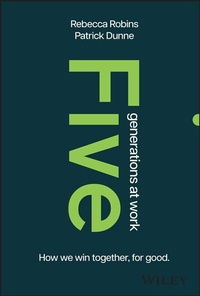
Five Generations at Work
Description

The definitive playbook for empowering intergenerational collaboration, innovation and productivity at work.
Five Generations at Work: How we win together, for good explores how to maximise the dynamics of our generational diversity to create more collaborative and competitive organisations. An energising and pragmatic read, this book unpacks six years of research and work with organisations and individuals who are taking progressive action to lead from lenses versus labels, evidencing the value of generational diversity.
For the first time in history, we have up to five generations at work. In the context of a world in flux and polycrisis, our diversity is a powerful force multiplier for good, if we debunk the stereotypes and know how to unlock it.
Get inspired by exclusive case studies and conversations written through the voices of five generations and four continents across global corporates, family businesses, education and foundations, including: Ahlström I The EY Foundation I The Financial Times I Hoffmann-La Roche I Imaginable Futures I LVMH I Liberty Global I MARS I Mission 44 I The Oxford Character Project I St Gallen Symposium I The UNDP and Samsung and more ...!
- Borrow and build on inspiring work from intergenerational alliances and intrapreneurs, to next generations and future generations
- Learn from case studies and solutions across diverse business contexts
- Apply the mindset, skillset and toolkits from work delivering shared value and sustainable impact
Five Generations at Work: How we win together, for good is a transformative read for all business leaders, people leaders and CEOs. Importantly, it stands out because it was written for every generation - for students, first career movers, founders, managers, leaders and board members. Above all, this book is a call to action to us all. When humanity is being challenged by the forces upon us, from climate, to geopolitics, to technology, we need to draw on the strengths of every generation for sustainable and systemic change for good.
More details
Other editions
Additional editions
Persons
Rebecca Robins is a leading advisor, changemaker and expert on brand leadership and intergenerational collaboration. She has over 20 years' experience across the world, with businesses such as Burberry, Hugo Boss, LEGO, LVMH, and founders and family businesses. This is her third book, including the best-selling Meta-luxury: Brands and the Culture of Excellence. Her transformative work on culture, change and the five-generation workplace has led to her collaboration with programmes at CISL, Oxford University and The St Gallen Symposium. Education is at the heart of Rebecca's non-profit and wider commitments, including on the advisories of The Chartered Management Institute, a leading AI for good company, and serving as Board Trustee of The EY Foundation. Rebecca holds two degrees from Cambridge University.
Patrick Dunne OBE is an experienced Chair, serial social entrepreneur, author of the award winning book Boards and a leading expert and advisor on boards and governance. His executive experience was with Air Products and FTSE 100 private equity business 3i Group plc where he held a variety of senior roles including Communications Director and a member of its Operating Committee. He is Chair of the charities The Royal Voluntary Service and ESSA-Education Sub Saharan Africa, a Visiting Professor at Cranfield University, and an Associate Fellow at Warwick Business School.
Content
Preface xi
Dear Reader 1
1 Introduction & Call to Action 3
2 Defining Our Generations 15
3 Intergenerational Working 35
4 The Intrapreneurial Mindset 59
5 Family Businesses 79
6 Next Generation Boards 125
7 Intergenerational Alliances 171
8 Generations Future 215
Coda & Call to Action 235
With Gratitude 239
Sources & Notes 241
Bibliography 247
Index by Industry & by A-Z 251
1
Introduction & Call to Action
The rise of five generations in the workplace is intersecting with the rise of exponential change. With the global advance of an ageing population, our workforces are operating across Silents, Boomers, Gen X, Millennials and Gen Z, with the advent of Gen Alpha on the horizon. What is striking is the simultaneous convergence and divergence - the convergence in the unprecedented moment of age diversity at work, and the divergence in the fractures and fragmentation exacerbated by the context of our times. In an age of flux, or as some have termed a 'polycrisis', the forces are being felt from the outfall of a pandemic to socio-political turbulence, from generative AI to the need to regenerate the planet. These multiple forces are rapidly changing the world of work, from the types of roles and shapes of our careers to the way in which we work together. Consequently, the knowledge, skills and behaviours needed to succeed are changing at a similar rate.
Yet the prevailing discourse on how different generations work together has defaulted into divisive generational silos and stereotypes. In the context of so much flux, and when it has never been more imperative to work together, we not only have a necessity to change this, but more importantly to transform it into a hopeful opportunity. For the first time in history companies have five generations in the workplace. And each generation has its own defining characteristics, values and attitudes shaped by the culture, technology and formative events of their time. In parallel, the pace of change in the workplace is accelerating, requiring adaptability from us all. As a consequence, the skills and behaviours necessary for how we win together are evolving. In valuing the human difference of each generation, we can rethink the dynamics of different generations as contributing to more connected, collaborative, and competitive organisations, drawing, rather than draining strength from multiple generations.
The indicators from leading global reports on the current and future state of generations, leadership and skills point consistently to the imperative of collaboration. Deloitte reports that only 6% of organizations believe their leaders understand how to effectively manage generational differences.1 The value that effective multigenerational workforces can create across their talents, improving continuity and stability, assisting with the retention of critical skills and knowledge and a significant competitive advantage is further evidenced by The World Economic Forum (WEF) in How a Multigenerational Workforce Is Key to Economic Growth.2 This also cites research on the age-inclusive workforce by the Organisation for Economic Co-operation and Development (OECD)3: "Diversity of experience, generations and skills gives employers an important opportunity to harness the talent that different age groups bring to the workplace and improve productivity and profitability."
Through a series of waves of research and our work over the past six years, we have amassed a global body of work and database on businesses, organisations and institutions who see generational diversity as a strength and are taking progressive action across generations. Underlying our research and this growing body of evidence is a consensus that we all, as individuals, collectives and organisations, have a greater capacity to thrive when we choose to turn generational labels into generational lenses, which are about learning from and with each other.
This is about breaking down silos and misperceptions on all aspects of generational equations. To do that, it will require unlearning of behaviours, it will need more empathy and understanding. The lazy discourse around generational differences has lost sight of the reality and recognition that there is value in the perspectives and experience of each generation, where no single generation has the prevailing monopoly.
With the fracturing of trust in institutions the world over, brands are stepping into the void, in some respects, in the mind of global consumers. There has never been a time for brands to establish more conscious and responsible roles, in business, and society and to demonstrate real progress from stated ambitions in diversity, ethics and sustainability, to systemic outcomes. Spanning intergenerational alliances, family businesses, next generation boards, intrapreneur platforms and deep commitments into future generations, this book demonstrates collaborative constructs that run counter to the divisive discourse that we seek to dismantle, exposing the counterpoint of generational tensions, with the urgency to regenerate - across business, society and the planet.
"We live in an age of classification and I am not sure it's helping any of us."
Alex Mahon, Chief Executive of Channel 4
FROM LABELS TO LENSES
Ironically, in the context of so much tension-laden debate around generations, there is no standard determination of how we define a generation. "As it stands, there is no official taxonomy or oversight committee who decide when a new generation starts or ends, or what to name it. Although these labels often evolve organically through popular media and public discourse, many originate from the Pew Research Center, a US Think Tank."4
This naming and labelling is linked to our behavioural wiring to seek meaning in types and stereotypes. As Alex Mahon, Chief Executive of Channel 4 states in Channel 4's 2023 Beyond Z report: "We live in an age of classification and I am not sure it's helping any of us." A defining factor of our research and so many of the collectives that we talk with is the breaking of types, the challenging of so-called norms and an approach to measurement that is inherently more balanced and linked more to collective outcomes.
We set out the business logic for investing across the multigenerational workplace, as evidenced through our research across industries and global markets, with leading global brands, SMEs, founder and family businesses, institutions and non-profits. The structures on which many organisations have been established were forged in a different age, and not all are fit for purpose across the five generational workplace. Others have sprinted ahead and evolved more organically to embrace generational diversity and difference as both a more natural modus operandi and a distinct competitive advantage. In conversation across generations and across the world, we hear from five generations across students, first careers, mid careers, managers, leaders, owners, board members and wider partners.
MUTUAL LEARNING: BUILDING THE MINDSET AND MUSCLE OF LEADERSHIP
What we need are tomorrow's regenerative leaders - today. The stark reality is that we will miss the critical mass that we need unless we engage with this transitional era, in diversifying the pipeline of talent, and crucially, in building the mindset, skillset and toolkit. As The London Interdisciplinary School argues: "The problems facing humanity are more complex, interconnected, and urgent than ever before. The modern workplace needs people who can tackle these kinds of issues and make a real impact on the world."5 The London Interdisciplinary School in the UK is amongst others across the world pioneering a new approach to higher education, where the curriculum is grounded not in subject matter verticals, but in the horizontal and zigzag connections of interdisciplinary thinking. As we shall go on to reinforce, the best working practice that we evidence is about shared value and outcomes - within and across generations. The skills required will converge around collaboration in new and deeper forms, around how to manage ambiguity and uncertainty, and, perhaps, one of the most important, yet underestimated skills - the ability to keep learning.
The shape and trajectory of careers are evolving and will change at an extraordinary pace, as are the skills needed to move with the pace of change, where singular disciplines of careers are becoming more multidisciplinary, where the linear verticals of career pathways are more fluid and cross-fertile. Putting a value on breadth and diversity of experience, and space for lateral exploration on our career paths, is the focus of David Epstein's prescient book: Range: How Generalists Triumph in a Specialized World. As the future of work is changing, and with it the shape of roles and the skills that we need, we must continue to adapt. The question is - are generations learning from each other, and are they working together effectively by putting their strengths to work? The cases that we share in the book are living examples of practical commitments to cultures of collaboration and lifelong learning.
One of the unintended consequences of change programmes or of ambitions to advance strategic agendas at work, has proven to be the tipping point of "project" or 'initiative' overload. Amongst that body of indicators, a survey by Gartner evidenced a steady decrease and drop in employee engagement with change initiatives in their organisations - from 74% in 2016 to 43% in 2022.6
This context is important for two reasons. First because the body of work that we share runs counter to this, defined by commitments that hardwire to business strategy, by doing fewer things well...
