

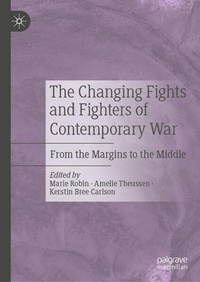
The Changing Fights and Fighters of Contemporary War
Description

This interdisciplinary volume examines how movement between the margins and mainstream of warfare is impacting contemporary conflict. Actors, battlefields, and practices traditionally considered within the margins of war - such as propagandists, and private companies - have increasingly found themselves at the centre of conflicts, while traditional practices, actors, and locations of war - such as geographically bounded battlefields and uniform clad soldiers engaging their enemy in direct battle - have become increasingly marginalized. Anchored in the war studies tradition with its prudent, multidisciplinary approach, this volume offers a fresh conceptual frame for an overdue investigation into how the changing practices in contemporary wars permit us to reevaluate our understandings of fighters and battlefields.
Reviews / Votes
"This book explores the multifaceted, complex, and fluid relationship between the margins and the centre of warfare, questioning enduring assumptions in the study of war-particularly the primacy of the centre over the periphery. By reinterpreting classical and emerging themes such as proxy war, cyber operations, peacemaking, and military organisations through the lens of margin-centre interactions, the book offers fresh and original perspectives on longstanding debates. This volume is of particular interest to scholars and practitioners engaged in the study of war, peace, security, and conflict." (Chiara Ruffa, professor of political science at Sciences Po, France)
"This collection of essays reconceptualises an old debate in a new form. Rather than agonise over the distinction between war's nature and its character, it sees war in terms of the relationship between combat - the 'middle' - and its periphery. The latter can shape war decisively from the outside, just as much as the former can spread outwards in unforgiving and surprising ways. The result is a host of fresh perspectives designed to stimulate innovative thinking in challenging times." (Prof Sir Hew Strachan, Professor of International Relations, University St. Andrews)
More details
Other editions
Additional editions
Persons
Marie Robin is Assistant Professor at the Institute of Security and Global Affairs (ISGA), Leiden University (The Netherlands), researching revenge in conflicts, disinformation/propaganda, and the ethics of war.
Amelie Theussen is Associate Professor at the Royal Danish Defence College, researching the changing character of war and Arctic and Baltic Sea security.
Kerstin Bree Carlson is Associate Professor in Law and Society at Roskilde University (Denmark) and The American University of Paris researching terror law and transitional justice.
Content
Chapter 1: Introduction: From Margins to Middle: Introducing Movement in Our Understanding of Wars.- Chapter 2: Not to Confuse Ourselves: The Changing Character of War and Conceptual Change.- Chapter 3: 'Pulling the Strings: Why are Proxy Wars back from the Margins.- Chapter 4: From Lines to Layers: Redrawing the Middle and Margins of the Battlefield.- Chapter 5: The Middle-Ground Amidst Great (Cyber) Power Competition: From Pawns to Kingmakers?.- Chapter 6: Peacemaking from the Peripheries: Lessons from the Women of Sudan on Informal Pathways to Peace.- Chapter 7: Fighting like a Propagandist? How Al Qaeda and the Islamic State Conceptualize their Battlefield.- Chapter 8: Politics of Exclusion in Military Organizations: The Institutional Position of RPA Pilots.- Chapter 9: Explaining European Military Engagement in the Fight Against Daesh.- Chapter 10: Transitional Justice for European Foreign Fighters? What Colombia's Transitional Justice Mechanism (JEP) Teaches.- Chapter 11: Conclusion: Applying the Middle/Margins Model to International Law and the Rules-Based International Order.
