

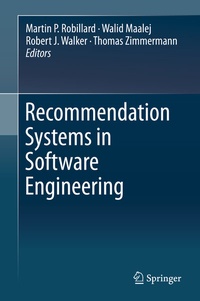
Recommendation Systems in Software Engineering
Description

With the growth of public and private data stores and the emergence of off-the-shelf data-mining technology, recommendation systems have emerged that specifically address the unique challenges of navigating and interpreting software engineering data.
This book collects, structures and formalizes knowledge on recommendation systems in software engineering. It adopts a pragmatic approach with an explicit focus on system design, implementation, and evaluation. The book is divided into three parts: "Part I - Techniques" introduces basics for building recommenders in software engineering, including techniques for collecting and processing software engineering data, but also for presenting recommendations to users as part of their workflow. "Part II - Evaluation" summarizes methods and experimental designs for evaluating recommendations in software engineering. "Part III - Applications" describes needs, issues and solution concepts involved in entire recommendation systems for specific software engineering tasks, focusing on the engineering insights required to make effective recommendations. The book is complemented by the webpage rsse.org/book, which includes free supplemental materials for readers of this book and anyone interested in recommendation systems in software engineering, including lecture slides, data sets, source code, and an overview of people, groups, papers and tools with regard to recommendation systems in software engineering.
The book is particularly well-suited for graduate students and researchers building new recommendation systems for software engineering applications or in other high-tech fields. It may also serve as the basis for graduate courses on recommendation systems, applied data mining or software engineering. Software engineering practitioners developing recommendation systems or similar applications with predictive functionality will also benefit from the broad spectrum of topics covered.
Reviews / Votes
" The book is a perfect starting point of study for graduate students of software engineering, especially when specializing in recommendation. It is highly recommended also to software professionals seeking to learn what are the possible future directions of their professional field. The book is impressive. [...] I highly recommend this book to software engineering students, professionals, experts, and other interested readers." P. Navrat, ACM Computing Reviews, November 2014More details
Other editions
Additional editions
Persons
Martin P. Robillard is an Associate Professor of Computer Science at McGill University. His current research focuses on problems related to API usability, information discovery and knowledge management in software engineering.
Walid Maalej is a Professor of Informatics at the University of Hamburg. He previously led a research group on human and context factors in software at the TU Munich. His current research interests include the context-aware recommendation systems and social software engineering.
Robert J. Walker is an Associate Professor of Computer Science at the University of Calgary. His current research involves automated analysis and support for unanticipated software reuse tasks.
Thomas Zimmermann is a researcher at Microsoft Research, Adjunct Assistant Professor at the University of Calgary and an affiliate faculty member at the University of Washington. He is best known for his research on systematic mining of version archives and bug databases to conduct empirical studies and to build tools.