

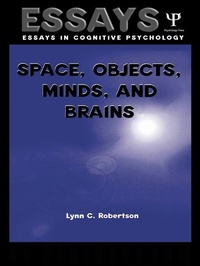
Space, Objects, Minds and Brains
Published on 2. June 2004
320 pages
978-1-135-43325-3 (ISBN)
Description

Lynn Robertson has been studying how brain lesions affect spatial abilities for over 20 years, and her work has revealed some surprising facts about space and its role in visual perception. In this book she combines evidence collected in her laboratory with findings from others to explore the cognitive and neural basis of spatial representations and their contributions to spatial awareness, object formation, attention, and binding.
Reviews / Votes
'The book is a substantive personal achievement and an important scientific contribution. It is also a valuable read for anyone seeking to enhance his ior her knowledge about the nature of visual-spatial perception. ... Space, Objects, Mind and Brains is an ambitious literary undertaking, and the text triggers a spirit of genuine scientific curiosity. Completing the text is a worthy intellectual exercise that ultimately leads to a fuller appreciatioon of the of the complexity and relevance of intact visual-spatial abilities.Students and professionals in neurology, neuropsychology, cognitive psychology, and neuroscience will all appreciate the rigor of Robertson's thinking and the clarity of her writing.' - Treven C. Pickett, in PsycCRITIQUES February 2005More details
Series
Language
English
Place of publication
London
United Kingdom
Publishing group
Taylor & Francis Ltd
Target group
College/higher education
File size
11,16 MB
ISBN-13
978-1-135-43325-3 (9781135433253)
Copyright in bibliographic data and cover images is held by Nielsen Book Services Limited or by the publishers or by their respective licensors: all rights reserved.
Schweitzer Classification
Other editions
Additional editions
Lynn C. Robertson
Space, Objects, Minds and Brains
Book
12/2012
1st Edition
Psychology Press Ltd
€49.50
Shipment within 15-20 days
Lynn C. Robertson
Space, Objects, Minds and Brains
Book
10/2003
1st Edition
Psychology Press Ltd
€208.33
Article not available at the moment
Content
Chapter 1. Losing Space. When There is No 'There' There. When Only Half is There. Not There But There.
Chapter2. Components of Spatial Reference Frames. Origin. Orientation. Sense of Direction. Unit Size. Summary.
Chapter 3. Spatial-based Attention andReference Frames. Selecting Locations. Reference Frames and Spatial Selection in Healthy and Neurological Populations. Spatial Resolution and Reference Frames. Spatial Extent, Spatial Resolution and Attention. What is the Space for Spatial Attention?
Chapter 4.Object-based Attention and Space. Dissociating Object- and Space-based Attention. Controlled Spatial Attention and Object-based Effects. Object-based Neglect. What is an Object for Object-based Attention?
Chapter 5. Spaceand Awareness. RM: Brief History and Spatial Function of a Balints Patient. Explicit Spatial Maps. A Case of Loss of Body Frame of Reference. Implicit Access to Space. 'What' and 'Where' Processing Streams Reconsidered. Many 'Where' Systems. Summary.
Chapter 6. Space and FeatureBinding. The Effect of Occipital-parietal Lesions on Binding. Additional Evidence for Parietal Involvement in Feature Binding. Implicit and Explicit Spaces and Binding. Summary.
Chapter 7. Space, Brains andConsciousness. Lessons from the Study of Spatial Deficits. Parietal Function and Consciousness. Spatial Maps and Conscious Perceptions. Some Final Comments.
Chapter2. Components of Spatial Reference Frames. Origin. Orientation. Sense of Direction. Unit Size. Summary.
Chapter 3. Spatial-based Attention andReference Frames. Selecting Locations. Reference Frames and Spatial Selection in Healthy and Neurological Populations. Spatial Resolution and Reference Frames. Spatial Extent, Spatial Resolution and Attention. What is the Space for Spatial Attention?
Chapter 4.Object-based Attention and Space. Dissociating Object- and Space-based Attention. Controlled Spatial Attention and Object-based Effects. Object-based Neglect. What is an Object for Object-based Attention?
Chapter 5. Spaceand Awareness. RM: Brief History and Spatial Function of a Balints Patient. Explicit Spatial Maps. A Case of Loss of Body Frame of Reference. Implicit Access to Space. 'What' and 'Where' Processing Streams Reconsidered. Many 'Where' Systems. Summary.
Chapter 6. Space and FeatureBinding. The Effect of Occipital-parietal Lesions on Binding. Additional Evidence for Parietal Involvement in Feature Binding. Implicit and Explicit Spaces and Binding. Summary.
Chapter 7. Space, Brains andConsciousness. Lessons from the Study of Spatial Deficits. Parietal Function and Consciousness. Spatial Maps and Conscious Perceptions. Some Final Comments.
