

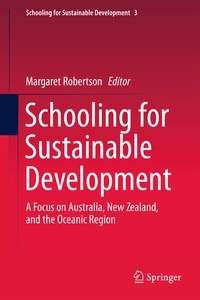
Schooling for Sustainable Development:
Description

"This book Schooling for Sustainable Development: A Focus on Australia, New Zealand and the Oceanic Region , is the product of passionate interests of teachers, scholars and researchers located in diverse parts of the Australasian region. Working with their colleagues within local contexts they have conducted research and gathered together information for practitioners and students interested in learning more about sustainable lifestyle practices. Some of the work has taken place in remote locations and some has been in within the confines of major cities. The Australasian Region brings together people and cultures that link traditional economies to global networks and lifestyles. Diverse terrain, politics and responses typify the region. Close to Asia there are lingering ties with old European ways and cultural beliefs. The major economies of Australia and New Zealand provide the lead with development practices for lesser economies such as Papua New Guinea, Fiji and the many island nations scattered throughout the South Pacific. This complexity is not easily represented. Key issues relate to land ownership, mobilities within the region and the gradual dissemination of knowledge, skills and wealth. The book will provide both reference material and interesting reading for teachers, researchers and practitioners in interested in community based perspectives on sustainability. We have learnt from each other and hope that others will benefit from our efforts."
More details
Other editions
Additional editions
Content
Chapter 1: Introduction and regional overview: Margaret Robertson.- Chapter 2: Sustainability education in classrooms: Developing teacher expertise: Allan Harrison and Ken Purnell.-Chapter 3: Educating for sustainability in New Zealand: Pamela Williams.- Chapter 4: Defining and explaining sustainable development and sustainability: A review of curriculum guides and school texts: Alaric Maude.-Chapter 5: Contradictory practices and geographical imaginaries in the rolling out of education for sustainability in Auckland New Zealand secondary schools: Richard Le Heron, Nick Lewis and Amy Harris.-Chapter 6: Fieldwork, schooling, sustainbility: A Tasmanian case: Robbie Johnston.- Chapter 7: Navigating through new terrain: Pre-service teachers' journeys in teaching "sustainability" : Alison Lugg.- Chapter 8: Indigenous perspectives on sustainable development: Children's views from the "top end": Jenni Webber and Margaret Robertson.- Chapter 9: A sustainability agenda in planning education: Trevor Budge and Andrew Butt.- Chapter 10: Earning a living in Papua New Gunea: From subsistence to a cash economy: George N. Curry, Gina Koczberski, Joachim Lummani, Sean Ryan and Veronica Bue.- Chapter 11: Adapting urban environments to climate change: A case study of Melbourne Australia: Nigel Tapper.- Chapter 12: Spatial models as a hub for sustainability education: Exemplifying the transition from producer to user-defined maps in the classroom: Jim Peterson and Margaret Robertson.- Chapter 13: Concluding comments: Margaret Robertson.
