

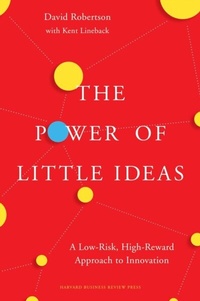
The Power of Little Ideas
Description

The logical and enduring way to innovate.
Conventional wisdom today says that to survive, companies must move beyond incremental, sustaining innovation and invest in some form of radical innovation. "Disrupt yourself or be disrupted!" is the relentless message company leaders hear. The Power of Little Ideas argues there's a "third way" that is neither sustaining nor disruptive. This low-risk, high-reward strategy is an approach to innovation that all company leaders should understand so that they recognize it when their competitors practice it, and apply it when it will give them a competitive advantage.
This distinctive approach has three key elements:
- It consists of creating a family of complementary innovations around a product or service, all of which work together to make that product more appealing and competitive.
- The complementary innovations work together as a system to carry out a single strategy or purpose.
- Crucially, unlike disruptive or radical innovation, innovating around a key product does not change the central product in any fundamental way.
In this powerful, practical book, Wharton professor David Robertson illustrates how many well-known companies, including CarMax, GoPro, LEGO, Gatorade, Disney, USAA, Novo Nordisk, and many others, used this approach to stave off competitive threats and achieve great success. He outlines the organizational practices that unintentionally torpedo this approach to innovation in many companies and shows how organizations can overcome those challenges.
Aimed at leaders seeking strategies for sustained innovation, and at the quickly growing numbers of managers involved with creating new products, The Power of Little Ideas provides a logical, organic, and enduring third way to innovate.
More details
Other editions
Additional editions
Person
David Robertson is a Professor of Practice at the Wharton School at the University of Pennsylvania. From 2002 through 2010, he was the LEGO Professor of Innovation and Technology Management at IMD in Lausanne, Switzerland. Robertson is the host of Innovation Navigation, a weekly radio show and podcast that focuses on the management of innovation. Robertson is the author of Brick by Brick: How LEGO Rewrote the Rules of Innovation and Conquered the Global Toy Industry and coauthor of Enterprise Architecture as Strategy.
Kent Lineback has spent more than twenty-five years as a manager and executive and, before that, several years as a consultant and a creator of management development programs. He has collaborated on several books, including Being the Boss.
Author social media/website info: robertsoninnovation.com; twitter.com/davidcrob; youtube.com/user/RobertsonInnovation; linkedin.com/in/davidchrobertson
Content
- Intro
- Contents
- Preface: Seeing Innovation Differently
- 1. How Little Innovations Produce Big Results
- 2. LEGO and Apple Computer: Masters of the Third Way
- 3. The Four Decisions and Why They're Difficult
- 4. Decision 1: What Is Your Key Product?
- 5. Decision 2: What Is Your Business Promise?
- 6. Decision 3: How Will You Innovate?
- 7. Decision 4: How Will You Deliver Your Innovations?
- 8. Lessons from an American Icon
- Epilogue
- Notes
- Index
- Acknowledgments
- About the Authors
