

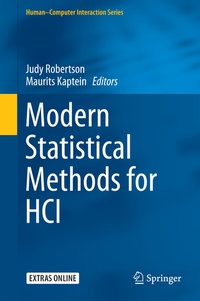
Modern Statistical Methods for HCI
Description

Covering many techniques and approaches for exploratory data analysis including effect and power calculations, experimental design, event history analysis, non-parametric testing and Bayesian inference; the research contained in this book discusses how to communicate statistical results fairly, as well as presenting a general set of recommendations for authors and reviewers to improve the quality of statistical analysis in HCI. Each chapter presents [R] code for running analyses on HCI examples and explains how the results can be interpreted.
Modern Statistical Methods for HCI is aimed at researchers and graduate students who have some knowledge of "traditional" null hypothesis significance testing, but who wish to improve their practice by using techniques which have recently emerged from statistics and relatedfields. This book critically evaluates current practices within the field and supports a less rigid, procedural view of statistics in favour of fair statistical communication.
Reviews / Votes
"The book is structured in five parts and 14 chapters/papers within. Each chapter presents R language codes, and explains the results obtained. . Each chapter presents multiple references and numerical illustrations for practical guide to writing codes in R. . The book can serve to students and practitioners in various fields where applied statistics is used so understanding hypotheses testing is needed for analysis and meaningful decision making." (Stan Lipovetsky, Technometrics, Vol. 59 (2), April, 2017)More details
Other editions
Additional editions
Content
Preface.- An Introduction to Modern Statistical Methods for HCI.- Part I: Getting Started With Data Analysis.- Getting started with [R]: A Brief Introduction.- Descriptive Statistics, Graphs, and Visualization.- Handling Missing Data.- Part II: Classical Null Hypothesis Significance Testing Done Properly.- Effect sizes and Power in HCI.- Using R for Repeated and Time-Series Observations.- Non-Parametric Statistics in Human-Computer Interaction.- Part III : Bayesian Inference.- Bayesian Inference.- Bayesian Testing of Constrained Hypothesis.- Part IV: Advanced Modeling in HCI.- Latent Variable Models.- Using Generalized Linear (Mixed) Models in HCI.- Mixture Models: Latent Profile and Latent Class Analysis.- Part V: Improving Statistical Practice in HCI.- Fair Statistical Communication in HCI.- Improving Statistical Practice in HCI.
