

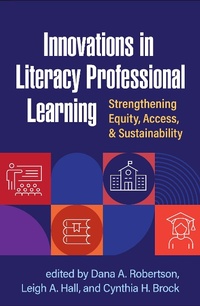
Innovations in Literacy Professional Learning
Strengthening Equity, Access, and Sustainability
Published on 23. January 2023
276 pages
978-1-4625-5132-3 (ISBN)
Description

K-12 literacy leaders, coaches, and specialists; staff developers; school principals; teacher educators and graduate students. May serve as a supplemental text in such courses as Literacy Coaching and Administration and Supervision of Literacy Programs.
More details
Other editions
Additional editions
Dana A. Robertson | Leigh A. Hall | Cynthia H. Brock
Innovations in Literacy Professional Learning
Strengthening Equity, Access, and Sustainability
Book
03/2023
1st Edition
Guilford Press
€42.00
Shipment within 15-20 days
Persons
Dana A. Robertson, EdD, is Associate Professor of Reading and Literacy in the School of Education at Virginia Tech. He is a former elementary classroom teacher, literacy specialist, and literacy coach, and conducts research focused on classroom discourse, reading and writing challenges, and literacy professional learning and whole-school literacy improvement. Prior to coming to Virginia Tech, Dr. Robertson was Executive Director of the Literacy Research Center and Clinic at the University of Wyoming. He was named an Emerging Scholar by the Reading Hall of Fame, is a frequent presenter at national and international conferences, was a collaborating author on the International Literacy Association's Standards for the Preparation of Literacy Professionals (2017), and serves as a board member-at-large for the International Literacy Association. His work has appeared in many journals and books of educational practice and research.
Leigh A. Hall, PhD, is Director of Research at Merlyn Mind in Fort Collins, Colorado, where she focuses on understanding and improving K-12 educators' experiences with AI technology in their classrooms. Previously, she was a Professor at the University of Wyoming, where she held the Wyoming Excellence in Higher Education Endowed Chair in Literacy Education. During her time in Wyoming, she focused on how teachers can work with diverse learners to improve their literacy instruction, and the role that technology can play in enhancing and supporting that instruction. Dr. Hall is a recipient of the Outstanding Dissertation award from the International Literacy Association and the Early Career Achievement Award and Edward B. Fry Book Award from the Literacy Research Association. She has published in leading journals of literacy research and practice.
Cynthia H. Brock, PhD, is Professor at the University of Wyoming, where she holds the Wyoming Excellence in Higher Education Endowed Chair in Literacy Education. Her scholarly research agenda centers on the study of opportunities for learning. Dr. Brock explores the literacy learning opportunities of elementary children from diverse cultural, linguistic, and economic backgrounds; she also explores ways to work with pre- and inservice teachers and administrators to foster children's literacy learning opportunities. She has conducted qualitative research in cross-cultural contexts, including in the United States, Australia, England, Fiji, Thailand, Laos, Spain, Chile, and Costa Rica.
Leigh A. Hall, PhD, is Director of Research at Merlyn Mind in Fort Collins, Colorado, where she focuses on understanding and improving K-12 educators' experiences with AI technology in their classrooms. Previously, she was a Professor at the University of Wyoming, where she held the Wyoming Excellence in Higher Education Endowed Chair in Literacy Education. During her time in Wyoming, she focused on how teachers can work with diverse learners to improve their literacy instruction, and the role that technology can play in enhancing and supporting that instruction. Dr. Hall is a recipient of the Outstanding Dissertation award from the International Literacy Association and the Early Career Achievement Award and Edward B. Fry Book Award from the Literacy Research Association. She has published in leading journals of literacy research and practice.
Cynthia H. Brock, PhD, is Professor at the University of Wyoming, where she holds the Wyoming Excellence in Higher Education Endowed Chair in Literacy Education. Her scholarly research agenda centers on the study of opportunities for learning. Dr. Brock explores the literacy learning opportunities of elementary children from diverse cultural, linguistic, and economic backgrounds; she also explores ways to work with pre- and inservice teachers and administrators to foster children's literacy learning opportunities. She has conducted qualitative research in cross-cultural contexts, including in the United States, Australia, England, Fiji, Thailand, Laos, Spain, Chile, and Costa Rica.
Content
Introduction: Innovation, Equity, and Sustainability in Literacy Professional Learning, Dana A. Robertson & Cynthia H. Brock
I. Professional Learning as Reflexive Growth-in-Practice
1. Developing Adaptive Expertise to Support Effective Professional Learning, Deidre M. Le Fevre
2. Innovative Hybrid Professional Learning at Redmond Mountain High School, Cynthia H. Brock, Leigh A. Hall, Erin E. Silcox, & Jeff Makelky
3. Professional Learning Designed to Cultivate Continuous Learning and Innovation, Cynthia L. Greenleaf, Mira-Lisa Katz, Mary Stump, & Gayle Cribb
4. Enhancing Secondary Teachers' Opportunities to Learn about Comprehension in Culturally Sustaining Ways, Sarah M. Lupo, Dianna R. Townsend, & Rachel Knecht
5. Situated Professional Learning through Targeted Reading Instruction: Building Teacher Capacity and Diagnostic Practice, Steven J. Amendum, Heather H. Aiken, Mary Bratsch-Hines, & Leslie M. Babinski
6. Teacher Agency and Sustainable Learning through Literacy Coaching with Teachers of Adolescents Who Are Emergent Bi- and Multilingual Students, Jennifer Sharples Reichenberg
II. Professional Learning in/through/with Social Networks and Communities
7. Equitable, Accessible, and Sustainable Professional Learning That Makes a Difference: The Case of the Aboriginal Reading Project, Pauline Harris
8. Whole-Community Early Literacy Improvement: K−3 Academic Vocabulary Instruction, Susan V. Piazza, Sarah Summy, & Robert Herrera
9. Using Digital Tools to Promote Teacher Agency and Enhance Teacher Professional Learning, Lauren Breckenridge Padesky, Dana A. Robertson, Alexis Barney, & Noelle Clark
10. Innovations in Elementary Literacy Coaching: Sustaining Coaching Practices in Virtual Spaces, Jacy Ippolito, Rita M. Bean, & Kristine Sacha
11. How Micro-Courses Shape Teachers' Perceptions, Engagement, and Learning in Professional Development, Leigh A. Hall
Epilogue. Creating Professional Learning That Works: Lessons for Going Forward. Leigh A. Hall
Index
I. Professional Learning as Reflexive Growth-in-Practice
1. Developing Adaptive Expertise to Support Effective Professional Learning, Deidre M. Le Fevre
2. Innovative Hybrid Professional Learning at Redmond Mountain High School, Cynthia H. Brock, Leigh A. Hall, Erin E. Silcox, & Jeff Makelky
3. Professional Learning Designed to Cultivate Continuous Learning and Innovation, Cynthia L. Greenleaf, Mira-Lisa Katz, Mary Stump, & Gayle Cribb
4. Enhancing Secondary Teachers' Opportunities to Learn about Comprehension in Culturally Sustaining Ways, Sarah M. Lupo, Dianna R. Townsend, & Rachel Knecht
5. Situated Professional Learning through Targeted Reading Instruction: Building Teacher Capacity and Diagnostic Practice, Steven J. Amendum, Heather H. Aiken, Mary Bratsch-Hines, & Leslie M. Babinski
6. Teacher Agency and Sustainable Learning through Literacy Coaching with Teachers of Adolescents Who Are Emergent Bi- and Multilingual Students, Jennifer Sharples Reichenberg
II. Professional Learning in/through/with Social Networks and Communities
7. Equitable, Accessible, and Sustainable Professional Learning That Makes a Difference: The Case of the Aboriginal Reading Project, Pauline Harris
8. Whole-Community Early Literacy Improvement: K−3 Academic Vocabulary Instruction, Susan V. Piazza, Sarah Summy, & Robert Herrera
9. Using Digital Tools to Promote Teacher Agency and Enhance Teacher Professional Learning, Lauren Breckenridge Padesky, Dana A. Robertson, Alexis Barney, & Noelle Clark
10. Innovations in Elementary Literacy Coaching: Sustaining Coaching Practices in Virtual Spaces, Jacy Ippolito, Rita M. Bean, & Kristine Sacha
11. How Micro-Courses Shape Teachers' Perceptions, Engagement, and Learning in Professional Development, Leigh A. Hall
Epilogue. Creating Professional Learning That Works: Lessons for Going Forward. Leigh A. Hall
Index
