

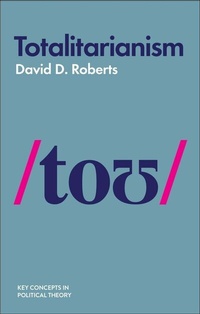
Totalitarianism
1st Edition
Published on 20. April 2020
170 pages
978-1-5095-3241-4 (ISBN)
Description

Less than a century old, the concept of totalitarianism is one of the most controversial in political theory, with some proposing to abandon it altogether. In this accessible, wide-ranging introduction, David Roberts addresses the grounds for skepticism and shows that appropriately recast--as an aspiration and direction, rather than a system of domination--totalitarianism is essential for understanding the modern political universe.
Surveying the career of the concept from the 1920s to today, Roberts shows how it might better be applied to the three ""classic"" regimes of Fascist Italy, Nazi Germany, and the Stalinist Soviet Union. Extending totalitarianism's reach into the twenty-first century, he then examines how Communist China, Vladimir Putin's Russia, the Islamic Republic of Iran, the self-proclaimed Islamic State (IS), and the threat of the technological "surveillance state" can be conceptualized in the totalitarian tradition. Roberts shows that although the term has come to have overwhelmingly negative connotations, some have enthusiastically pursued a totalitarian direction--and not simply for power, control, or domination.
This volume will be essential reading for any student, scholar or reader interested in how totalitarianism does, and could, shape our modern political world.
Surveying the career of the concept from the 1920s to today, Roberts shows how it might better be applied to the three ""classic"" regimes of Fascist Italy, Nazi Germany, and the Stalinist Soviet Union. Extending totalitarianism's reach into the twenty-first century, he then examines how Communist China, Vladimir Putin's Russia, the Islamic Republic of Iran, the self-proclaimed Islamic State (IS), and the threat of the technological "surveillance state" can be conceptualized in the totalitarian tradition. Roberts shows that although the term has come to have overwhelmingly negative connotations, some have enthusiastically pursued a totalitarian direction--and not simply for power, control, or domination.
This volume will be essential reading for any student, scholar or reader interested in how totalitarianism does, and could, shape our modern political world.
More details
Other editions
Additional editions
David D. Roberts
Totalitarianism
Book
04/2020
1st Edition
Polity Press
€56.00
Shipment within 15-20 days
David D. Roberts
Totalitarianism
Book
04/2020
1st Edition
Polity Press
€38.56
Shipment within 15-20 days
Person
David D. Roberts is Albert Berry Saye Professor (Emeritus) at the University of Georgia
Content
- Cover
- Title page
- Copyright page
- Contents
- 1 Why Should We Care about Totalitarianism?
- A new political phenomenon
- The range of totalitarianism
- Grounds for doubt about the category
- The scope for learning from experience
- 2 The Career of a Concept
- As understood by insiders at the time
- As a critical and analytical concept
- The quest for deep historical roots
- George Orwell's dystopia
- The ongoing influence of Hannah Arendt
- Friedrich and Brzezinski: the political science approach
- Robert Jay Lifton and thought reform in communist China
- Herbert Marcuse and the wider use of totalitarianism
- The testimony of opponents and victims
- Moralism and overuse
- Recent defenders and recasters
- 3 Totalitarian Trajectories During the Era of the Two World Wars
- Recasting the category
- Fascist Italy
- The communist experiment in the Soviet Union
- Nazi Germany
- From the earlier to the later cases
- 4 Movements and Regimes Since World War II
- The waning of communism in the Soviet bloc
- Beyond Europe: the Chinese communist experiment
- Radical Islam or "Islamism"
- The Islamic Republic of Iran
- 5 The Future of Totalitarianism
- Neo-fascism and populism
- Vladimir Putin's Russia
- China under Xi Jinping
- The Islamic world
- The scope for further totalitarian departures
- The totalitarian potential of new technologies
- Adjusting the concept in light of new experience
- Relating to totalitarians and learning from experience
- Notes
- Chapter 1 Why Should We Care about Totalitarianism?
- Chapter 2 The Career of a Concept
- Chapter 3 Totalitarian Trajectories During the Era of the Two World Wars
- Chapter 4 Movements and Regimes Since World War II
- Chapter 5 The Future of Totalitarianism
- Index
- EULA
