

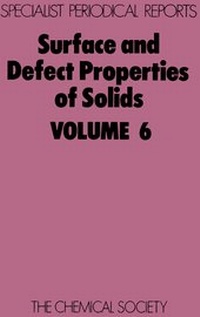
Surface and Defect Properties of Solids
Volume 6
1st Edition
Published on 31. October 2007
378 pages
978-1-84755-699-8 (ISBN)
Description

Specialist Periodical Reports provide systematic and detailed review coverage of progress in the major areas of chemical research. Written by experts in their specialist fields the series creates a unique service for the active research chemist, supplying regular critical in-depth accounts of progress in particular areas of chemistry. For over 90 years The Royal Society of Chemistry and its predecessor, the Chemical Society, have been publishing reports charting developments in chemistry, which originally took the form of Annual Reports. However, by 1967 the whole spectrum of chemistry could no longer be contained within one volume and the series Specialist Periodical Reports was born. The Annual Reports themselves still existed but were divided into two, and subsequently three, volumes covering Inorganic, Organic and Physical Chemistry. For more general coverage of the highlights in chemistry they remain a 'must'. Since that time the SPR series has altered according to the fluctuating degree of activity in various fields of chemistry. Some titles have remained unchanged, while others have altered their emphasis along with their titles; some have been combined under a new name whereas others have had to be discontinued. The current list of Specialist Periodical Reports can be seen on the inside flap of this volume.
More details
Series
Edition
1. Auflage
Language
English
Place of publication
Cambridge
United Kingdom
Target group
Professional and scholarly
ISBN-13
978-1-84755-699-8 (9781847556998)
DOI
10.1039/9781847556998
Copyright in bibliographic data and cover images is held by Nielsen Book Services Limited or by the publishers or by their respective licensors: all rights reserved.
Schweitzer Classification
Other editions
Additional editions
Book
01/1977
Royal Society of Chemistry
€334.50
Shipment within 3-4 weeks
Persons
Content
- Surface and Defect Properties of Solids
- Contents
- Chapter 1 Microscopic Approaches to Physisorption: Theoretical and Experimental Aspects
- 1 Introduction
- 2 Theoretical Approaches for the Study of Physisorption
- Introduction
- van der Waals Forces and Physical Adsorption
- Semi-empirical Calculations
- Fundamental Calculations of Physisorption Binding Energies
- 3 Microscopic Experimental Methods for the Study of Physisorption
- Introduction
- General Introductory Remarks
- On the Use of UPS in Characterization of the Physisorption State
- Experimental Techniques for the Study of Atomic Arrangement in Physisorption Systems
- LEED: Background Remarks
- LEED Studies of Physisorption Systems
- Neutron Scattering: Background Remarks
- The Adsorption of N2 and 36Ar on Graphite
- The Study of Thermal Vibrations using LEED
- Low Energy Molecular (Atomic) Beam Scattering (LEMS)
- Experimental Observations. Scattering Regimes
- Experimental Observations. Diffraction of Rare Gases from Metals
- Experimental Observations. Selective Adsorption
- On Interaction Potentials used in Theoretical Analysis of LEMS
- Experimental Techniques for the Study of the Electronic Structure of Physisorbed Systems
- Ultraviolet Photoemission Spectroscopy (UPS)
- X-Ray Photoemission Spectroscopy (XPS)
- Electron Energy Loss Spectroscopy (EELS)
- Field Emission Techniques
- Field Emission and the Probe-hole Techniques
- Field Emission. Theoretical Considerations
- Measurement of Adsorption Isotherms via Electron Spectroscopy
- Auger Electron Emission in Adsorption Isotherm Studies
- 4 Conclusion
- Chapter 2 57-Iron Conversion Electron Mössbauer Spectroscopy
- 1 Introduction
- 2 Principles of the Mössbauer Effect
- 3 Interaction of the Nucleus with its Environment
- Chemical Isomer Shift
- Quadrupole Interaction
- Magnetic Interaction
- Spectral Areas
- 4 Surface Studies
- 5 Internal Conversion
- 6 Theory of the Attenuation of 57Fe Conversion Electrons
- 7 57Fe CEMS Experimental Considerations
- 8 Probing Depth and Sensitivity
- 9 Applications
- Corrosion and Oxidation Studies
- Surface Phase Analyses of Steels
- Surface Stress Measurements
- Ion Implantation Studies
- Applications in Geochemistry
- 10 Depth Selective 57Fe CEMS
- 11 Conclusions
- Chapter 3 The Interplay of Theory and Experiment in the Field of Surface Phenomena on Metals
- 1 Introduction
- 2 Bare Metal Surfaces
- Theoretical Models of Metal Surfaces
- Comparison of Theoretical and Experimental Results
- 3 Chemisorption of Gas Molecules on Transition Metal Surfaces
- Model Representation of the Gas-Metal System
- CFSO-BEBO Approach
- The Localized Free Electron Interplay Model
- The Comparison of Theoretical and Experimental Results
- 4 Conclusion
- Chapter 4 Angle-resolved Ultraviolet Photoelectron Spectroscopy of Clean Surfaces and Surfaces with Adsorbed Layers
- 1 Introduction
- 2 Photoemission from Clean Surfaces
- Theory
- Comparisons with Angle-resolved Spectra
- 3 Angle-resolved Spectra of Adsorbed Species
- Theory
- Comparison with Experiment
- Chapter 5 Point Defects in Ionic Crystals
- 1 Introduction
- 2 Intrinsic Defect Parameters
- Self-diffusion
- Ionic Conductivity
- 3 Impurity Defect Parameters
- Diffusion of Impurities
- Impurity-Vacancy Complexes
- 4 Theoretical Calculation of the Properties of Point Defects
- Defect Energies: Methods
- Defect Energies: Results
- Defect Interactions
- Rare Gas Diffusion in Ionic Crystals
- Defect Entropies
- 5 Fast Ion Conduction
- Ag+ and Cu+ as Fast Ion Conductors
- Fast Conduction by Alkali Ions
- Anionic Fast Conduction
- 6 Paraelectric Impurities
- Static and Dynamic Behaviour of PEC
- Devonshire Model
- Multi-well Potential Tunnelling Model
- Experimental Techniques and Data
- Electro-optical Technique
- Electrocaloric Method
- Specific Heat Measurements
- Paraelectric Resonance
- The Kerr Effect Method
- 7 Molecular Impurities
- Diatomic Molecular Ions
- Triatomic Molecular Ions
- Planar Molecular Ions
- Molecular Ions of Tetrahedral Symmetry
- Complex Molecular Ions
- 8 Impurity Ions with the S2 Configuration
- Emission
- Chapter 6 Assessment of Crystal Perfection by X-Ray Topography
- 1 Introduction
- 2 Techniques of X-Ray Topography
- Laboratory X-Radiation Techniques
- The Berg-Barrett Topography
- The Lang Technique
- The Double Crystal Method
- X-Ray Topography using Synchrotron Radiation
- Direct Viewing of X-Ray Topographs
- 3 Contrast on X-Ray Topographs
- Perfect Crystal Phenomena - Pendellösung
- Contrast of Dislocations
- Contrast of Stacking Faults
- Contrast of Twins and Sub-grains
- 4 Applications to Crystal Defect Studies
- Crystal Growth
- Metallurgy and Plastic Deformation
- Mineralogy
- Control of Electronic Devices
- Oxidation Studies
- Chapter 7 The Plasticity of Highly Plastic Molecular Crystals
- 1 Introduction
- 2 High Temperature/Low Stress Deformation - Self-diffusion Control
- 3 Low Temperature/High Stress Deformation - Dislocation Slip
- Evaluation of Dislocation Energies
- 4 Conclusions
- Chapter 8 The Ultrastructure of Minerals as Revealed by High Resolution Electron Microscopy
- 1 Introduction
- 2 The Etch-decoration Technique and its Use in the Detection of Stacking Faults
- 3 Pyroxene Minerals
- Structures
- Enstatite Polymorphism
- Orthopyroxenes
- Clinopyroxenes
- 4 Pyroxenoids
- Wollastonite
- Planar Defects in Wollastonite
- Linear Defects and other Anomalous Features in Wollastonite
- Other Pyroxenoids
- 5 Amphiboles
- Exsolution in Amphiboles
- 6 Serpentine Materials
- Chrysotile
- Antigorite
- Lizardite
- Polygonal Serpentine
- Garnierites
- 7 Silicates based on the Mica Type of Layer
- Mica Group
- Chlorite Group
- Zussmanite
- Stilpnomelane
- 8 Orthosilicates
- Chloritoid
- Mullite
- 9 Graphite and its Intercalates
- 10 Sulphides
- 4C Pyrrhotite
- Intermediate (nC) Pyrrhotite
- nA Pyrrhotite
- Smythite, Fe3S4
- Troilite, FeS
- 11 Fluorocarbonates
- Author Index
