

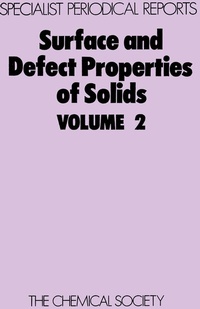
Surface and Defect Properties of Solids
Volume 2
1st Edition
Published on 31. October 2007
289 pages
978-1-84755-695-0 (ISBN)
Description

Specialist Periodical Reports provide systematic and detailed review coverage of progress in the major areas of chemical research. Written by experts in their specialist fields the series creates a unique service for the active research chemist, supplying regular critical in-depth accounts of progress in particular areas of chemistry. For over 90 years The Royal Society of Chemistry and its predecessor, the Chemical Society, have been publishing reports charting developments in chemistry, which originally took the form of Annual Reports. However, by 1967 the whole spectrum of chemistry could no longer be contained within one volume and the series Specialist Periodical Reports was born. The Annual Reports themselves still existed but were divided into two, and subsequently three, volumes covering Inorganic, Organic and Physical Chemistry. For more general coverage of the highlights in chemistry they remain a 'must'. Since that time the SPR series has altered according to the fluctuating degree of activity in various fields of chemistry. Some titles have remained unchanged, while others have altered their emphasis along with their titles; some have been combined under a new name whereas others have had to be discontinued. The current list of Specialist Periodical Reports can be seen on the inside flap of this volume.
More details
Series
Edition
1. Auflage
Language
English
Place of publication
Cambridge
United Kingdom
Target group
Professional and scholarly
ISBN-13
978-1-84755-695-0 (9781847556950)
DOI
10.1039/9781847556950
Copyright in bibliographic data and cover images is held by Nielsen Book Services Limited or by the publishers or by their respective licensors: all rights reserved.
Schweitzer Classification
Other editions
Additional editions
Book
01/1973
Royal Society of Chemistry
€337.50
Shipment within 3-4 weeks
Persons
Content
- Surface and Defect Properties of Solids
- Contents
- Chapter 1 Recent Trends in the Application of Low-energy Electron Diffraction
- 1 Introduction
- 2 The Theory of Surface Structure Analysis by Low-energy Electron Diffraction
- Ion-core Potentials and Energy-dependent Phase Shifts
- The Effect of including Various Numbers of Layers Parallel to the Surface in the Calculation
- Multiple Scattering: Order and Temperature Effects
- Sensitivity of Calculations to the Incident Beam Angle
- Inner Potential and Inelastic Damping Factor
- Sensitivity of Calculations to Changes in the Positions of Atoms in the Surface Layer
- Results of Calculation
- 3 Surface Phase Transformations: Order?Order Transformations
- 4 The Application of LEED to the Study of Stepped Surfaces
- 5 Studies of Thin Films and Liquids by LEED
- 6 Adsorption on Metals
- Adsorption of Complex Molecules
- Adsorption on Metals: Physical Adsorption
- 7 Epitaxy and Metal?Metal Adsorption
- 8 LEED Studies at High Pressures
- 9 The Application of LEED in Studies of Catalysis
- 10 Application of LEED to Studies of Electrode Surfaces
- 11 Trends in Techniques Associated with LEED
- 12 Conclusion
- Chapter 2 Some Developments in Field Ion Microscopy and its Applications
- 1 Introduction
- 2 Principles of Operation
- 3 Developments in Technique
- 4 Image Foundation
- Field-stabilized Adsorption
- Field Ionization
- Image Contrast
- Image Resolution
- 5 Field Evaporation
- 6 Applications in Surface Science
- Chemisorption of Gases on Metals
- Surface Reactions
- Vapour-deposited Metals
- Single Adatom Behaviour
- Interaction between Adatoms
- Growth and Structure of Thin Films
- 7 Metallurgical Applications
- Alloys
- Precipitation Reactions
- Interfaces
- Dislocations
- Points Defects and Radiation Damage
- 8 Conclusions
- Chapter 3 Electron Spin Resonance Studies of Adsorbed Species
- 1 Introduction
- 2 Principles of E.S.R.
- 3 Adsorbed Species
- Atoms and Monatomic Ions
- Hydrogen
- Oxygen
- Inorganic Radicals and Ion-radicals
- Molecular Oxygen Ion
- Ozone Ion
- Nitric Oxide
- Nitrogen Dioxide
- Chlorine Dioxide
- Nitrogen Dioxide Ion
- Carbon Dioxide Ion
- Sulphur Dioxide Ion
- Chlorine Ion
- Organic Radicals and Ion-radicals
- Methyl Radicals
- Oxy-hydrocarbon Radicals
- Radicals derived from Benzene and its Methyl-substituted Derivatives
- Polynuclear Aromatic Hydrocarbon Radicals
- Nitrogen-containing Radicals
- Sulphur-containing Radicals
- Alkene Radicals
- Phenoxyl Radicals
- DPPH
- Adsorbed Quinones
- Chapter 4 Reactions of Saturated Hydrocarbons with Hydrogen on Metals
- 1 Introduction
- Types of Reaction on Metals
- Types of Metal Catalysts
- 2 Exchange Reactions
- Reactions as a Function of Temperature
- Temperature Regions on Various Metals
- Nickel
- Platinum
- Tungsten
- Iron
- Interpretation of Temperature Regions
- 3 Hydrogenolysis Reactions
- Ethane Hydrogenolysis
- Hydrogenolysis of Larger Hydrocarbons
- Simultaneous Exchange and Hydrogenolysis
- Experimental Techniques
- Results over Nickel, Iron, and Cobalt
- Chapter 5 Infrared Studies of Species Adsorbed on Oxide Surfaces
- 1 Introduction
- 2 Oxides of Elements in Group II
- Beryllium Oxide
- Magnesium Oxide
- Calcium Oxide
- 3 Oxides of Elements in Group III
- Boria (Impregnated in Silica Glasses)
- Alumina
- Gallium Oxide and Indium Oxide
- 4 Oxides of Elements in Group IV
- Silica
- Germanium Dioxide
- Tin(IV) Oxide
- 5 Oxides of First-row Transition Metals
- Titanium Dioxide
- Vanadium Pentoxide
- Oxides of Chromium
- Manganese Dioxide
- Iron (III) Oxide
- Cobalt(II) Oxide
- Nickel(II) Oxide and Mixed Oxides containing Nickel
- Copper(II) Oxide
- Zinc Oxide
- 6 Oxides of Second-row Transition Metals
- Yttrium(III) Oxide
- Zirconium Dioxide
- Mixed Oxides of Molybdenum with Bismuth
- 7 Oxides of Third-row Transition Metals
- Hafnium Dioxide
- Tantalum(V) Oxide
- Platinum(IV) Oxide
- 8 Oxides of the Lanthanides and Actinides
- 9 Silica-aluminas
- 10 Aluminium Phosphate (a Mixed Oxide of Aluminium and Phosphorus)
- 11 Raman Spectroscopic Studies of Oxide Surfaces
- Chapter 6 Orientational Order and Disorder in the Solid Isotopic Methanes
- 1 General Introduction
- 2 Molecular Reorientation in Solid Hydrogen
- 3 Thermodynamic Properties of the Solid Methanes
- 4 The Problem of the Structure of the Solid Phase
- 5 Energy States of Methane Molecules in Solids
- 6 Nuclear Magnetic Resonance Measurements on the Solid Methanes
- A Nuclear Magnetization
- B Spin-Lattice Relaxation
- C Level Crossing as a Probe of Spin-isomer Interconversion
- 7 Summary
- Chapter 7 Point Defects in Ionic Crystals
- 1 Nature and Occurrence of Point Defects
- Highly Defective Materials
- 2 Number of Point Defects
- 3 Distribution of Point Defects
- 4 Evidence for Point Defects
- Nominally Pure Crystals
- Doped Crystals
- 5 Aggregates of Impurity Ions
- 6 Defect Interactions
- Debye-Hückel Model
- Statistical Mechanical Theories
- 7 Mobility of Point Defects
- 8 Ionic Conductivity
- 9 Diffusion
- Correlation Effects
- Comparison with Ionic Conductivity
- Isotope Effects
- Diffusion of Impurities
- 10 Relaxation Phenomena
- Dielectric Loss and Internal Friction
- Ionic Thermoconductivity
- 11 Magnetic Resonance Techniques
- N.M.R.
- E.S.R.
- 12 Numerical Values of Parameters
- For the Host Crystal (Mostly Halides)
- For Oxides
- For Impurity Ions
- 13 Theoretrical Calculation of Defect Parameters
- Energies of Defect Formation
- Binding Energies
- Defect Migration Energies
- Entropies of Defect Formation and Migration
- Volume Changes Associated with Defect Formation and Migration
- Solubility of impurity Ions
- Chapter 8 The Role of Structural Defects in the Luminescence of Organic Molecular Crystals
- 1 Introduction
- 2 Basic Concepts
- 3 Direct and Defect Fluorescence
- Spectral Characteristics
- Fluorescence Lifetimes
- 4 Delayed Fluorescence and Phosphorescence
- 5 Electroluminescence and Charge-carrier Modulation of Luminescence
- 6 Thermoluminescence
- Chapter 9 Diffusion in Molecular Solids
- 1 Introduction
- 2 Mass-transport Experiments
- Self-diffusion
- Radiotracer Studies
- Plastic-deformation Studies
- Radical-recombination Studies
- Pulsed Field Gradient Measurements
- Summary
- Impurity Diffusion and Diffusion in Impure Solids
- Mechanistic Studies
- 3 Relaxation-time Experiments
- N.M.R. Studies
- Self-diffusion
- Diffusion in Impure Systems
- Mechanistic Studies
- 4 Evaluation of Point-defect Properties
- Theoretical Calculations
- Noble-gas Solids
- Experimental Determinations
- Noble-gas Solids
- Organic Solids
- Author Index
