

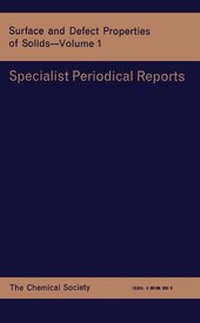
Surface and Defect Properties of Solids
Volume 1
1st Edition
Published on 31. October 2007
264 pages
978-1-84755-694-3 (ISBN)
Description

Specialist Periodical Reports provide systematic and detailed review coverage of progress in the major areas of chemical research. Written by experts in their specialist fields the series creates a unique service for the active research chemist, supplying regular critical in-depth accounts of progress in particular areas of chemistry. For over 90 years The Royal Society of Chemistry and its predecessor, the Chemical Society, have been publishing reports charting developments in chemistry, which originally took the form of Annual Reports. However, by 1967 the whole spectrum of chemistry could no longer be contained within one volume and the series Specialist Periodical Reports was born. The Annual Reports themselves still existed but were divided into two, and subsequently three, volumes covering Inorganic, Organic and Physical Chemistry. For more general coverage of the highlights in chemistry they remain a 'must'. Since that time the SPR series has altered according to the fluctuating degree of activity in various fields of chemistry. Some titles have remained unchanged, while others have altered their emphasis along with their titles; some have been combined under a new name whereas others have had to be discontinued. The current list of Specialist Periodical Reports can be seen on the inside flap of this volume.
More details
Series
Edition
1. Auflage
Language
English
Place of publication
Cambridge
United Kingdom
Target group
Professional and scholarly
ISBN-13
978-1-84755-694-3 (9781847556943)
DOI
10.1039/9781847556943
Copyright in bibliographic data and cover images is held by Nielsen Book Services Limited or by the publishers or by their respective licensors: all rights reserved.
Schweitzer Classification
Other editions
Additional editions
Book
01/1972
Royal Society of Chemistry
€334.50
Shipment within 3-4 weeks
Persons
Content
- Surface and Defect Properties of Solids
- Contents
- Chapter 1 Shear Structures and Non-stoicheiometry
- 1 Crystallographic Shear
- 2 The Mechanism and Kinetics of Crystallographic Shear
- 3 The Characterization of Compounds with Planar Defects or Superstructures
- 4 Crystallographic Stiear in Specific Systems
- Derivatives of the ReO3 Structure
- Tungsten (and Molybdenum) Oxides
- Niobium Oxyfluoride
- Derivatives of the MoO3 Structure
- Derivatives of the Rutile Structure
- 5 Thermodynamics of Rutile CS Phases
- 6 Ternary Defect Rutile Oxides
- 7 Double Shear and Block Structures
- Symbolism
- Ordered Block Structures
- 8 Stoicheiometric Faults, Intergrowths, and Non-stoicheiometric Faults
- 9 Related Types of Non-stoicheiometry
- Chapter 2 Direct Study of Structural Imperfections by High-resolution Electron Microscopy
- 1 Introduction
- 2 Electron Optical Considerations
- 3 Instrumentation
- 4 Materials Studied
- Carbons
- Carbon Blacks
- Distribution of graphitic layer spacings
- Different types of images in heat-treated carbon blacks
- Carbon Films
- Pyrolysed Polymers - Glassy Carbon
- Coal and Char Samples
- Polymers
- Amorphous Polymers
- Macromolecules - DNA
- 5 Summary and Conclusions
- Chapter 3 The Role of Defects in Solid-phase Polymerization
- 1 Introduction
- 2 Some General Considerations
- 3 Vinyl Polymerization
- Reaction Kinetics
- Nature of Reaction Sites
- Molecular Mobility
- U.v. Initiation
- E.S.R. Studies
- Polymerization at Low Temperatures
- Topotactic Polymerization
- The Influence of Additives
- Effects of Pressure
- 4 Polymerization of Cyclic Monomers
- 5 Co-polymerization
- 6 Concluding Remarks
- Chapter 4 Structural Imperfections in Organic Molecular Crystals
- 1 Point Defects
- 2 Dislocations
- 3 Stacking Faults
- 4 Long-range Disorder and Short-range Order
- Chapter 5 Surface Studies by Photoemission
- 1 Introduction
- Formal Description of the Photoemission Process
- Photoemission near the Threshold
- Escape Depth of Photoelectrons
- 2 Experimental Approaches in Photoemission
- 3 Information from Photoemission Studies
- Alloy Surfaces
- Studies of Silicon
- Nickel + Oxygen and Copper + Oxygen Systems
- Yield
- Energy Distribution
- The Aluminium-Oxygen and Aluminium-Water Interfaces
- Density of States
- Chapter 6 The Application of Electron Spectroscopy to Surface Studies
- 1 Introduction
- 2 Principles of Electron Spectroscopy
- Summary of the Techniques Involved
- Chemical Information from Electron Spectroscopy
- Photoelectron Spectroscopy
- Energy Loss Electron Spectroscopy
- Electron Impact Auger Spectroscopy
- Ion Neutralization (I.N.) Spectroscopy
- 3 Application to Surface Studies
- Mean Free Path Lengths of Electrons
- Electron Impact Auger Spectroscopy
- Ion Neutralization Spectroscopy
- Photoelectron Spectroscopy
- Molecular Photoelectron Spectroscopy: Photoemission Studies
- X-Ray Photoelectron Spectroscopy, ESCA
- Energy Loss Spectroscopy
- Chapter 7 Exchange and Equilibration Reactions on Metal Surfaces
- 1 The Hydrogen-Deuterium Reaction
- 2 Nitrogen Isotope Reactions
- 3 Carbon Monoxide Isotope Reactions
- 4 Oxygen Isotope Reactions
- 5 Exchange of Hydrogen Isotopes in Organic Molecules
- Chapter 8 Infrared Spectra of Adsorbed Species on Metals
- 1 Carbon Monoxide
- 2 Reflection Spectroscopy of Chemisorbed Carbon Monoxide
- 3 Other Reflection Spectra
- 4 Hydrogen, Nitrogen, and Nitric Oxide
- 5 Hydrocarbons and other Compounds
- Chapter 9 Some Aspects of the Selective Action of Metal Catalysts
- 1 Introduction
- 2 Selectivity and Catalyst Structure
- 3 Selectivity and Reaction Mechanism
- Consecutive Reactions
- The Thermodynamic Factor
- The Kinetic Factor
- A Selectivity Pattern and its Interpretation
- The Role of Occluded Hydrogen
- Unresolved Problems
- Parallel Reactions
- Substituent Effects in Selectivity
- Isomerization of Product before Desorption
- Reduction of Selectivity by Polymerization
- 4 Selective Poisoning and Shape-selective Catalysts
- 5 Summary
- Author Index
