

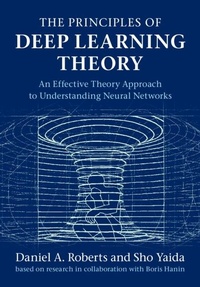
The Principles of Deep Learning Theory
An Effective Theory Approach to Understanding Neural Networks
Published on 11. May 2022
978-1-009-02092-3 (ISBN)
Description

This textbook establishes a theoretical framework for understanding deep learning models of practical relevance. With an approach that borrows from theoretical physics, Roberts and Yaida provide clear and pedagogical explanations of how realistic deep neural networks actually work. To make results from the theoretical forefront accessible, the authors eschew the subject's traditional emphasis on intimidating formality without sacrificing accuracy. Straightforward and approachable, this volume balances detailed first-principle derivations of novel results with insight and intuition for theorists and practitioners alike. This self-contained textbook is ideal for students and researchers interested in artificial intelligence with minimal prerequisites of linear algebra, calculus, and informal probability theory, and it can easily fill a semester-long course on deep learning theory. For the first time, the exciting practical advances in modern artificial intelligence capabilities can be matched with a set of effective principles, providing a timeless blueprint for theoretical research in deep learning.
Reviews / Votes
'In the history of science and technology, the engineering artifact often comes first: the telescope, the steam engine, digital communication. The theory that explains its function and its limitations often appears later: the laws of refraction, thermodynamics, and information theory. With the emergence of deep learning, AI-powered engineering wonders have entered our lives - but our theoretical understanding of the power and limits of deep learning is still partial. This is one of the first books devoted to the theory of deep learning, and lays out the methods and results from recent theoretical approaches in a coherent manner.' Yann LeCun, New York University and Chief AI Scientist at Meta 'For a physicist, it is very interesting to see deep learning approached from the point of view of statistical physics. This book provides a fascinating perspective on a topic of increasing importance in the modern world.' Edward Witten, Institute for Advanced Study 'This is an important book that contributes big, unexpected new ideas for unraveling the mystery of deep learning's effectiveness, in unusually clear prose. I hope it will be read and debated by experts in all the relevant disciplines.' Scott Aaronson, University of Texas at Austin 'It is not an exaggeration to say that the world is being revolutionized by deep learning methods for AI. But why do these deep networks work? This book offers an approach to this problem through the sophisticated tools of statistical physics and the renormalization group. The authors provide an elegant guided tour of these methods, interesting for experts and non-experts alike. They write with clarity and even moments of humor. Their results, many presented here for the first time, are the first steps in what promises to be a rich research program, combining theoretical depth with practical consequences.' William Bialek, Princeton University 'This book's physics-trained authors have made a cool discovery, that feature learning depends critically on the ratio of depth to width in the neural net.' Gilbert Strang, Massachusetts Institute of Technology 'An excellent resource for graduate students focusing on neural networks and machine learning ... Highly recommended.' J. Brzezinski, Choice 'The book is a joy and a challenge to read at the same time. ... The joy is in gaining a much deeper understanding of deep learning (pun intended) and in savoring the authors' subtle humor, with physics undertones. ... In a field where research and practice largely overlap, this is an important book for any professional.' Bogdan Hoanca, Optics and Photonics NewsMore details
Language
English
Place of publication
Cambridge
United Kingdom
Illustrations
Worked examples or Exercises
File size
6,37 MB
ISBN-13
978-1-009-02092-3 (9781009020923)
Copyright in bibliographic data and cover images is held by Nielsen Book Services Limited or by the publishers or by their respective licensors: all rights reserved.
Schweitzer Classification
Other editions
Additional editions
Daniel A. Roberts | Sho Yaida
The Principles of Deep Learning Theory
An Effective Theory Approach to Understanding Neural Networks
Book
05/2022
Cambridge University Press
€86.20
Shipment within 15-20 days
Persons
Content
Preface; 0. Initialization; 1. Pretraining; 2. Neural networks; 3. Effective theory of deep linear networks at initialization; 4. RG flow of preactivations; 5. Effective theory of preactivations at initializations; 6. Bayesian learning; 7. Gradient-based learning; 8. RG flow of the neural tangent kernel; 9. Effective theory of the NTK at initialization; 10. Kernel learning; 11. Representation learning; ?. The end of training; ?. Epilogue; A. Information in deep learning; B. Residual learning; References; Index.
