

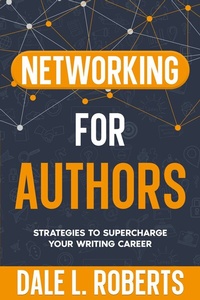
Networking for Authors
Description

You're ready to build your author career... ...but how do you expand your network? What's the secret to forging lasting industry connections?
In Networking for Authors: Strategies to Supercharge Your Writing Career, Dale L. Roberts delivers a practical guide to mastering networking. Discover step-by-step strategies to connect authentically with industry professionals and elevate your author brand.
Inside, you'll find: - Proven methods for effective networking - Tips for a compelling author bio and online presence - Confidence-boosting advice for introverts - Strategies for making the most of conferences and events - Insights on leveraging social media and virtual platforms - Techniques for using email, podcasts, and videos to enhance your reach
Ready to expand your reach and supercharge your writing career?
Get it now!
All prices
More details
Other editions
Additional editions
Content
Chapter 2
Building an Author Brand
You never truly get a second chance to make a first impression. Based on your choice to read a book about networking for authors, I'm assuming that you treat your author business seriously. Everything you put out is probably your absolute best effort. After all, no one sets out to be the absolute worst writer on the planet.
Let's consider some of the finer details of building an author brand, especially one that creates the best first impression, leaving an impact on anyone you meet. You want to stand out. After all, the goal of building a deep business network is to help elevate your author brand.
Your author brand includes everything about what you do and who you are. When packaging your brand, account for not just what people read, but what they see, can expect, and can access through you. Let's explore the best first steps.
Crafting a Compelling Author Bio
Start with the fundamental element of your author brand identity-a short bio. Many indie authors get this wrong on so many levels because they end up dumping way too much needless and irrelevant info, forcing a potential reader to power through an overstuffed bio that really is a synopsis of their life story.
While no one is going to be in danger of a flogging for a padded or wordy bio, it can certainly create a lot of unnecessary friction for potential readers who want to learn more about you.
Treat business professionals the same way you would a potential reader. You can imagine after someone meets you, they're going to search for your books online and read your bio.
The main point of a bio is to give your readers enough substance to relate to so they understand more about you. When you're crafting that bio, think about the ideal audience you want to attract. Conversely, what you choose will also repel the audience you don't want. This means your bio must be specific, clear, and to the point.
Crafting a bio doesn't require a deep understanding of copywriting, although that doesn't hurt. In the art of copywriting, the point is to get folks to read from top to bottom and take a specific action. While some experts will have you believe a call-to-action is a necessity in your bio, I really think it comes down to preference.
Some authors promote their websites, email newsletters, or latest books. That's fine, but remember, a little goes a long way, so don't give your potential reader too many choices. If they are overwhelmed with options, they may not take any at all. Pick one specific action you want them to take and stick with that.
Crafting your author bio is like creating your elevator pitch. In one to two paragraphs with only 150 to 200 words, describe who you are, what you do, and why you do it.
Many people debate over what works best-first person or third person. It comes down to taste. I prefer third person since it conveys credibility. It's easier for someone else to share I'm a thirty-two-time award-winning author-okay, I swear that's the last flex-and for potential readers to view it as a big deal.
Here's the current iteration of my bio:
Dale L. Roberts is a self-publishing advocate, award-winning author, and video content creator. Dale's inherent passion for life fuels his self-publishing advocacy both in print and online. After publishing over fifty titles and becoming an international bestselling author on Amazon, Dale started his YouTube channel, Self-Publishing with Dale. Selected by Feedspot and LA Weekly as one of the best sources in self-publishing of 2022, Dale cemented his position as the go-to authority in the indie author community.
Dale currently lives with his wife and two rescue cats in Columbus, Ohio.
I lead with the three most important hats I wear: a proponent of self-publishing, an award-winning author, and a YouTuber.
In the next two sentences, I add more context to those hats I wear, so I clear up any ambiguity. Within those two sentences, I'm clear about what it is I do, who it's for, and how I'm pretty darned good at it.
The last sentence is where some authors would place a call-to-action. I keep it simple. I take pride in my family and the home we've built, so I'll end by introducing them and sharing my homebase. If you aren't comfortable exposing where you live, I totally understand. Anyone wanting to remain anonymous will have a tough time networking, since a lot of it consists of making yourself vulnerable with complete strangers.
Do not be confused; you aren't crafting a great author bio to rattle off at a networking event. This will represent your brand online and in print. Too many authors take this area for granted-which I think is a missed opportunity-while others over-share in their bio. Find the balance in between. Go too short and a reader won't know how they can relate with you. Go too long and only your diehard fans will appreciate the insights.
The rest? Yeah, they tuned out when you went on about all your degrees in college, your hobbies of shuffleboard and pickleball, and your weird attraction to eating Takis in bed. If any of that information bears relevance to the niche you write in, use it. If not, toss it out.
Though I'm a former professional wrestler, I don't have to include that in my bio since my audience comprises writers and self-publishers. Is my wrestling background cool? Sure, but is it relevant? No, it brings nothing of value to the conversation.
Don't be afraid to infuse your personality within the bio and loosely use these rules for crafting your author bio. Once you have an edited second draft of your bio, have a few people proofread it for you-preferably someone who knows you and someone who doesn't know you.
The person who knows you might remind you of something you're missing, like an interesting factoid that could elevate your perceived importance. When someone unfamiliar with you reviews your bio, they're going to attack it from the viewpoint of a potential reader.
It definitely doesn't hurt having more than a couple of people to help. Just don't bog yourself down with too much advice. It's your bio and you have the final say on the final draft.
Remember, you aren't married to this bio, so change it up occasionally, updating facts and info that'll lend more credibility.
When all else fails and you're stumped, consider hiring out or leveraging generative artificial intelligence (A.I.) to write your author bio.
In my video series about building an author brand, I worked with a few freelancers on the Fiverr marketplace-a website that allows customers to order business-related projects. I worked with a few bio writers and found the results to be pleasantly surprising. I gave them all my relevant points and facts, then let them handle the rest.
If you're banging your head against the wall trying to come up with the perfect bio, consider hiring a pro. They'll do it faster and let you get back to doing your other writerly things.
Recently, A.I. has come to the forefront of the publishing business, dividing authors into a few camps. One camp is all for the advancement of technology, embracing what A.I. can do to better our lives. The other camp is the polar opposite, viewing A.I. as a threat. Then, the last camp consists of people who are on the fence and don't really know much about it.
I encourage you to try generative A.I. in areas like drafting an author bio. You're ethically leveraging a tool to complete the sometimes-arduous task of describing yourself.
Google any number of text-generated A.I. services to see what's the best fit. At this time, you don't need to get a premium plan to craft a brief bio. Between ChatGPT and Dibbly Create, I have access to more than enough free-to-use generative A.I. to create a bio for myself anytime I want. I provide all the details to the A.I. and request an author bio with the specs I input. Then, hit enter. Within seconds, you should have a rough working bio. It might take a few tweaks or a couple of prompts to deliver a bio you can be proud of, but you can add your own touch without writing the bio from scratch.
Your Author Brand Image
Everyone judges a book by its cover; this is especially true with your author brand. You should present yourself, your work, and what you do in a cut and dry manner, right? Certainly, because you shouldn't be anything short of your authentic self.
However, you'll have to be self-aware and realize that most folks might not appreciate your authentic self. If you're the type who enjoys loafing around in your sweats and an unwashed T-shirt, then you probably shouldn't lead with that as your brand image.
Consider presenting yourself in your best casual attire, or if you want to project a professional image, opt for your Sunday best. In 2017, I stopped wearing business attire, such as pressed slacks, a long-sleeve shirt, tie with tie pin, and often a vest. I dressed that way for my career as an activities director. And, for a year after I left my job, I continued to use that as my look, even though I...
