

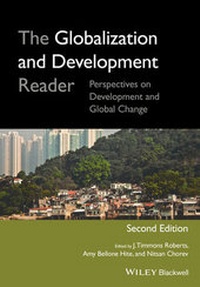
The Globalization and Development Reader
Description

More details
Other editions
Additional editions
Persons
Content
Globalization and Development: Recurring Themes 1
Amy Bellone Hite, J. Timmons Roberts, and Nitsan Chorev
Part I Formative Approaches to Development and Social Change 19
Introduction 21
1 Manifesto of the Communist Party (1848) and Alienated Labour (1844) 29
Karl Marx and Friedrich Engels
2 The Protestant Ethic and the Spirit of Capitalism (1905) 39
Max Weber
3 The Stages of Economic Growth: A Non-Communist Manifesto (1960) 52
W. W. Rostow
4 Economic Backwardness in Historical Perspective (1962) 62
Alexander Gerschenkron
5 A Study of Slum Culture: Backgrounds for La Vida (1968) 79
Oscar Lewis
6 Political Participation: Modernization and Political Decay (1968) 88
Samuel Huntington
Part II Dependency and Beyond 95
Introduction 97
7 The Development of Underdevelopment (1969) 105
Andre Gunder Frank
8 Dependency and Development in Latin America (1972) 115
Fernando Henrique Cardoso
9 The Rise and Future Demise of the World Capitalist System: Concepts for Comparative Analysis (1979) 126
Immanuel Wallerstein
10 Taiwan's Economic History: A Case of Etatisme and a Challenge to Dependency Theory (1979) 147
Alice H. Amsden
11 Rethinking Development Theory: Insights from East Asia and Latin America (1989) 169
Gary Gereffi
12 Interrogating Development: Feminism, Gender and Policy (1998) 191
Ruth Pearson and Cecile Jackson
13 Why Is Buying a "Madras" Cotton Shirt a Political Act? A Feminist Commodity Chain Analysis (2004) 204
Priti Ramamurthy
Part III What Is Globalization? 225
Introduction 227
14 The New International Division of Labour in the World Economy (1980) 231
Folker Fröbel, Jürgen Heinrichs, and Otto Kreye
15 In Defense of Global Capitalism (2003) 247
Johan Norberg
16 It's a Flat World, After All (2005) 263
Thomas L. Friedman
17 The Financialization of the American Economy (2005) 272
Greta R. Krippner
18 The Transnational Capitalist Class and the Discourse of Globalization (2000) 304
Leslie Sklair
19 The Washington Consensus as Transnational Policy Paradigm: Its Origins, Trajectory and Likely Successor (2012) 319
Sarah Babb
20 The Crises of Capitalism (2010) 333
David Harvey
Part IV Development after Globalization 337
Introduction 339
21 Global Crisis, African Oppression (2001) 345
Patrick Bond
22 Agrofuels in the Food Regime (2010) 356
Philip McMichael
23 Global Cities and Survival Circuits (2002) 373
Saskia Sassen
24 What Makes a Miracle: Some Myths about the Rise of China and India (2008) 391
Pranab Bardhan
25 Foreign Aid (2006) 398
Steven Radelet
26 The Globalization Paradox: Democracy and the Future of the World Economy (2011) 417
Dani Rodrik
Part V Global Themes Searching for New Paradigms 441
Introduction 443
27 A New World Order (2004) 449
Anne-Marie Slaughter
28 Transnational Advocacy Networks in International Politics (1998) 476
Margaret E. Keck and Kathryn Sikkink
29 Multipolarity and the New World (Dis)Order: US Hegemonic Decline and the Fragmentation of the Global Climate Regime (2011) 486
J. Timmons Roberts
30 Changing Global Norms through Reactive Diffusion: The Case of Intellectual Property Protection of AIDS Drugs (2012) 503
Nitsan Chorev
31 Development as Freedom (1999) 525
Amartya Sen
32 From Polanyi to Pollyanna: The False Optimism of Global Labor Studies (2010) 549
Michael Burawoy
33 The Developmental State: Divergent Responses to Modern Economic Theory and the Twenty-First-Century Economy (2014) 563
Peter Evans
Index 583
Globalization and Development: Recurring Themes
Amy Bellone Hite, J. Timmons Roberts, and Nitsan Chorev
One week in April 2013 brought home how global forces of change affect our lives, and how important it is to understand development and the international system to know how we might respond.
- A huge factory in Bangladesh producing cheap goods for the global market collapsed, killing over 1,100 people and injuring 2,500 others. The Rana Plaza workers were earning under US$50 per month sewing garments for giant firms like Walmart, J. C. Penney, Dress Barn, and Primark.
- Two ethnic Chechen immigrants who came to the United States from Dagestan, a region long oppressed by Russian occupation, placed homemade bombs at the finish line of the Boston Marathon, killing three people and wounding over 200 spectators.
- Tensions between China and Japan over islands between them impeded economic growth for both countries, a tremor felt around the world since they are both important customers, lenders, and investors.
- The six-month anniversary for victims of Superstorm Sandy was the filing deadline for federal disaster assistance in the eastern United States. Estimates of damage had risen to over 70 billion US dollars, an amount only surpassed by Hurricane Katrina in 2005. These kinds of extreme events are expected more often with climatic change induced by human beings.
- Negotiations in Bonn, Germany sought to craft an international response to climate change, by small groupings of countries and in the United Nations Framework Convention on Climate Change process, now two decades old. Among those pushing for rapid action were Bangladesh, Haiti, and Pacific Island atolls, all facing devastating coastal flooding as oceans warm and expand and the polar icecaps melt.
Production, trade, investment, terror, security, climate change, and statesmanship all involve new types and intensities of flows of goods, people, greenhouse gas molecules, and ideas around the world. Meanwhile, the unevenness of economic development and cultural and social change around the globe continues to present us with stark paradoxes and contrasts.1 These contrasts of the hypermodern with traditional ways of life, often in the same place and at the same time, are microcosms of inequality between the two worlds that exist on our one planet: the so-called "developed" and the "underdeveloped" worlds, the "First World" and the "Third World,"2 the poor and the rich nations, the "global North" and "global South," Americanization and Africanization, "McWorld" and Islam. Within most poor nations, the great divides that pervade the globe are more startling because the contrasts are so close together.
Why should people in wealthy nations, which also face many disparities and contradictions, care about these poorer countries' economic development and their experiences with social change? A hundred people would give as many answers. Some people in the wealthier nations are excited about economic opportunities in what might be a booming market for export products in the "developing South." Some see a source of cheap imports to keep inflation down. Others want to know about development because they worry about losing jobs to new industries in the South or about losing European and US control over the world's political and economic arenas. Some experts worry about political instability or extremism in developing countries threatening business interests abroad or security at home. There is grave concern in some places about large-scale immigration from poorer areas of the world. Many people appreciate the close association between poverty and disease, and worry that the next pandemic will be caused by inadequate public health and medical infrastructure in the poorer parts of the world. Others still are troubled about the global environment and are aware of poorer nations' crucial role for climate change, pollution, biodiversity, or species preservation. Others care about developing countries because they have experienced their warm beaches, jungles, mountains, pyramids, and temples. These are some concrete reasons to care.
Some people's concern springs from very different places, based in moral, religious, or purely academic roots. Some specialists who have devoted their lives to "development studies" or who work in development agencies are aware that of the world's more than 7 billion people, over 3 billion live in countries where the average income is less than $2.50 a day.3 Oxfam International reports that the richest 85 individuals in the world have as much wealth as the poorest 3 billion people combined.4
Many religious groups have targeted these billions as the greatest potential growth areas for their churches, sending missionaries, money, and material aid. Some are concerned with converting all the world's major population groups to hasten or to be prepared for the Second Coming of Christ. Other religious groups might be concerned with studying and documenting gaps in development, so that their populations might live without the daily indignities of poverty. Some people want to understand the roots and potential cures of the problems that cause the desperate poverty of which we are reminded on television ads for groups who bring aid.
Finally, a few people point out that in countries where Western economic and social systems have not fully penetrated, there remains a possible alternative to the development model followed in wealthy countries. Beyond the material level, many authors are now proposing that we can learn from aboriginal cultures not just their medicinal uses of plants and land-use, but also their cosmology and non-materialist values. More concretely, education and health techniques have "trickled up" from Brazil and Central America to wider application in the rich nations. Under duress from the collapse of the Soviet empire and an embargo from the United States, for example, Cuban agriculture conducted the largest experiment ever in organic farming. Innovative urban solutions of mass transit, recycling, and job training are coming from the city of Curitiba in the south of Brazil.5
People, then, have diverse and often multiple reasons to care about what happens to the poor nations, and it is critical to grasp the roots of their interest to understand the approach they take and the conclusions they reach. This volume puts at your fingertips the original words of scholars attempting to understand how societies are changing. The goal of this introduction is to provide some context for new readers and some framework for old hands. It begins with a discussion of the deep divide in our society over who people believe are to blame for the poverty of poor nations. This divide runs through the decades of debate about international development, which this reader attempts to chronicle. We then introduce the five sections of the book by briefly discussing their contexts, main questions, and approaches.
This volume chronicles two major social revolutions and the transition between them: the industrial revolution and the shift to global economic production. Part I, which covers the earliest theories of social change and the development of capitalism, begins the volume with two "classical" pieces by pivotal thinkers on these questions: Karl Marx/Friedrich Engels and Max Weber, and then moves on to W. W. Rostow and Alexander Gerschenkron's classic pieces on economic growth, Oscar Lewis's controversial piece on "the culture of poverty," and Samuel Huntington on politics and change. Part II includes seven pieces from what some argue was the earliest "globalization" theorizing, by writers who developed what came to be called the "dependency" and "world-systems" approaches. Parts III, IV, and V contain 20 path-breaking pieces on the relationship between globalization and development, of which 16 are new for this edition.
The first of these three sections on globalization represents a segment of the array of conceptualizations of economic globalization. Part III features a classic description of the global division of labor by Fröbel, Heinrichs, and Kreye, Johan Norberg's positive assessment of global capitalism, Greta Krippner's piece on financialization, and Thomas Friedman's famous argument that "the world is flat." In addition to Krippner's work, Part III features three additional selections (by Sklair, Babb, and Harvey) pertaining to the 2008-10 economic crisis (and its roots in financialization of the economy), and what the crisis can teach us about how the global and national economies function. As globalization has unfolded, there have been strong debates about what role foreign aid and international banks should play, described in Part IV by Steven Radelet and Patrick Bond. Also in Part IV, McMichael and Sassen take up globalization's impact on the countryside and the cities respectively, while Bardhan compares the rise of China and India, and Rodrik explores the limits to democracy and globalization. The volume concludes with a sampling of pieces we describe as "Global Themes Searching for New Paradigms," which includes descriptions of new forms of governance, by Anne-Marie Slaughter and by Margaret Keck and Kathryn Sikkink, and analyses of international debates over environment and health by...
