

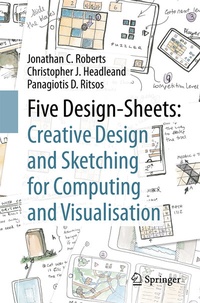
Five Design-Sheets: Creative Design and Sketching for Computing and Visualisation
Description

This book describes a structured sketching methodology to help you create alternative design ideas and sketch them on paper. The Five Design-Sheet method acts as a check-list of tasks, to help you think through the problem, create new ideas and to reflect upon the suitability of each idea. To complement the FdS method, we present practical sketching techniques, discuss problem solving, consider professional and ethical issues of designing interfaces, and work through many examples.
Five Design-Sheets: Creative Design and Sketching for Computing and Visualization is useful for designers of computer interfaces, or researchers needing to explore alternative solutions in any field. It is written for anyone who is studying on a computing course and needs to design a computing-interface or create a well-structured design chapter for their dissertation, for example. We do acknowledge that throughout this book we focus on the creation of interactive software tools, and usethe case study of building data-visualization tools. We have however, tried to keep the techniques general enough such that it is beneficial for a wide range of people, with different challenges and different situations, and for different applications.
Reviews / Votes
"Each chapter within the work has a brief, well-focused set of exercises and an appropriate set of references. In addition, the work contains a well-developed index useful to readers. The book may also serve as a reference for those interested in exploring an approach utilizing tools that may assist them in visualizing their designs. Summing Up: Recommended. Upper-division undergraduates and above; faculty and professionals." (J. Beidler, Choice, Vol. 55 (5), January, 2018)"The book describes a practical and structured methodology based on planning and designing by sketching, taking into account idea generation and creative thinking. This book will be useful for practitioners, students, instructors, and researchers from interaction design, human-computer interaction, ergonomics (human factors), video game design, and related areas. The book has plenty of illustrations, examples, and background information that will be suitable for school projects and assignments, research projects, and related academic activities where creative thinking and sketching are involved." (Computing Reviews, November, 2017)
More details
Other editions
Additional editions
Persons
Jonathan C. Roberts is in the field of computer visualization, human computer interaction and computing pedagogy and a Professor in the School of Computer Science, Bangor University, UK. He has extensive experience in teaching computer graphics and data visualization to both undergraduate and postgraduate students.
Christopher J. Headleand is in the field of virtual environments, computational ethics, and human-computer interaction in the School of Computer Science, at the University of Lincoln. He is also an experienced entrepreneur and has formed successful startups in the web, and virtual reality sectors.
