

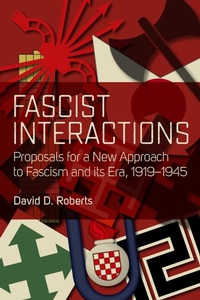
Fascist Interactions
Description

Although studies of fascism have constituted one of the most fertile areas of historical inquiry in recent decades, more and more scholars have called for a new agenda with more research beyond Italy and Germany, less preoccupation with definition and classification, and more sustained focus on the relationships among different fascist formations before 1945. Starting from a critical assessment of these imperatives, this rigorous volume charts a historiographical path that transcends rigid distinctions while still developing meaningful criteria of differentiation. Even as we take fascism seriously as a political phenomenon, such an approach allows us to better understand its distinctive contradictions and historical variations.
More details
Other editions
Additional editions
Person
David D. Roberts is Albert Berry Saye Professor of History, Emeritus, at the University of Georgia.
Content
Preface
PART I: PROBLEMS AND PROSPECTS
Chapter 1. New Restiveness, New Possibilities, and Unfinished Business in Fascist Studies
Chapter 2. Assessing the New Restiveness
Chapter 3. Transnational Turn, Further Unfinished Business, and Some Preliminary Categories and Distinctions
PART II: MODES OF EPOCHAL INTERACTION
Chapter 4. Internal Interaction: Fascists, Conservatives, and the Establishment
Chapter 5. Supranational Interaction within the New Right
Chapter 6. Interaction with the Liberal Democracies
Chapter 7. Interaction across the Left-Right Divide and Uncertainty over "Totalitarianism"
PART III: SOME TENTATIVE PRESCRIPTIONS
Chapter 8. Categories for Us: Blurring and Rigor
Chapter 9. Fascism as "Epochal" or Continuing Possibility?
Chapter 10. The Epochal Aggregate
Works Cited
Index
