

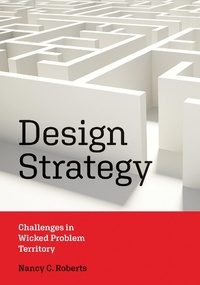
Design Strategy
Challenges in Wicked Problem Territory
Published on 14. November 2023
522 pages
978-0-262-37659-4 (ISBN)
Description

A new approach to addressing the contemporary world's most difficult challenges, such as climate change and poverty.
Conflicts over "the problem" and "the solution" plague the modern world and land problem solvers in what has been called "wicked problem territory"-a social space with high levels of conflict over problems and solutions. In Design Strategy, Nancy C. Roberts proposes design as a strategy of problem solving to close the gap between an existing state and a desired state. Utilizing this approach, designers and change agents are better able to minimize self-defeating conflicts over problems and solutions, break the logjam of opposition, and avoid the traps that lock problem solvers into a never-ending cycle of conflict.
Design as a field continues to grow and evolve, but Design Strategy focuses on three levels of design where "wicked problems" tend to lurk-strategic design (of private and public organizations), systemic design (of networked and overlapping economic, technical, political, and social subsystems), and regenerative design (of life-giving realignment between humanity and nature). Within this framework, Roberts presents refreshingly interdisciplinary case studies that integrate theory and practice across diverse fields to guide professionals in any domain-from business and nonprofit organizations to educational and healthcare systems-and finally offers hope that humanity can tackle the existential challenges we face in the twenty-first century.
Conflicts over "the problem" and "the solution" plague the modern world and land problem solvers in what has been called "wicked problem territory"-a social space with high levels of conflict over problems and solutions. In Design Strategy, Nancy C. Roberts proposes design as a strategy of problem solving to close the gap between an existing state and a desired state. Utilizing this approach, designers and change agents are better able to minimize self-defeating conflicts over problems and solutions, break the logjam of opposition, and avoid the traps that lock problem solvers into a never-ending cycle of conflict.
Design as a field continues to grow and evolve, but Design Strategy focuses on three levels of design where "wicked problems" tend to lurk-strategic design (of private and public organizations), systemic design (of networked and overlapping economic, technical, political, and social subsystems), and regenerative design (of life-giving realignment between humanity and nature). Within this framework, Roberts presents refreshingly interdisciplinary case studies that integrate theory and practice across diverse fields to guide professionals in any domain-from business and nonprofit organizations to educational and healthcare systems-and finally offers hope that humanity can tackle the existential challenges we face in the twenty-first century.
More details
Other editions
Additional editions
Book
11/2023
MIT Press
€64.50
Shipment within 10-20 days
Person
Nancy C. Roberts is Professor Emerita of Defense Analysis in the School of Operational and Information Sciences at the Naval Postgraduate School in Monterey, California. In her research, writing, teaching, and consulting, Roberts uses design strategy to assist business and government leaders in becoming more creative, open-minded, and innovative problem solvers.
Content
Series Foreword ix
Preface xiii
Acknowledgments xix
Introduction 1
I Landing in Wicked Problem Territory
1 From Wicked Problems to Wicked Problem Territory 31
2 Traditional Strategies in Wicked Problem Territory 57
II Design Strategy
3 Introduction to Design Strategy 101
4 Design Strategist's Mindsets and Metadesigns 127
5 Design Strategy's Scaffolding: Skill Sets and Toolkits 147
III Designing in Wicked Problem Territory
6 Strategic Design 181
7 Systemic Design 207
8 Regenerative Design 235
IV Assessing the Design Strategy
9 Critiques of Design/Design Thinking 263
10 Design Strategy: Overall Assessment 287
Conclusion 311
Notes 325
Bibliography 405
Index 465
Preface xiii
Acknowledgments xix
Introduction 1
I Landing in Wicked Problem Territory
1 From Wicked Problems to Wicked Problem Territory 31
2 Traditional Strategies in Wicked Problem Territory 57
II Design Strategy
3 Introduction to Design Strategy 101
4 Design Strategist's Mindsets and Metadesigns 127
5 Design Strategy's Scaffolding: Skill Sets and Toolkits 147
III Designing in Wicked Problem Territory
6 Strategic Design 181
7 Systemic Design 207
8 Regenerative Design 235
IV Assessing the Design Strategy
9 Critiques of Design/Design Thinking 263
10 Design Strategy: Overall Assessment 287
Conclusion 311
Notes 325
Bibliography 405
Index 465
