


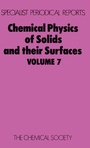
Chemical Physics of Solids and Their Surfaces
Volume 7
1st Edition
Published on 31. October 2007
190 pages
978-1-84755-580-9 (ISBN)
Description

Specialist Periodical Reports provide systematic and detailed review coverage of progress in the major areas of chemical research. Written by experts in their specialist fields the series creates a unique service for the active research chemist, supplying regular critical in-depth accounts of progress in particular areas of chemistry. For over 80 years the Royal Society of Chemistry and its predecessor, the Chemical Society, have been publishing reports charting developments in chemistry, which originally took the form of Annual Reports. However, by 1967 the whole spectrum of chemistry could no longer be contained within one volume and the series Specialist Periodical Reports was born. The Annual Reports themselves still existed but were divided into two, and subsequently three, volumes covering Inorganic, Organic and Physical Chemistry. For more general coverage of the highlights in chemistry they remain a 'must'. Since that time the SPR series has altered according to the fluctuating degree of activity in various fields of chemistry. Some titles have remained unchanged, while others have altered their emphasis along with their titles; some have been combined under a new name whereas others have had to be discontinued.
More details
Series
Edition
1. Auflage
Language
English
Place of publication
Cambridge
United Kingdom
Target group
Professional and scholarly
ISBN-13
978-1-84755-580-9 (9781847555809)
DOI
10.1039/9781847555809
Copyright in bibliographic data and cover images is held by Nielsen Book Services Limited or by the publishers or by their respective licensors: all rights reserved.
Schweitzer Classification
Other editions
Additional editions
Book
01/1978
Royal Society of Chemistry
€398.50
Shipment within 3-4 weeks
Persons
Content
- Chemical Physics Of Solids And Their Surfaces
- Contents
- Chapter 1 Defects and Microstructures in Feldspars
- 1 Introduction
- 2 The Structure of e-Plagioclase
- Background
- Microstructure
- High-resolution, Lattice-imaging TEM
- 3 Defects and Microstructures in Microline and Anorthoclase
- Background
- General Nature of the Microstructures
- Optical Microscopy
- Transmission Electron Microscopy
- Discussion of Observations
- 4 General Discussion
- Chapter 2 The Use of Atom-Atom Potentials in Interpreting the Behaviour of Organic Molecular Crystals
- 1 Introduction
- 2 Atom-Atom Potentials
- Fundamental Considerations
- Electrostatic Interactions
- Dispersive and Repulsive Interaction Potentials
- 3 Computation of Lattice Energies and Crystal Structures
- 4 Applications
- Molecular Conformations in Perfect Crystals
- 9, 10-Biphenyl Anthracene
- Pyrene
- Polyphenyls
- Barrier Heights to Molecular Rotation in Ordered Crystals
- Planar Faults in Organic Crystals
- Polymorphism and Co-existance of Phases
- Other Types of Defect Disorders in Molecular Crystals
- Lattice Dynamics
- 5 Concluding Remarks
- Chapter 3 The Characterization and Properties of Small Metal Particles
- 1 Introduction
- 2 Morphology and Electronic Properties of Small Metal Particles
- Structural Considerations
- Electronic Properties
- Theoretical Descriptions
- 3 Metal Particle Preparation on a Support Material
- The Vacuum Deposition Approach
- Cluster and Cluster Compounds
- 4 Matrix Isolation Techniques
- Metal Cluster Formation
- Chemisorption Simulation
- 5 Conclusions and Outlook
- Chapter 4 Neutron Scattering from Adsorbed Molecules, Surfaces, and Intercalates
- 1 Introduction
- 2 Experimental Techniques
- 3 Comparison with other Surface Techniques
- Inelastic Incoherent Neutron Scattering
- Elastic Coherent Scattering
- Diffusion Measurements
- Magnetic Scattering
- Inelastic Coherent Scattering
- 4 Theory
- Scattering Intensities in Inelastic Scattering
- The Influence of Diffusion on the Scattering Cross-section
- 5 Physisorbed Gases
- Nitrogen, Oxygen, and the Inert gases Adsorbed on Graphite
- Hydrogen and Hydrogenous Molecules Adsorbed on Graphite
- Hydrogen
- CH4, C2H4, and C2H2
- C4H10
- C5H12
- NH3
- 6 Chemisorbed Gases
- Chemisorption on Metal Surfaces
- Adsorption on Oxide Surfaces
- Vibration Spectra
- Quasielastic Scattering
- 7 Clean Surfaces
- The Density of Phonon States at the Surface
- Surface Magnetism
- 8 Intercalated Phases
- Structural Investigations
- Dynamics
- Spectroscopic Measurements
- Quasielastic Scattering
- 9 Future Applications
- Chapter 5 Photo-induced Reactivity at Oxide Surfaces
- 1 Introduction
- 2 Photoelectronic Processes
- Optical Absorption
- Photoconductivity and Photoluminescence
- Photochromic and Electro-optical Effects
- 3 Photoeiectrochemical Processes
- Photosensitization of Solids
- Photoelectrocatalysis
- 4 Photoadsorption and Photodesorption at Oxide Surfaces
- General Comments
- Zinc Oxide
- Photoadsorption and Photodesorption Induced by Ultraviolet/Visible Light
- Photoadsorption Induced by X-radiation
- Photoadsorption Induced by ?-radiation
- Magnesium Oxide
- Photoadsorption Induced by ?-radiation
- Titanium Dioxide
- Hydroxylated Surfaces
- Dehydroxylated Surfaces
- 5 Photocatalytic Reactions on Oxide Surfaces
- Zinc Oxide
- Photocatalytic Oxidation of Carbon Monoxide
- Hydrogen-Deuterium Exchange
- Titanium Dioxide
- Photocatalytic Oxidation of Alcohols
- Photocatalytic Oxidation of Alkanes
- Photohydrogenation of Ethyne and Ethene
- 6 Concluding Remarks
- Chapter 6 Reflection-absorption Infrared Spectroscopy
- 1 Introduction
- 2 Physical Basis of Reflection Infrared Spectroscopy
- 3 Experimental Methods
- Wavelength Modulation
- Polarization Modulation
- 4 Applications
- Carbon Monoxide
- Copper
- Silver and Gold
- Palladium
- Platinum
- Rhodium
- Nickel
- Tungsten
- Nitrogen
- Hydrogen
- Oxidation
- Nitric Oxide
- Organic Molecules
- Author Index
