

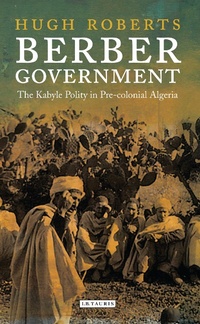
Berber Government
The Kabyle Polity in Pre-Colonial Algeria
1st Edition
Published on 19. August 2014
352 pages
978-0-85772-420-5 (ISBN)
Description

The Berber identity movement in North Africa was pioneered by the Kabyles of Algeria. But a preoccupation with identity and language has obscured the fact that Kabyle dissidence has been rooted in democratic aspirations inspired by the political traditions of Kabylia itself, a mountainous region in northern Algeria. The political organisation of pre-colonial Kabylia, from which these traditions originate, was well-described by nineteenth-century French ethnographers. But their inability to explain it led to a trend amongst later theorists of Berber society, such as Ernest Gellner and Pierre Bourdieu, to dismiss Kabylia's political institutions, notably the jema'a (assembly or council), and to reduce Berber politics to a function of social structure and shared religion. In Berber Government, Hugh Roberts explores the remarkable logics of Kabyle political organisation and the unusual degree of autonomy it enjoyed in relation to both kinship divisions and the religious field. Combining political anthropology and political and social history in an interdisciplinary analysis, this book further offers a pioneering account of the history of Kabylia during the Ottoman period and establishes a radically new way to understand the complex place of the Kabyles in Algerian politics..
Reviews / Votes
Shattering the views of Orientalists and nativists alike, this massively erudite and ruthlessly precise book takes the reader on an exhilarating detective hunt through barely-known sources, exposing a rich political history of Berber self-government that generations of researchers have missed. This is a landmark study that decisively changes the received wisdom on Berbers, Algeria, and the political history of the region. It is one of the best books I have read in Middle East Studies in recent years. * John Chalcraft, Associate Professor, Department of Government, LSE, UK * In Berber Government: the Kabyle polity in pre-colonial Algeria, Hugh Roberts brings to bear his unbeatable knowledge of Ottoman Algerian history and politics as well as his equally impressive gift for social theory. He provides a convincing map of the structures, legal system, and complex social networks that had generated a self-governing Kabyle Berber polity by the advent of French colonial rule * Edmund Burke III, Research Professor of Modern Middle Eastern and World History, Emeritus; University of California, Santa Cruz, USA * Thoroughly researched and well written, this much needed study fills an important gap in the history of the Berbers of Algeria. Roberts challenges the work of scholars such as Ernest Gellner and Pierre Bourdieu demonstrating that the Kabyle polity was much more complicated than they originally claimed. Dense in detail and comprehensive in structure, Roberts's fine contribution to the historiography of the area is indispensable reading for anyone interested in the development of political structures in the pre-colonial Maghreb and, more particularly, in the Kabyles of Algeria. * Patricia M.E. Lorcin, Professor of History, University of Minnesota-Twin Cities, USA * Hugh Roberts's book is sharp, exhaustive, detailed and poignant. It fills an important gap and its general point about the institutional richness of Kabyle politics (and the primacy of politics more generally) is made with devastating effect. The book does not just track and explain five hundred years of 'the Kabyle polity' (though it does that) but also explores the logic of how and why the polity transformed as it did when it did. There is no arguing from first causes or flaccidly conceived 'cultural tendencies'. Roberts alerts us to multiple possible readings of every turn of events, and marshals evidence for his way of understanding each one of them. What makes this intellectually satisfying is the way these are brought together, the way empirical rigor and sometimes bewildering specificity is rendered sensible via a broader logic of institutional forms understood and acted upon in particular cultural ways. Neither the culture nor material conditions explain political life. Political life is undertaken by political actors, whom we get to know through Roberts's description, and these actors employ the institutional resources available to them in culturally sensible ways in their historically specific moments. Eric Wolf long ago complained that European scholars conceive of Others as 'people without history'. Roberts's book is a potent antidote to that. I have not read anything like it. * David Crawford, Professor of Sociology and Anthropology, Fairfield University, USA *More details
Edition
1. Auflage
Language
English
Place of publication
London
United Kingdom
Publishing group
Bloomsbury Publishing PLC
Target group
College/higher education
Professional and scholarly
Illustrations
15 b&w integrated, 12 maps, 13 tables
File size
6,76 MB
ISBN-13
978-0-85772-420-5 (9780857724205)
Copyright in bibliographic data and cover images is held by Nielsen Book Services Limited or by the publishers or by their respective licensors: all rights reserved.
Schweitzer Classification
Other editions
Additional editions
Book
01/2017
I.B. Tauris
€59.60
Shipment within 3-4 weeks
Book
08/2014
I.B. Tauris
€173.50
Shipment within 3-4 weeks
Person
Hugh Roberts is the Edward Keller Professor of North African and Middle Eastern History, Emeritus, at Tufts University, USA, and a Visiting Professor in the Middle East Centre at the London School of Economics and Political Science, UK. He is also the author of The Battlefield: Algeria 1988-2002 (2017).
Content
Chapter 1: Considering Kabylia
Chapter 2: Economy and Forms of Settlement
Chapter 3: Kabyle Law
Chapter 4: The Kabyle Polity
Chapter 5: Pre-colonial Kabylia and the Regency: Religion and Political Development, 1509-1639
Chapter 6: The Rise and Fall of the Lords of Koukou
Chapter 7: The Reconstitution of Greater Kabylia after 1640
Chapter 8: Transcending Kabylia: the Constitutional Tradition and the Exceptional Tradition
Chapter 2: Economy and Forms of Settlement
Chapter 3: Kabyle Law
Chapter 4: The Kabyle Polity
Chapter 5: Pre-colonial Kabylia and the Regency: Religion and Political Development, 1509-1639
Chapter 6: The Rise and Fall of the Lords of Koukou
Chapter 7: The Reconstitution of Greater Kabylia after 1640
Chapter 8: Transcending Kabylia: the Constitutional Tradition and the Exceptional Tradition
