

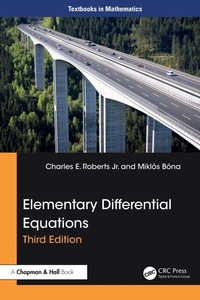
Elementary Differential Equations
3rd Edition
Published on 9. June 2026
558 pages
978-1-040-55841-6 (ISBN)
Description

This book is written to innovate the standard course and to modernize it. There has been a dramatic change in the past century in how solutions to differential equations are calculated. However, the way the topic has been taught in introductory courses has barely changed to reflect these advances, which leaves students at a disadvantage.
Elementary Differential Equations, Third Edition builds on the previous editions, continuing to innovate with the addition of a new topic: combinatorics. The goal is to assist instructors as they facilitate new teaching methods and utilize the latest technology and to provide flexibility in presenting a new topic to encourage students to explore mathematics and not only its applications.
The text is designed to help instructors who want to use computers in their classrooms. It accomplishes this by emphasizing and integrating computers. Many examples and exercises included in the text require the use of computer software to solve problems. It should be noted that since instructors use their own preferred software, this book has been written to be independent of any specific software package.
Features:
Focuses on numerical methods and computing to generate solutions
Features extensive coverage of nonlinear differential equations and nonlinear systems
Contains a wider variety of non-mathematical models than any competing textbook
In the new Chapter 11, readers will learn notions of set partitions, graphs, and rooted trees, the concept of exponential generating functions, and see how differential equations can be surprisingly useful in solving complex counting problems
The third edition continues to serve as an excellent introductory textbook for undergraduate students majoring in applied mathematics, computer science, various engineering disciplines, and other sciences. They also will find that the textbook will aid them greatly in their professional careers because of its instructions on how to use computers to solve equations.
Elementary Differential Equations, Third Edition builds on the previous editions, continuing to innovate with the addition of a new topic: combinatorics. The goal is to assist instructors as they facilitate new teaching methods and utilize the latest technology and to provide flexibility in presenting a new topic to encourage students to explore mathematics and not only its applications.
The text is designed to help instructors who want to use computers in their classrooms. It accomplishes this by emphasizing and integrating computers. Many examples and exercises included in the text require the use of computer software to solve problems. It should be noted that since instructors use their own preferred software, this book has been written to be independent of any specific software package.
Features:
Focuses on numerical methods and computing to generate solutions
Features extensive coverage of nonlinear differential equations and nonlinear systems
Contains a wider variety of non-mathematical models than any competing textbook
In the new Chapter 11, readers will learn notions of set partitions, graphs, and rooted trees, the concept of exponential generating functions, and see how differential equations can be surprisingly useful in solving complex counting problems
The third edition continues to serve as an excellent introductory textbook for undergraduate students majoring in applied mathematics, computer science, various engineering disciplines, and other sciences. They also will find that the textbook will aid them greatly in their professional careers because of its instructions on how to use computers to solve equations.
More details
Series
Edition
3rd edition
Language
English
Place of publication
London
United Kingdom
Publishing group
Taylor & Francis Ltd
Target group
College/higher education
Illustrations
21 Tables, black and white; 122 Line drawings, black and white; 122 Illustrations, black and white
File size
11,91 MB
ISBN-13
978-1-040-55841-6 (9781040558416)
Copyright in bibliographic data and cover images is held by Nielsen Book Services Limited or by the publishers or by their respective licensors: all rights reserved.
Schweitzer Classification
Other editions
Additional editions
Charles E. Roberts Jr. | Miklos Bona
Elementary Differential Equations
Book
06/2026
3rd Edition
CRC Press
€120.50
Shipment within 15-20 days
Persons
Charles E. Roberts, Jr. (deceased) was Professor Emeritus in the Department of Mathematics and Computer Science at Indiana State University. He is remembered as a master teacher and prolific researcher. His book, A Mathematical Introduction to Proofs, is also published by CRC Press.
Miklos Bona received his Ph.D in mathematics from the Massachusetts Institute of Technology in 1997. Since 1999, he has taught at the University of Florida, where, in 2010, he was inducted into the Academy of Distinguished Teaching Scholars. Professor Bona has mentored numerous graduate and undergraduate students. He is the author of five books and more than 100 research articles, mostly focusing on enumerative and analytic combinatorics. His book, Combinatorics of Permutations, won a 2006 Outstanding Title Award from Choice, the journal of the American Library Association. He is also an Editor-in-Chief for the Electronic Journal of Combinatorics, and for two book series at CRC Press.
Miklos Bona received his Ph.D in mathematics from the Massachusetts Institute of Technology in 1997. Since 1999, he has taught at the University of Florida, where, in 2010, he was inducted into the Academy of Distinguished Teaching Scholars. Professor Bona has mentored numerous graduate and undergraduate students. He is the author of five books and more than 100 research articles, mostly focusing on enumerative and analytic combinatorics. His book, Combinatorics of Permutations, won a 2006 Outstanding Title Award from Choice, the journal of the American Library Association. He is also an Editor-in-Chief for the Electronic Journal of Combinatorics, and for two book series at CRC Press.
Content
About the Authors. Preface to the Second Edition. Acknowledgments. Preface to the Third Edition. 1 Introduction. 2 The Initial Value Problem y' = f(x, y); y(c) = d. 3 Applications of the Initial Value Problem y' = f(x, y); y(c) = d 87. 4 N-th Order Linear Differential Equations. 5 The Laplace Transform Method. 6 Applications of Linear Differential Equations with Constant Coefficients. 7 Systems of First-Order Differential Equations. 8 Linear Systems of First-Order Differential Equations. 9 Applications of Linear Systems with Constant Coefficients. 10 Applications of Systems of Equations. 11 Applications to Combinatorics. A Appendix. Answers to Selected Exercises. References. Index.
