

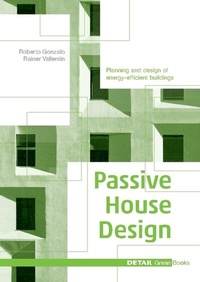
Passive House Design
Planning and design of energy-efficient buildings
Published on 9. September 2014
144 pages
978-3-95553-221-5 (ISBN)
Description

"Passive House Design" provides architects with the confidence required to deal with the Passive House Standard. It shows where there is significant scope for design and explains design strategies that lead to better passive houses. A selection of international buildings illustrate how design, construction and building technology combine in passive houses. Chapters on building physics, building services engineering and energy balancing round out the planning guidelines.
More details
Edition
Digital original
Language
English
Place of publication
Munchen
Germany
Target group
Professional and scholarly
US School Grade: College Graduate Student
Edition type
Digital original
Illustrations
380 Abbildungen
380 Illustrations
File size
25,63 MB
ISBN-13
978-3-95553-221-5 (9783955532215)
Copyright in bibliographic data and cover images is held by Nielsen Book Services Limited or by the publishers or by their respective licensors: all rights reserved.
Schweitzer Classification
Other editions
Additional editions
Book
06/2014
1st Edition
Detail Architecture
€59.90
Article exhausted; check different version
Persons
Dr.-Ing. Roberto Gonzalo and Dr. -Ing. Rainer Vallentin, Munich, Germany.
Content
- Intro
- Contents
- Introduction
- Principles
- Concept approach: energy efficiency
- Definition of the Passive House standard
- Passive House components
- How does a Passive House work at different times of the year?
- Thermal comfort and wellbeing
- Scope and field of application
- Economy
- Energy-related sustainability and climate protection
- Passive House planning
- Main principles and comparison with other standards
- Passive house criteria
- Passive House Planning Package (PHPP)
- Certified building components
- Certification of Passive House buildings
- Certified Passive House designers
- EnerPHit standard
- Minergie-P standard
- 2000-Watt Society - SIA D 216
- Net-zero energy standard
- Design and planning principles
- General design issues
- Passive House design principles
- Principle of thermal envelope and form factor
- Principle of homogeneity
- Solar building design in Passive Houses
- The importance of window placement
- Basic principles of Passive House building services
- Design-based energy balance
- Impact of regional and urban climate
- Coordination of individual aspects
- Residential projects
- Reference buildings - residential
- Urban design
- Impact of energy-related aspects on the urban design
- Design principles of compact and solar building
- Model urban design guidelines
- Reference projects
- Completed Passive House developments
- Non-residential building
- Passive House principles in non-residential buildings
- Energy balance
- Features of different building typologies
- Reference buildings - non-residential
- Passive House refurbishment
- Conditions for an energy efficiency refurbishment
- Refurbishment standards and strategies
- Energy balance and individual measures
- Outlook
- Reference buildings - Passive House refurbishments
- Building envelope components
- Significance of the building envelope
- Opaque envelope constructions
- Transparent components
- Other construction elements and special components
- Building methods and construction systems
- Building services
- Ventilation
- Space heating
- Heat supply concepts
- Energy-efficient cooling systems
- Outlook
- Appendix
