

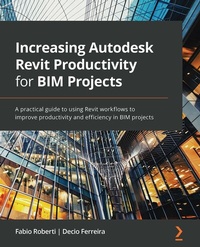
Increasing Autodesk Revit Productivity for BIM Projects
A practical guide to using Revit workflows to improve productivity and efficiency in BIM projects
Published on 23. September 2024
492 pages
978-1-80056-640-8 (ISBN)
Description

Implement Revit best practices with Dynamo and Power BI to visualize and analyze BIM information
Key Features
Boost productivity in Revit and apply multiple workflows to work efficiently on BIM projects
Optimize your daily work in Revit to perform more tasks in less time
Take a hands-on approach to improving your efficiency with useful explanations, which will step-change your productivity
Book DescriptionIncreasing Autodesk Revit Productivity for BIM Projects takes a hands-on approach to implementing Revit effectively for everyone curious about this new and exciting methodology. Complete with step-by-step explanations of essential concepts and practical examples, this Revit book begins by explaining the principles of productivity in Revit and data management for BIM projects. You'll get to grips with the primary BIM documentation to start a BIM project, including the contract, Exchange Information Requirements (EIR), and BIM Execution Plan (BEP/BXP). Later, you'll create a Revit template, start a Revit project, and explore the core functionalities of Revit to increase productivity. Once you've built the foundation, you'll learn about Revit plugins and use Dynamo for visual programming and Power BI for analyzing BIM information. By the end of this book, you'll have a solid understanding of Revit as construction and design software, how to increase productivity in Revit, and how to apply multiple workflows in your project to manage BIM.What you will learn
Explore the primary BIM documentation to start a BIM project
Set up a Revit project and apply the correct coordinate system to ensure long-term productivity
Improve the efficiency of Revit core functionalities that apply to daily activities
Use visual programming with Dynamo to boost productivity and manage data in BIM projects
Import data from Revit to Power BI and create project dashboards to analyze data
Discover the different Revit plugins for improved productivity, visualization, and analysis
Implement best practices for modeling in Revit
Who this book is forThis book is for architects, designers, engineers, modelers, BIM coordinators, and BIM managers interested in learning Autodesk Revit best practices. Increasing Autodesk Revit Productivity for BIM Projects will help you to explore the methodology that combines information management and research for quality inputs when working in Revit.
Key Features
Boost productivity in Revit and apply multiple workflows to work efficiently on BIM projects
Optimize your daily work in Revit to perform more tasks in less time
Take a hands-on approach to improving your efficiency with useful explanations, which will step-change your productivity
Book DescriptionIncreasing Autodesk Revit Productivity for BIM Projects takes a hands-on approach to implementing Revit effectively for everyone curious about this new and exciting methodology. Complete with step-by-step explanations of essential concepts and practical examples, this Revit book begins by explaining the principles of productivity in Revit and data management for BIM projects. You'll get to grips with the primary BIM documentation to start a BIM project, including the contract, Exchange Information Requirements (EIR), and BIM Execution Plan (BEP/BXP). Later, you'll create a Revit template, start a Revit project, and explore the core functionalities of Revit to increase productivity. Once you've built the foundation, you'll learn about Revit plugins and use Dynamo for visual programming and Power BI for analyzing BIM information. By the end of this book, you'll have a solid understanding of Revit as construction and design software, how to increase productivity in Revit, and how to apply multiple workflows in your project to manage BIM.What you will learn
Explore the primary BIM documentation to start a BIM project
Set up a Revit project and apply the correct coordinate system to ensure long-term productivity
Improve the efficiency of Revit core functionalities that apply to daily activities
Use visual programming with Dynamo to boost productivity and manage data in BIM projects
Import data from Revit to Power BI and create project dashboards to analyze data
Discover the different Revit plugins for improved productivity, visualization, and analysis
Implement best practices for modeling in Revit
Who this book is forThis book is for architects, designers, engineers, modelers, BIM coordinators, and BIM managers interested in learning Autodesk Revit best practices. Increasing Autodesk Revit Productivity for BIM Projects will help you to explore the methodology that combines information management and research for quality inputs when working in Revit.
All prices
More details
Edition
Digital original
Language
English
Place of publication
Birmingham
United Kingdom
Target group
Professional and scholarly
US School Grade: College Graduate Student
Edition type
Digital original
Product notice
Reflowable
File size
34,25 MB
ISBN-13
978-1-80056-640-8 (9781800566408)
Copyright in bibliographic data and cover images is held by Nielsen Book Services Limited or by the publishers or by their respective licensors: all rights reserved.
Schweitzer Classification
Other editions
Additional editions
Fabio Roberti | Decio Ferreira
Increasing Autodesk Revit Productivity for BIM Projects
A practical guide to using Revit workflows to improve productivity and efficiency in BIM projects
Book
11/2021
Packt Publishing
€57.60
Shipment within 3-4 weeks
Persons
Roberti Fabio :
Fabio Roberti is a Regional Practice Technology Leader (EMEA) and Associate at HKS Architects, where he develops and implements the digital strategy to consolidate processes and workflows to enhance project deliverables. He supports BIM processes in innovative ways to improve technology adoption with a thorough understanding of British Standards and the ISO 19650 framework and has many years of experience using Revit across all design stages. He holds a Master's degree in Architecture, the Autodesk Revit Architecture Professional Certificate, and a BIM Level 2 Certificate from BRE Academy. Fabio has presented at multiple conferences, including Digital Construction Week and Autodesk University in London and Las Vegas. His passions for digital technology and teaching others new skills helped him achieve his company's objectives and support many colleagues over the years. Besides BIM excellence, Fabio is interested in the rapidly advancing artificial intelligence sector, programming, and technologies that support superior construction deliverables.Ferreira Decio :
Decio Ferreira, with over 20 years of professional experience as an Architect, is a BIM and Design Systems BIM Coordinator at Foster+Partners, where he is responsible alongside with his team for developing and implementing standards, methods, and procedures across the practice. He is a strong, committed individual who thrives when developing and researching BIM strategies, workflows, and approaches to improve what he believes to be the most important: collaboration. He holds three BIM certifications: BIM Level 2 Fundamentals and BIM Level 2 BS1192-2 Project Information Manager and Task Information Management, both from BRE Academy, and BS EN ISO 19650-3:2020 from BSI, both in London. In terms of software, he has worked with Revit since 2000 and holds Autodesk Revit Architectural, Structural and Mechanical Professional Certificates (since version 2011), along with an AutoCAD Professional Certificate (since version 2005), and is an Autodesk Certified trainer. He lectures at several academic institutions as a guest lecturer and actively lectures at NossoBIM on the International Master BIM Manager program and also at Polytechnic Institute ISEP (Instituto Superior de Engenharia do Porto), providing a high level of expertise in the BIM software training field. Decio has presented at multiple conferences, including at Autodesk University in Las Vegas and Sao Paulo. Decio is passionate about photography, planes, and traveling, which allows him to contact, learn about, and understand new cultures and different lifestyles. For him, there is nothing more important than his family!
Fabio Roberti is a Regional Practice Technology Leader (EMEA) and Associate at HKS Architects, where he develops and implements the digital strategy to consolidate processes and workflows to enhance project deliverables. He supports BIM processes in innovative ways to improve technology adoption with a thorough understanding of British Standards and the ISO 19650 framework and has many years of experience using Revit across all design stages. He holds a Master's degree in Architecture, the Autodesk Revit Architecture Professional Certificate, and a BIM Level 2 Certificate from BRE Academy. Fabio has presented at multiple conferences, including Digital Construction Week and Autodesk University in London and Las Vegas. His passions for digital technology and teaching others new skills helped him achieve his company's objectives and support many colleagues over the years. Besides BIM excellence, Fabio is interested in the rapidly advancing artificial intelligence sector, programming, and technologies that support superior construction deliverables.Ferreira Decio :
Decio Ferreira, with over 20 years of professional experience as an Architect, is a BIM and Design Systems BIM Coordinator at Foster+Partners, where he is responsible alongside with his team for developing and implementing standards, methods, and procedures across the practice. He is a strong, committed individual who thrives when developing and researching BIM strategies, workflows, and approaches to improve what he believes to be the most important: collaboration. He holds three BIM certifications: BIM Level 2 Fundamentals and BIM Level 2 BS1192-2 Project Information Manager and Task Information Management, both from BRE Academy, and BS EN ISO 19650-3:2020 from BSI, both in London. In terms of software, he has worked with Revit since 2000 and holds Autodesk Revit Architectural, Structural and Mechanical Professional Certificates (since version 2011), along with an AutoCAD Professional Certificate (since version 2005), and is an Autodesk Certified trainer. He lectures at several academic institutions as a guest lecturer and actively lectures at NossoBIM on the International Master BIM Manager program and also at Polytechnic Institute ISEP (Instituto Superior de Engenharia do Porto), providing a high level of expertise in the BIM software training field. Decio has presented at multiple conferences, including at Autodesk University in Las Vegas and Sao Paulo. Decio is passionate about photography, planes, and traveling, which allows him to contact, learn about, and understand new cultures and different lifestyles. For him, there is nothing more important than his family!
Content
Table of Contents
Introduction to Productivity in Revit
Project Data Management
Revit Templates and Standards
Starting a Revit Project Efficiently
Core Revit Functionalities
Visual Programming with Dynamo
Dashboard Analyses with Power BI
Collaborating With Consultants
Enhancing Productivity with Plugins
Improving Performance
Introduction to Productivity in Revit
Project Data Management
Revit Templates and Standards
Starting a Revit Project Efficiently
Core Revit Functionalities
Visual Programming with Dynamo
Dashboard Analyses with Power BI
Collaborating With Consultants
Enhancing Productivity with Plugins
Improving Performance
