

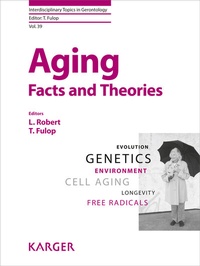
Aging
Facts and Theories
1st Edition
Published on 15. May 2014
216 pages
978-3-318-02653-5 (ISBN)
Available for download
Description

Aging inspired a large number of theories trying to rationalize the aging process common to all living beings. In this publication the most important environmental and intrinsic mechanisms involved in the aging process and in its pathological consequences are reviewed. Furthermore theoretical and experimental evidence of the most important theoretical elements based on Darwinian evolution, cellular aging, role of cell membranes, free radicals and oxidative processes, receptor-mediated reactions, the extracellular matrix and immune functions as well as the most important environmental and intrinsic mechanisms involved in the aging process and in its pathological consequences are discussed. These presentations of theories and related experimental facts give a global overview of up to date concepts of the biology of the aging process and are of essential reading not only for specialists in this field but also for practitioners of scientific, medical, social and experimental sciences.
More details
Other editions
Additional editions
Book
05/2014
1st Edition
S. Karger
€57.80
Article exhausted; check different version
Persons
Content
- Cover
- Front Matter
- Contents
- Preface
- References
- The Commitment of Human Cells to Senescence
- Abstract
- The Commitment Theory of Cellular Aging
- Experimental Tests of the Commitment Theory
- The Longevities of Human Skin Fibroblasts
- Mixed Populations
- Commitment, the Loss of Telomerase and DNA Methylation
- Conclusions
- References
- Evolutionary Theories of Aging Can Explain Why We Age
- Abstract
- Longevity and the Other Life History Traits
- Living in the Wild: A World of Constraints
- A Summary of the Classic Evolutionary Theories of Aging
- Some Consequences of Evolutionary Theories for the Biology of Aging
- Challenges to the Evolutionary Theories of Aging
- Conclusions
- References
- Control of Cell Replication during Aging
- Abstract
- The Concept of Aging of Proliferative Cells
- Contradictions in the Term 'Cell Senescence'
- The Search for Mechanisms Causing 'Cell Senescence'
- Quest for the 'Senescent Cell' in vivo
- Back to Reality: Relevance of the Control of Cell Division for Aging of the Organism according to the Data
- References
- Cell Senescence: Role in Aging and Age-Related Diseases
- Abstract
- Cell Aging in vitro: The Hayflick Paradigm
- End of Proliferation: The Senescent Phenotype
- The Senescent Cell
- References
- Aging of Cell Membranes: Facts and Theories
- Abstract
- The Main Roots of a Synthetic and Critical Approach to the Biology of Aging
- The First Personal Results
- The Main Facts Involved in the Membrane Hypothesis of Aging
- The Relationship between the Membrane Hypothesis of Aging and the Genetic Results
- The Anti-Aging Experiments with Centrophenoxine
- The Role of the Species-Specific Factors in the Aging Process
- References
- Oxidative Stress, Mitochondrial Dysfunction and the Mitochondria Theory of Aging
- Abstract
- Reactive Oxygen Species
- Accumulation of Oxidative Damage in Mitochondria with Age
- Reactive Oxygen Species, Oxidative Stress, Mitochondrial Dysfunction and Aging
- Mitochondrial Dysfunction, Reactive Oxygen Species and Age-Associated Diseases
- Reactive Oxygen Species as Signaling Molecules in Aging
- References
- Aging of Connective Tissues: Experimental Facts and Theoretical Considerations
- Abstract
- Evolution of the Tissue Concept
- Phylogenetic Origins of Connective Tissues
- Cell-Matrix Interactions
- Aging of Connective Tissues
- Effect of Aging on Cell-Matrix Interactions
- Theoretical Considerations
- References
- Aging of Cell Communication: Loss of Receptor Function
- Abstract
- Age-Dependent Loss of Functions
- Loss of Receptor-Mediated Transmission Function
- Uncoupling of the Elastin-Receptor Transmission Pathway
- Receptors and Aging of the Heart Muscle
- Receptors of the Immune System as another Example of Receptor Function Alterations with Aging
- Some Theoretical Considerations
- References
- On the Immunological Theory of Aging
- Abstract
- The Role of the Immune System
- Innate Immunity
- Adaptive Immunity
- The Immune System, a System among Others
- Immunosenescence: Where Do We Stand?
- Inflamm-Aging
- How Do Immunosenescence and Inflamm-Aging Impact on Survival?
- On The Immunological Theory of Aging
- Conclusions
- Acknowledgments
- References
- Aging of the Brain, Dementias, Role of Infectious Proteins: Facts and Theories
- Abstract
- Protein Folding and Proteostasis
- Toxic Proteins in Neurodegenerative Diseases
- How Do Proteinopathies Spread?
- Protein Strains and Neurodegenerative Diseases
- Proteolytic Systems and Aging
- Drosophila as a Model to Study Human Neurodegenerative Diseases
- Reflection
- References
- Aging as Alteration
- Abstract
- Can Aging Be Reduced to an Entropic Cost?
- Aging as a Repulsive Organizational Constraint
- Vicious Circles
- Alteration and Delay
- Conclusion
- References
- Longevity and Its Regulation: Centenarians and Beyond
- Abstract
- Genetic and Environmental Determinants of Longevity
- The Role of Tinkering
- Epidemiological Approach
- References
- Subject Index
- Cover

