

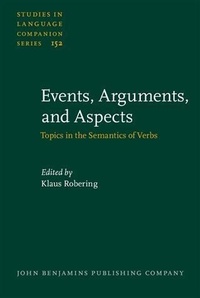
Events, Arguments, and Aspects
Topics in the Semantics of Verbs
1st Edition
Published on 28. March 2014
VIII, 373 pages
978-90-272-7062-7 (ISBN)
Description

The verb has often been considered the 'center' of the sentence and has hence always attracted the special attention of the linguist. The present volume collects novel approaches to two classical topics within verbal semantics, namely argument structure and the treatment of time and aspect. The linguistic material covered comes from a broad spectrum of languages including English, German, Danish, Ukrainian, and Australian aboriginal languages; and methods from both cognitive and formal semantics are applied in the analyses presented here. Some of the authors use a variety of event semantics in order to analyze argument structure and aspect whereas others employ ideas coming from object-oriented programming in order to achieve new insights into the way how verbs select their arguments and how events are classified into different types. Both kinds of methods are also used to give accounts of dynamical aspects of semantic interpretation such as coercion and type shifting.
More details
Other editions
Additional editions
Book
03/2014
John Benjamins Publishing Co
€111.30
Shipment within 10-15 days
Person
Content
- Events, Arguments, and Aspects
- Editorial page
- Title page
- LCC data
- Table of contents
- Preface
- Introduction: Events, arguments, and aspects
- 1. Two issues in the semantics of verbs
- 2. Arguments
- 2.1 Theories of argument structure
- 2.2 Introductory comments on the articles
- 3. Time, eventities, and aspect
- 3.1 Time
- 3.2 Eventities
- 3.3 Aspect
- 3.4 Introductory comments on the articles
- 4. Brief note on notation
- Bibliography
- part i Verb meaning and argument structure
- 1. Ergativity and the object-oriented representation of verb meaning
- 1. Introduction
- 2. The object-oriented paradigm
- 3. Polysemy and argument roles
- 4. Ergativity
- 5. Correlates of the ergative/absolutive distinction
- 5.1 Bondedness to the verb
- 5.2 Control phenomena
- 6. Conclusion
- Bibliography
- 2. Grammatical metaphors and there-insertion in Danish
- 1. Introduction
- 2. Grammatical metaphors
- 3. Unaccusativity
- 4. The position of the logical subject
- 5. Aktionsart and event structure
- 6. The there-insertion constraint
- 7. Danish transitive verbs in there-constructions(
- 8. Formal analysis of transitive verbs
- 9. Arguments and topology(
- 10. Passives
- 11. Conclusion
- Bibliography
- 3. Abstract objects of verbs
- 1. Introduction
- 1.1 Verbs and their arguments
- 1.2 Classifying linguistic signs
- 2. Explaining the theory
- 2.1 The traditional analysis
- 2.2 Types and polymorphism(
- 2.3 Representation by abstract objects
- 2.4 Identifying objects(
- 3. Types and representation
- 3.1 Types as data types
- 3.2 Uniqueness and elimination
- 4. Comprehension
- 4.1 Problems with functions
- 4.2 More problems
- 4.3 A way out (?)
- 5. Historical remarks
- 6. Appendix: Ackermann's original system
- 6.1 Axioms of propositional logic
- 6.2 Axioms of predicate logic
- 6.3 Axioms for identity
- 6.4 Axioms of class theory
- 6.5 Rules
- Bibliography
- 4. Object-orientation and the semantics of verbs
- 1. Introduction
- 2. Object-orientation and its relevance to semantics
- 3. Modeling object-oriented: Unified Modeling Language (UML)
- 4. Verbal meaning
- 5. Object-oriented representation of verbal meaning: The basics
- 6. Multi-layered architecture
- 7. Eventity classes
- Bibliography
- Part II. Aspect and aktionsart
- 5. Aspectual coercion and eventuality structure
- 1. Introduction
- 2. A survey of eventuality structure
- 2.1 Aspectuality and eventuality structure
- 2.2 Sortal structure of eventualities
- 2.3 Intersortal structure of eventualities
- 3. A system of aspectual coercion
- 3.1 Coercion by durative adverbials
- 3.2 Coercion by time-span adverbials
- 3.3 Coercion by time-point adverbials
- 3.4 Coercion by the progressive
- 3.5 A two-stage approach: Aspectual coercion as pragmatic enrichment
- 4. Conclusion
- Bibliography
- 6. Phases in verbal semantics
- 1. Introduction
- 1.1 Phasal verb research and the phasal verb interface complex
- 1.2 Classical and medieval reasoning on phasal verbs and its connection with modern theories
- 2. Modern approaches to phasal verbs
- 2.1 Phasal verbs and the notion of boundedness (Jackendoff)
- 2.2 Explaining polysemy and underspecification in phasal verbs (Pustejovsky)
- 2.3 Interval semantics and phasal verbs (Partee & Bennett)
- 3. A model for the description of phasal verbs
- 3.1 Simple phase semantics: SPS
- 3.2 Conceptual completeness: CC
- 3.3 Time condition: TC
- 3.4 Restricted categorical selection: RCS
- 3.5 Participant reconstruction: PR
- 4. Conclusion and perspectives
- Bibliography
- 7. How light are aspectual meanings? A study of the relation between light verbs in Ukrainian
- 1. Theoretical and methodological preliminaries
- 1.1 Grammatical aspects vs. aktionsarten
- 1.2 Lexical aspects
- 1.3 Definitions and diagnostic tests for lexical aspects
- 1.4 Aspectual coercion
- 1.5 Light verbs
- 1.6 Two functional approaches to grammar
- 1.7 Dictionary definitions and semantic knowledge
- 2. Empirical base and methodological procedure
- 2.1 Some observations about the definitions in SUM (2004)
- 2.2 Analytical procedure
- 3. Types of light verbs
- 3.1 Lightness vs. frequency
- 3.2 Compensators, modifiers and complicators
- 3.3 Semantic relations between light verbs as defining units
- 3.4 Semantic types of objects of light verbs
- 3.5 Light verbs and lexical aspects
- 4. Vendlerian lexical aspects
- 4.1 States
- 4.2 Activities
- 4.3 Achievements
- 4.4 Accomplishments
- 5. Conclusions: Light verbs, aktionsarten, and lexical aspects
- Bibliography
- 8. The 'say, do' verb in Nyulnyul, Warrwa, and other Nyulnyulan languages is monosemic
- 1. Introduction
- 2. Morphology
- 3. {-JI} 'say' as a simple verb
- 4. {-Ji} 'say' in compound verb constructions
- 5. On the meaning of {-JI} 'say'
- 6. Conclusion
- Bibliography
- 9. Predicate classes: A study in compositional semantics
- 1. Introduction
- 2. Discussing the state of the art
- 3. What are the criterial features for classification?
- 3.1 States and properties
- 3.2 Events
- 3.3 Durativity
- 3.4 Resultativity
- 3.5 Perfectivity and imperfectivity
- 3.6 A short note on ambiguity and underspecification
- 3.7 Punctuality
- 3.8 Summary
- 4. Classification according to verbal aspect and elementary predicates
- 4.1 Descriptive classification based on verbal aspect and argument structure
- 4.2 Resultativity and causativity
- 4.3 Resultativity without BECOME
- 4.4 Lexical entries for all classes
- 4.5 Some more examples
- 5. Prospectus: Predicate classes, tense and aspect
- 5.1 "Tense" is a characteristic function
- 5.2 Form and interpretation of inflection
- 5.3 Sentential aspect, temporal adverbials and the German perfect tense
- 6. Conclusion
- Bibliography
- Index of names
- Index of objects
