

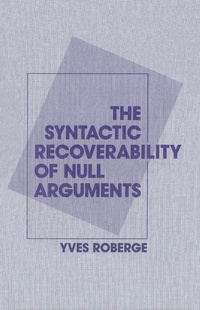
The Syntactic Recoverability of Null Arguments
1st Edition
Published on 14. May 2014
228 pages
978-0-7735-6229-5 (ISBN)
Description

Recent work in the generative framework of grammar has avoided explicit language-particular syntactic rules. This has had definite consequences for some theories of recoverability. In his solidly argued work, Yves Roberge considers the possibility that empty syntactic argument positions, where their content is recoverable in a very local sense, are a property of some natural languages: the null argument property.
More details
Language
English
Place of publication
Montreal, QC
United States
Edition type
Digital original
File size
9,05 MB
ISBN-13
978-0-7735-6229-5 (9780773562295)
Copyright in bibliographic data and cover images is held by Nielsen Book Services Limited or by the publishers or by their respective licensors: all rights reserved.
Schweitzer Classification
Other editions
Additional editions
Yves Roberge
The Syntactic Recoverability of Null Arguments
Book
03/1990
McGill-Queen's University Press
€154.50
Article not available at the moment
Person
Content
- Intro
- Contents
- Preface
- Introduction
- 1 SYNTACTIC THEORY AND NULL ARGUMENTS
- 1.0. Introduction
- 1.1. Variation and Learnability
- 1.1.1. The Government and Binding Framework
- 1.2. Null Arguments
- 1.2.1. Previous Analyses
- 1.2.2. Zero-Topic Languages
- 1.2.3. A Theory of pro
- 1.3. On Empty Categories
- 1.4. Summary
- 2 NULL ARGUMENTS IN ROMANCE LANGUAGES
- 2.0. Introduction
- 2.1. A Generalization
- 2.2. Pro and Clitics
- 2.2.1. On pro
- 2.2.2. On Agreement
- 2.2.3. Subject Clitics and Object Clitics
- 2.2.4. Base Generation of Clitics
- 2.2.5. Case and ?-Role
- 2.3. On the Non-Existence of the Null Subject Parameter
- 2.4. Free Inversion
- 2.5. Causatives
- 2.6. Summary
- 3 ON CLITIC DOUBLING
- 3.0. Introduction
- 3.1. Subject Doubling
- 3.1.1. Northern Italian Dialects
- 3.1.2. Previous Analyses
- 3.1.3. French Dialects
- 3.1.4. Analysis
- 3.2. Object Doubling and Subject Doubling
- 3.2.1. Structures
- 3.2.2. Case Assignment
- 3.3. Extractions
- 3.3.1. The Facts
- 3.3.2. Summary
- 3.3.3. Previous Accounts
- 3.3.4. C-Chains
- 3.4. A Note on Complex Inversion
- 3.5. A Note on Reflexive se
- 3.6. Summary
- 4 CLITICS AND AGREEMENT MARKERS
- 4.0. Introduction
- 4.1. Subject Cliticization
- 4.1.1. Internal Structure of INFL
- 4.1.2. Verb Raising or INFL Lowering?
- 4.1.3. Coordination
- 4.2. Agreement Markers vs. Clitics
- 4.2.1. Coordination
- 4.2.2. Doubling
- 4.2.3. Extractions
- 4.2.4. Obligatoriness
- 4.2.5. Morphology
- 4.2.6. Conclusion
- 4.3. Historical Speculations
- 4.4. Summary
- Conclusion
- Notes
- Bibliography
- Index
- A
- B
- C
- D
- E
- F
- G
- H
- I
- J
- K
- L
- M
- N
- O
- P
- Q
- R
- S
- T
- U
- V
- W
- X
- Y
- Z
