

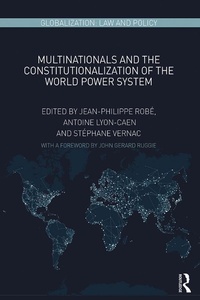
Multinationals and the Constitutionalization of the World Power System
1st Edition
Published on 3. June 2016
264 pages
978-1-317-09334-3 (ISBN)
Description

This collection offers a powerful and coherent study of the transformation of the multinational enterprise as both an object and subject of law within and beyond States. The study develops an analysis of the large firm as being a system of organization exercising vast powers through various instruments of private law, such as property rights, contracts and corporations.
The volume focuses on the firm as the operational unit of governance within emerging systems of globalization, whilst exploring in-depth the forms within which the firm might be regulated as against the inhibiting parameters of national law. It connects, through the ordering concept of the firm in globalization, the distinct regimes of constitutionalization, national and international law.
The study will be of interest to students and academics in globalization and the regulation of multinational corporations, as well as law, economics and politics on a global scale. It will also interest government leaders and NGOs working in the areas of MNE regulations.
The volume focuses on the firm as the operational unit of governance within emerging systems of globalization, whilst exploring in-depth the forms within which the firm might be regulated as against the inhibiting parameters of national law. It connects, through the ordering concept of the firm in globalization, the distinct regimes of constitutionalization, national and international law.
The study will be of interest to students and academics in globalization and the regulation of multinational corporations, as well as law, economics and politics on a global scale. It will also interest government leaders and NGOs working in the areas of MNE regulations.
Reviews / Votes
'Building on a legal pluralist theoretical framework, this study makes a stimulating contribution to the growing body of scholarship dedicated to the private international legal dimension of global governance through its focus on the multinational firm as a power system interacting with a characteristically complex and reflexive regulatory environment.'Horatia Muir Watt, Sciences-Po, France
More details
Series
Edition
1. Auflage
Language
English
Place of publication
London
United Kingdom
Publishing group
Taylor & Francis Ltd
Target group
College/higher education
Illustrations
2 Tables, black and white
File size
1,85 MB
ISBN-13
978-1-317-09334-3 (9781317093343)
Copyright in bibliographic data and cover images is held by Nielsen Book Services Limited or by the publishers or by their respective licensors: all rights reserved.
Schweitzer Classification
Other editions
Additional editions
Jean-Philippe Robe | Antoine Lyon-Caen | Stephane Vernac
Multinationals and the Constitutionalization of the World Power System
Book
05/2018
1st Edition
Routledge
€76.94
Shipment within 10-20 days
Jean-Philippe Robe | Antoine Lyon-Caen | Stephane Vernac
Multinationals and the Constitutionalization of the World Power System
Book
06/2016
1st Edition
Routledge
€222.84
Shipment within 10-20 days
Persons
Jean-Philippe Robe is a French and New York qualified partner in the Paris office of Gibson, Dunn & Crutcher and a specialist in International Business Law. He teaches Globalization and Legal Pluralism at Sciences Po, Paris. He has published widely and has given numerous lectures on enterprise law and corporate governance. In 2016 he was awarded the prestigious Prix du Cercle Montesquieu for his book `Le temps du monde de l'entreprise - Globalisation et mutation du systeme juridique'.
Antoine Lyon-Caen is Professor of Law at the University of Paris West - Nanterre La Defense. He recently rejoined the Board of Lyon-Caen & Thiriez, solicitors to the State Council and Court of Cassation, France. He is the author of many legal publications.
Stephane Vernac lectures in Law at the University of Picardie Jules Verne, France. He is the author of publications on the relationship between labour law and company law and on the regulation of private organizations.
Antoine Lyon-Caen is Professor of Law at the University of Paris West - Nanterre La Defense. He recently rejoined the Board of Lyon-Caen & Thiriez, solicitors to the State Council and Court of Cassation, France. He is the author of many legal publications.
Stephane Vernac lectures in Law at the University of Picardie Jules Verne, France. He is the author of publications on the relationship between labour law and company law and on the regulation of private organizations.
Content
Foreword: constitutionalization and the regulation of transnational firms, John Gerard Ruggie;
Introduction, Jean-Philippe Robe, Antoine Lyon-Caen and Stephane Vernac.
Part I Firms and Power: Globalization and constitutionalization of the world-power system, Jean-Philippe Robe;
Constitutionalizing financial power: the corporation and the new aristocracy of finance, Paddy Ireland;
Corporate power in the global economy: an evolutionary perspective, Ronen Palan;
Powers and responsibilities in multi-member organizations, Elsa Peskine and Stephane Vernac.
Part II The Concept of Constitutionalization: Reflections on the constitutionalization of the world power system, Gunther Teubner;
Law in the global age: heading toward a societal constitutionalism, Jean De Munck;
Constitutionalization outside of the state? A constitutionalist's point of view, Veronique Champeil-Desplat;
The concept of constitutionalization and the multi-corporate enterprise in the 21st century - the body corporate from incarnation to ensoulment to ministry (but whose?), Larry Cata Backer.
Part III The Concept of Constitutionalization Applied to the Firm: Human rights and the constitutionalized corporation, Sheldon Leader;
The responsibility of multinational enterprises: a constitutionalization process in action, Antoine Lyon-Caen and Tatiana Sachs;
'Constitutionalization' and the status of the director: the test of 'say on pay', Charley Hannoun;
Can states regain fiscal sovereignty over globalized business?, Christian Chavagneux.
Afterword;
Index.
Introduction, Jean-Philippe Robe, Antoine Lyon-Caen and Stephane Vernac.
Part I Firms and Power: Globalization and constitutionalization of the world-power system, Jean-Philippe Robe;
Constitutionalizing financial power: the corporation and the new aristocracy of finance, Paddy Ireland;
Corporate power in the global economy: an evolutionary perspective, Ronen Palan;
Powers and responsibilities in multi-member organizations, Elsa Peskine and Stephane Vernac.
Part II The Concept of Constitutionalization: Reflections on the constitutionalization of the world power system, Gunther Teubner;
Law in the global age: heading toward a societal constitutionalism, Jean De Munck;
Constitutionalization outside of the state? A constitutionalist's point of view, Veronique Champeil-Desplat;
The concept of constitutionalization and the multi-corporate enterprise in the 21st century - the body corporate from incarnation to ensoulment to ministry (but whose?), Larry Cata Backer.
Part III The Concept of Constitutionalization Applied to the Firm: Human rights and the constitutionalized corporation, Sheldon Leader;
The responsibility of multinational enterprises: a constitutionalization process in action, Antoine Lyon-Caen and Tatiana Sachs;
'Constitutionalization' and the status of the director: the test of 'say on pay', Charley Hannoun;
Can states regain fiscal sovereignty over globalized business?, Christian Chavagneux.
Afterword;
Index.
