

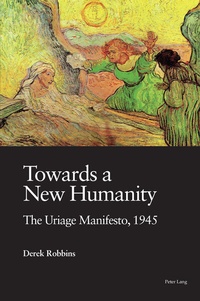
Towards a new humanity
Description

Vers le style du XXe siècle (Towards a style for the 20th Century), by the «Uriage team» under the direction of Gilbert Gadoffre, was published by Seuil in 1945. It was the work of nine authors who had been involved with the «école de cadres» (leadership school) which ran from 1940 until 1945. At first the école was part of a programme initiated by the Youth Ministry of the Vichy government. After the German invasion of the «Unoccupied zone», the team cooperated clandestinely with the Resistance movement. The work offers their vision of how humanity should recover after the trauma of World War II.
Known for his studies of the work of Pierre Bourdieu (1930-2002), Derek Robbins attempts to put into practice Bourdieu's injunction that all intellectual works should be understood «socio-genetically», that is to say as bi-products of the social positions and trajectories of their authors. Towards a New Humanity: The Uriage Manifesto, 1945 offers a translation of the Uriage text, but it offers much more. Robbins examines the social backgrounds of the authors and considers how they adjusted their views in their subsequent careers as de Gaulle normalised much of what they had wanted to challenge.
Produced during the Covid-19 pandemic lockdown, this book examines, as a case-study, the process by which nine privileged Frenchmen articulated a vision for the whole of humanity. Few of their proposals materialised, but their discussion is thought-provoking as we confront our future.
More details
Other editions
Additional editions
Person
Derek Robbins is Emeritus Professor of International Social Theory at the University of East London. He is the author of The Work of Pierre Bourdieu (Open University Press, 1991), Bourdieu and Culture (Sage, 2000), On Bourdieu, Education and Society (Bardwell Press, 2006) and French Post-War Social Theory: International Knowledge Transfer (Sage, 2011). He has published many articles and book chapters on the work of Bourdieu. He edited and introduced Jean-Claude Passeron's Sociological Reasoning, (Bardwell Press, 2013). Most recently, he published Cultural Relativism and International Politics (Sage, 2014) and edited and contributed to the volume on Bourdieu in the Anthem Companions to Sociology series (Anthem Press, 2016). His The Bourdieu paradigm. The origins and evolution of an intellectual social project was published by Manchester University Press in July, 2019.
Content
Contents: L'École des cadres à Uriage: its origins and its originators - L'École des cadres à Uriage: its practice - Vers le style du XXe siècle: its authors - Vers le style du XXe siècle: brief synopsis and introduction to editorial practice - The translated text of Vers le style du XXe siècle - The subsequent careers of the authors - The French reception, 1960- 2020 - Editorial reflections.
