

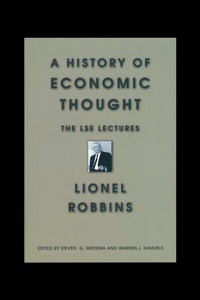
A History of Economic Thought
The LSE Lectures
1st Edition
Published on 16. October 2000
408 pages
978-1-4008-2279-9 (ISBN)
Description

Lionel Robbins's now famous lectures on the history of economic thought comprise one of the greatest accounts since World War II of the evolution of economic ideas. This volume represents the first time those lectures have been published.
Lord Robbins (1898-1984) was a remarkably accomplished thinker, writer, and public figure. He made important contributions to economic theory, methodology, and policy analysis, directed the economic section of Winston Churchill's War Cabinet, and served as chairman of the Financial Times. As a historian of economic ideas, he ranks with Joseph Schumpeter and Jacob Viner as one of the foremost scholars of the century. These lectures, delivered at the London School of Economics between 1979 and 1981 and tape-recorded by Robbins's grandson, display his mastery of the intellectual history of economics, his infectious enthusiasm for the subject, and his eloquence and incisive wit. They cover a broad chronological range, beginning with Plato, Aristotle, and Aquinas, focusing extensively on Adam Smith, Thomas Malthus and the classicals, and finishing with a discussion of moderns and marginalists from Marx to Alfred Marshall. Robbins takes a varied and inclusive approach to intellectual history. As he says in his first lecture: "I shall go my own sweet way--sometimes talk about doctrine, sometimes talk about persons, sometimes talk about periods." The lectures are united by Robbins's conviction that it is impossible to understand adequately contemporary institutions and social sciences without understanding the ideas behind their development.
Authoritative yet accessible, combining the immediacy of the spoken word with Robbins's exceptional talent for clear, well-organized exposition, this volume will be welcomed by anyone interested in the intellectual origins of the modern world.
Lord Robbins (1898-1984) was a remarkably accomplished thinker, writer, and public figure. He made important contributions to economic theory, methodology, and policy analysis, directed the economic section of Winston Churchill's War Cabinet, and served as chairman of the Financial Times. As a historian of economic ideas, he ranks with Joseph Schumpeter and Jacob Viner as one of the foremost scholars of the century. These lectures, delivered at the London School of Economics between 1979 and 1981 and tape-recorded by Robbins's grandson, display his mastery of the intellectual history of economics, his infectious enthusiasm for the subject, and his eloquence and incisive wit. They cover a broad chronological range, beginning with Plato, Aristotle, and Aquinas, focusing extensively on Adam Smith, Thomas Malthus and the classicals, and finishing with a discussion of moderns and marginalists from Marx to Alfred Marshall. Robbins takes a varied and inclusive approach to intellectual history. As he says in his first lecture: "I shall go my own sweet way--sometimes talk about doctrine, sometimes talk about persons, sometimes talk about periods." The lectures are united by Robbins's conviction that it is impossible to understand adequately contemporary institutions and social sciences without understanding the ideas behind their development.
Authoritative yet accessible, combining the immediacy of the spoken word with Robbins's exceptional talent for clear, well-organized exposition, this volume will be welcomed by anyone interested in the intellectual origins of the modern world.
All prices
More details
Edition
Core Textbook
Language
English
Place of publication
Princeton, NJ
United States
Publishing group
De Gruyter
Target group
Professional and scholarly
Edition type
Digital original
Product notice
Reflowable
Illustrations
11 line illus.
File size
1,31 MB
ISBN-13
978-1-4008-2279-9 (9781400822799)
Schweitzer Classification
Other editions
Additional editions
Book
11/2000
Princeton University Press
€49.70
Shipment within 10-20 days
Book
08/1998
Princeton University Press
€68.09
Article exhausted; check different version
Persons
Lionel Robbins taught at the London School of Economics from 1929 to 1961, directed the economic section of the British War Cabinet during World War II, and served as Chairman of the Financial Times from 1961 until 1970. His best known work is An Essay on the Nature and Significance of Economic Science. He became a life peer in 1959 and a Companion of Honour in 1968. Steven G. Medema is Professor of Economics at the University of Colorado at Denver. He is the editor of the Journal of the History of Economic Thought, author of Ronald H. Coase, and the coauthor, with Nicholas Mercuro, of Economics and the Law (Princeton). Warren J. Samuels is Professor of Economics at Michigan State University. He is the author of The Classical Theory of Economic Policy and The Economy as a Process of Valuation and coedits Research in the History of Economic Thought and Methodology with Jeff E. Biddle.
Content
List of Figures
Foreword
Introduction
A Anticipations 3
Lecture 1 Introduction - Plato 5
Lecture 2 Plato and Aristotle 16
Lecture 3 Aquinas and the Scholastics 26
Lecture 4 Pamphleteers - Money (Oresme, Bodin, "W.S.") 35
Lecture 5 Pamphleteers - Mercantilism (Malynes, Misselden, Mun) 46
Lecture 6 Sir William Petty 55
Lecture 7 Child and Locke (Interest) 66
B Emergence of Systems 75
Lecture 8 Cantillon 77
Lecture 9 Cantillon (cont.) - Physiocracy 86
Lecture 10 Physiocrats - Turgot 95
Lecture 11 Locke and Hume on Property - Hume on Money 104
Lecture 12 Hume on Interest and Trade - Precursors of Adam Smith 114
Lecture 13 General Survey of Smith's Intentions - The Wealth of Nations: Analytical (I) 125
Lecture 14 The Wealth of Nations: Analytical (II) 133
Lecture 15 The Wealth of Nations: Analytical (III) - Policy (I) 143
Lecture 16 The Wealth of Nations: Policy (II) 153
C Nineteenth-Century Classicism 165
Lecture 17 General Review - Malthus on Population 167
Lecture 18 Value and Distribution: Historical Origin - Analytical (I) 176
Lecture 19 Value and Distribution: Analytical (II) 185
Lecture 20 Value and Distribution: Analytical (III) 192
Lecture 21 Overall Equilibrium 201
Lecture 22 International Trade 210
Lecture 23 John Stuart Mill 219
D Other Mid-Nineteenth-Century Thought 229
Lecture 24 Mill (cont.) - Saint-Simon and Marx 231
Lecture 25 Marx (cont.) - List and the Historical School 238
E Beginnings of Modern Analysis 247
Lecture 26 The Historical School (cont.) - Precursors of Change: Cournot, von Thunen, and Rae 249
Lecture 27 The Marginal Revolution (I): Jevons 258
Lecture 28 The Marginal Revolution (II): Jevons and Menger 268
Lecture 29 The Marginal Revolution (III): Costs (Wieser) - The Pricing of Factor Services (Wieser, Clark, Wicksteed) 277
Lecture 30 Capital Theory: Bohm-Bawerk and Fisher 285
Lecture 31 Walras - Pareto 295
Lecture 32 Marshall 303
Lecture 33 Money: Fisher, Marshall, Wicksell 312
App. A Robbins' Reading List 321
App. B Robbins' Writings in the History of Economic Thought 331
References 337
Index 355
Foreword
Introduction
A Anticipations 3
Lecture 1 Introduction - Plato 5
Lecture 2 Plato and Aristotle 16
Lecture 3 Aquinas and the Scholastics 26
Lecture 4 Pamphleteers - Money (Oresme, Bodin, "W.S.") 35
Lecture 5 Pamphleteers - Mercantilism (Malynes, Misselden, Mun) 46
Lecture 6 Sir William Petty 55
Lecture 7 Child and Locke (Interest) 66
B Emergence of Systems 75
Lecture 8 Cantillon 77
Lecture 9 Cantillon (cont.) - Physiocracy 86
Lecture 10 Physiocrats - Turgot 95
Lecture 11 Locke and Hume on Property - Hume on Money 104
Lecture 12 Hume on Interest and Trade - Precursors of Adam Smith 114
Lecture 13 General Survey of Smith's Intentions - The Wealth of Nations: Analytical (I) 125
Lecture 14 The Wealth of Nations: Analytical (II) 133
Lecture 15 The Wealth of Nations: Analytical (III) - Policy (I) 143
Lecture 16 The Wealth of Nations: Policy (II) 153
C Nineteenth-Century Classicism 165
Lecture 17 General Review - Malthus on Population 167
Lecture 18 Value and Distribution: Historical Origin - Analytical (I) 176
Lecture 19 Value and Distribution: Analytical (II) 185
Lecture 20 Value and Distribution: Analytical (III) 192
Lecture 21 Overall Equilibrium 201
Lecture 22 International Trade 210
Lecture 23 John Stuart Mill 219
D Other Mid-Nineteenth-Century Thought 229
Lecture 24 Mill (cont.) - Saint-Simon and Marx 231
Lecture 25 Marx (cont.) - List and the Historical School 238
E Beginnings of Modern Analysis 247
Lecture 26 The Historical School (cont.) - Precursors of Change: Cournot, von Thunen, and Rae 249
Lecture 27 The Marginal Revolution (I): Jevons 258
Lecture 28 The Marginal Revolution (II): Jevons and Menger 268
Lecture 29 The Marginal Revolution (III): Costs (Wieser) - The Pricing of Factor Services (Wieser, Clark, Wicksteed) 277
Lecture 30 Capital Theory: Bohm-Bawerk and Fisher 285
Lecture 31 Walras - Pareto 295
Lecture 32 Marshall 303
Lecture 33 Money: Fisher, Marshall, Wicksell 312
App. A Robbins' Reading List 321
App. B Robbins' Writings in the History of Economic Thought 331
References 337
Index 355

